
#On the Compact and Its Standing
Strasbourg holds the deed to the fjord. The Moot holds the oil.
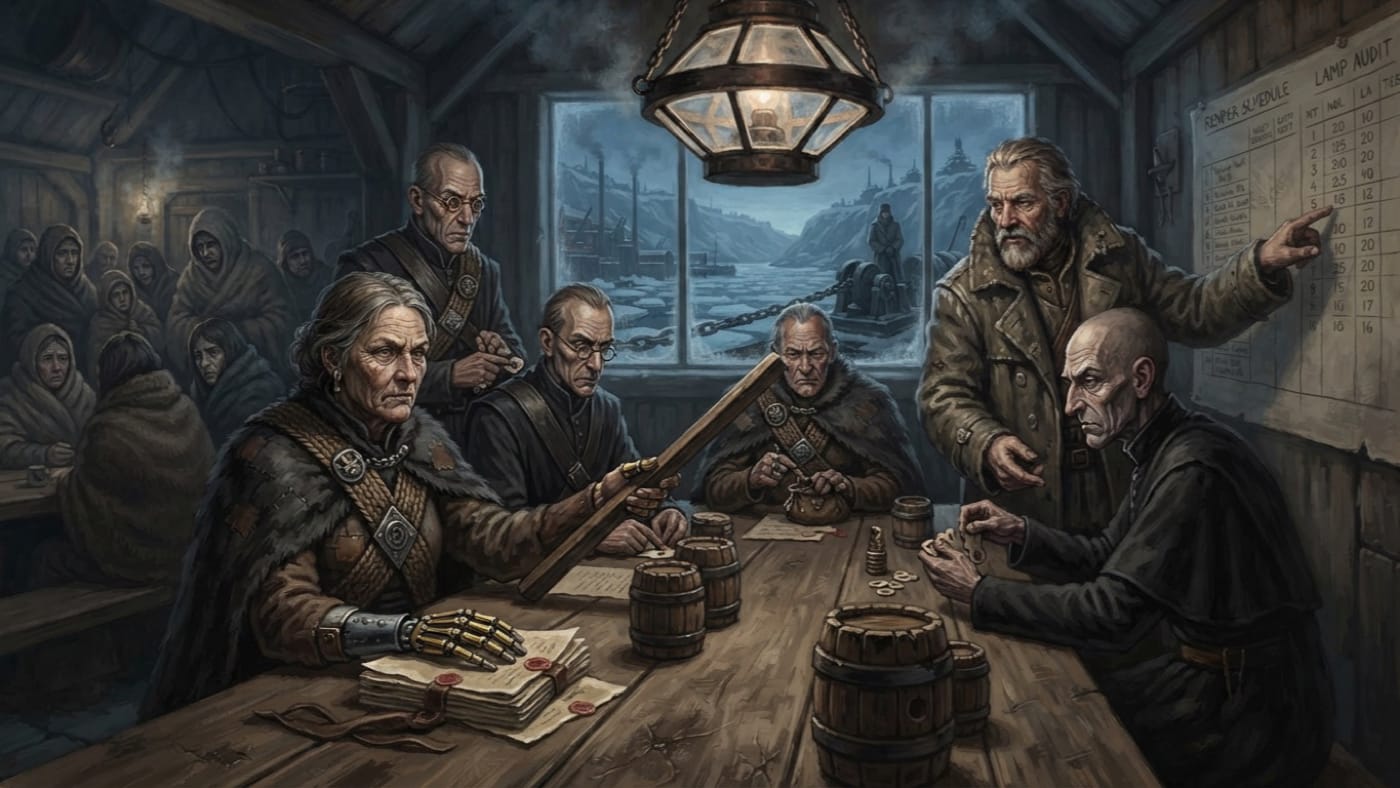
The Clan Moot of Hrafnvik is a compact of elders who speak for the longhouse families of one Norwegian fjord in Zone 8. The wider northern institution, with its many valleys and its midsummer quarrels, has its own entry under Clan Moot. This entry concerns one fjord's worth of old people, the barrels they count, and the households that live or freeze by the count. The compact holds no charter, draws no stipend, and receives no delegate from Bastion-Königsberg that it would trouble to feed twice.
The Moot's public justification is tradition, and its working instrument is warmth. The elders govern by oath, by feud and by control of passage. Their territory runs from the Longhouse Rows up to the Watch Cairns on the ridge, where ancestral claim and signal fire share the same stones.
Elder Sigrun Half-Wick is its senior voice. She is one elder among several, and the others would make that point with some force to any clerk who wrote otherwise. Her standing rests on household survival, reputation and the Moot's assent. The Bureau's forms can accommodate a Grand Inquisitor and a sub-deacon of bell-rope maintenance. They have no box for any of those three qualifications.
I documented the arrangement during my nine-day compliance inspection in A.S. 197. I could not establish the compact's founding, its founders or the number of its members, and I decline to manufacture them for the comfort of the Bureau of Records.
#On the Render Schedule and the Count
The Moot's first instrument is the render schedule. It fixes which households skin, which boil, which tend the vats through the night, which carry oil to the Shrine Rings, which store barrels in the Frost Pits, and which load the shipments bound south. Sigrun sets it at dawn and adjusts it as the catch requires.
Every assignment is wages and sentence together. The household given first rendering gets the earliest heat and the worst scalds. The household given night-cooling has the vats when no one else is watching, so it receives the first accusation when a barrel comes up short. The carriers smell of fat for a week, and everyone suspects the storers. A household left off the schedule entirely is shut out of the economy that pays for light.
The count is kept in wood. Every barrel carries notch-codes cut along the stave, because paper rots in the Hrafnvik damp and ink runs in the first sleet. Oil-chits and bone tokens settle smaller debts between households. Lamp-time, meaning the hours of burning drawn from the communal lamps, can be owed, traded and withdrawn. Three old women sit beside the Render Yard wall and keep a private count under their shawls. I never learned whether the Moot consults them or merely fears them.
Disagreements go to the lamp audit. There the elders check the barrel notches against the wicks burned and the oil remembered. When memory and notch disagree, an oath vote settles it, and sometimes the colour of a flame does. The Shrine Chapter keeps its sanctified ledgers alongside, and the audit does not wait for them.
Sigrun bought her authority over this machinery in the Seal-Death Winter of A.S. 188, when she stretched three weeks of household oil into seven and paid two fingers for it. That winter dates her reputation. It dates nothing else, whatever the Northern Office would prefer.
#On Lamp-Aid and the Dark-Houses
Every household owes the Moot oil-tithes, watch-hours on the cliffs, its fast days and its wick dues. In return it receives communal lamp-aid, the allowance of oil and lamp-time that carries a longhouse through the twenty-hour dark.
The Moot uses that allowance both to provide and to punish. In a bad winter the frost cannot tell the two apart. A household in arrears may see its debt turned into watch duty, paying in nights on the ridge for fat it does not have. A household that fails its quota, breaks a fast without sanction, sells tainted oil or puts out a shrine lamp in spite may lose lamp-aid altogether and become a dark-house. A household that breaks a fast is un-counted, which strikes it from the tally and from passage priority when the ice opens. None of this runs by tariff. The elders weigh the offence, the house, the season, and how much the barrels will bear.
The consequences are physical. A dark-house in January burns whatever it owns that will burn, then its furniture, then nothing. Sigrun has ordered doors left unlit for three nights. She has also sent wicks to dark-houses by routes that no Watch report records. Both entries are true, and neither cancels the other.
The Dark-House Circle works beneath the ledgers. The Moot does not acknowledge it and could not abolish it if it tried. The Circle hides oil in the Frost Pits under false tags, steals wicks from shrine lamps, and keeps unlit paths between the excluded houses and their caches. It has no seat at the audit, yet it shapes every audit. Each elder knows that some part of the shortfall has gone to keep a child breathing two doors away.
#On the Prior, the Watch and the Narrows
Three powers stand on the fjord, and each holds something the other two need. The Moot allocates oil. The Shrine Chapter of the Blessed Wick, under Prior Malthus and his three shrine-clerks, blesses each batch before rendering. It also keeps the confession record, sets the fast calendar, issues exemptions and passage papers, and reports compliance south to the Bureau of Doctrine. The Winter Watch keeps the routes, the escorts, the cliff warnings and the ugly arithmetic of rescue.
Malthus has been posted at Hrafnvik since A.S. 192. He has no seat on the Moot and controls none of its allocations. He can still excuse a darkened house from the fast that darkened it, delay the paper that would carry a son south, or leave a name off a roster in ink nobody checks. What he leaves undone carries nearly the force of what the Moot decides. The elders know it, and so does he.
Watch Captains are elected by clan moots and answer to the elders, and Rauk One-Eye answers to these elders. His thirty-odd watchers come from the same longhouses whose oil the Moot counts. Sigrun knows which households can spare a body for the ridge. Rauk knows which bodies the ridge will give back. Neither of them decides without the other.
The chain across the narrows shows the division plainly. The Moot keeps the chain and oils it twice a year, and Rauk orders it drawn. In living memory it has been drawn four times: twice against southern tax-boats, once against a vessel flying no flag, and once, by Rauk's account, against a tide that came in wrong. I record his account and add nothing to it.
The split-barrel dispute, already in the published accounts, belongs here. Malthus moved to deny fast exemptions to three households after a thin-seal week. Sigrun answered with a barrel tally showing they had met quota by weight, although one barrel had split and been re-bound. The Chapter held the form and the Moot held the count. The fjord needed both.
A Northern Office abstract of A.S. 195 described Hrafnvik's oil allocation as "managed jointly by Shrine Chapter and Clan Moot under Synodal advisory order."
Corrected after the A.S. 197 inspection. The Chapter blesses, documents and exempts. The Moot allocates. The Watch decides who may travel and who will be fetched. The advisory order exists in the abstract's grammar and in no ledger I was shown at Hrafnvik.
#On Passage, Oaths and the Child's Lamp
The Warm Paper Brokers keep a hut at the Slipways. They deal in what the south calls documents and the north calls warm papers: exemptions, passage writs and ration stamps, all paid for in oil. The Moot tolerates them because a stamped writ can carry a son past a bad draft or a mother past an impossible fast. It restrains them because every writ bought with oil is a barrel the Render Yards must replace, and a piece of a household the broker now owns. Paper keeps a family alive through one winter and in debt through the next.
The Moot needs no permission from Strasbourg to discipline a broker. It can refuse him escort, cancel a render share, or close the narrows to his boat. It can also step aside and let the cousins at the Slipways settle the matter with hooks.
One prohibition outranks the trade. No broker may take a child's lamp, or the lamp-pin cut for a child's cloak, as payment. A broker who accepts one has opened a blood feud, and the clans will close it in their own fashion.
Oaths bind the rest. An elder who swears to an allocation swears before every household that will sell him fish for the remainder of his life. Oath-notes sealed in wax circulate alongside the chits, and oath-knots in seal hide keep the record where wax would not survive.
Passage control has one further cause, which I note and leave there. Certain cliff paths are walked in silence. Salt circles are renewed after every tide, and triple-wick lanterns are carried low where the fog is thickest. The Bureau of Rites classifies the fog as responsive. The Moot treats those paths as closed to anyone who cannot keep his mouth shut, and assigns watch-hours accordingly.
#On the Present Bargain
As of A.S. 201, Hrafnvik's conditional compliance stands renewed pending review, and the Moot remains where it was. Seal returns have thinned. The south wants tighter quotas, because Königsberg burns northern oil and the Northern Office measures faith in barrels. The longhouses want fewer fast days, since a lean fast in a lean year empties houses the Render Yards will need when the seals return. Brokers multiply at the Slipways. Sigrun, Malthus and Rauk remain at their posts and at one another's throats, in the courteous northern manner.
No southern office can replace the compact. None of them knows which households can spare a body, which barrel was re-bound, or who is keeping which dark-house alive. The Bureau may disapprove of the Moot, but it goes on burning the Moot's oil.