
#On the Rights to a Wound
The Charter Wars were a commercial quarrel among the licensed houses that held extraction rights to the Synod's wound-sites, and the houses fought it with purses, lanterns and knives. An amendment to the Fuel Monopoly Acts settled them in A.S. 167. That is the whole of the official account. The Bureau of Doctrine has found it sufficient for thirty-four years.
I find it short.
The trade is older than its law. In the decades after the Sundering, men scraped seepage from broken ground and sold it to any furnace that would buy it. Nobody counted how many of them died. In A.S. 112 the Acts placed the work under Synodal license. The Bureau of Tithes sold rights over designated sites and grids. The Bureau of Engines & Furnaces coordinated what came out of them. Charter houses bought the rights and hired the crews, and the crews went into the pits. The owners collected percentages, and the prospectors collected the cough.
The Acts created property in the one place no sane man would care to stand. Once property exists, it attracts the usual sacraments.
#On the Value of the Survey
A charter is a sheet of vellum describing a piece of ground. The ground does not read.
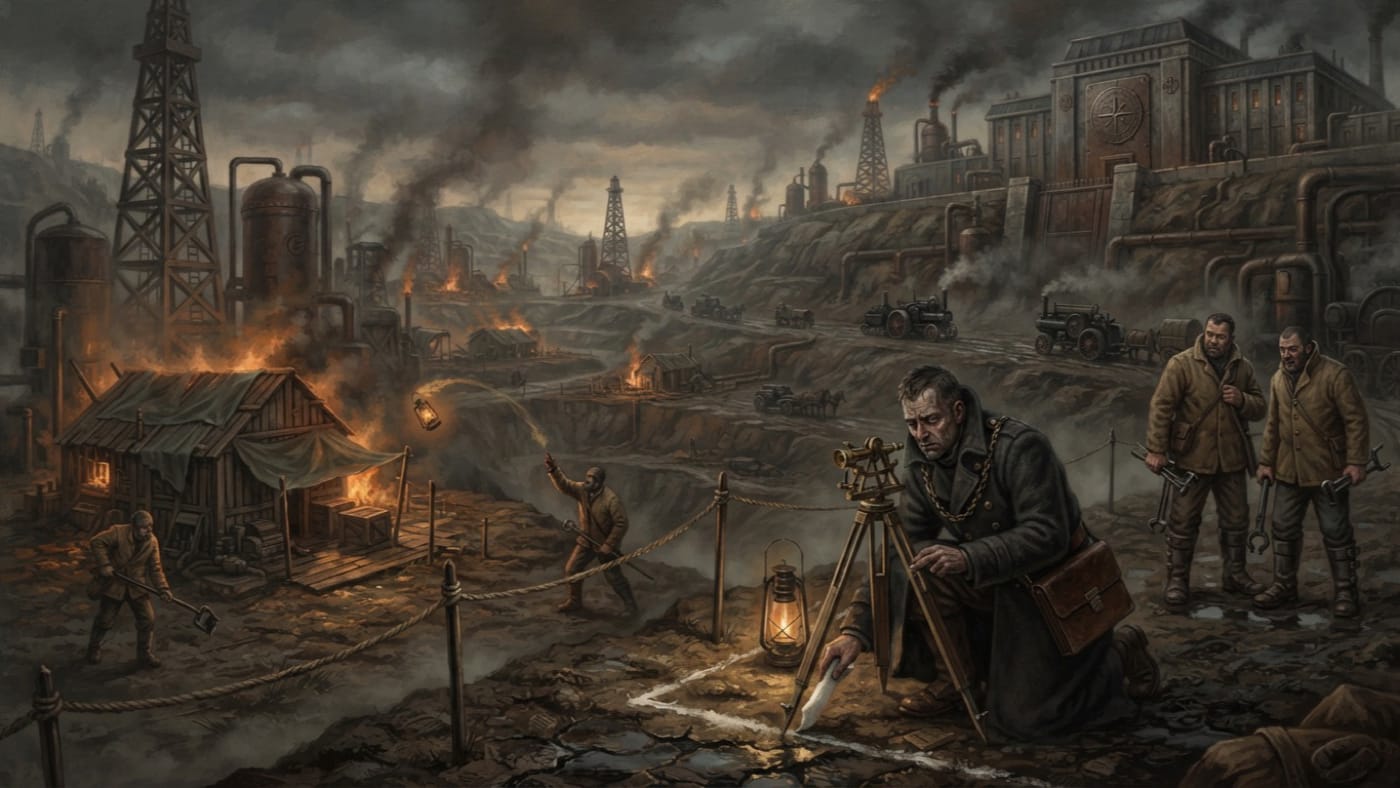
Seams wander. A wound that sweats oily sand at one lip may vent its vapors forty yards east, beneath a neighbour's stakes. The survey was all that stood between a house and the loss of its best tap. A crew walked the chain and noted the blue frost, the dead summer moss and the birds flying in wrong circles. The boundary went down in chalk salt, and a survey scribe copied it into a folio that the Bureau of Records would either honour or refuse. Tithes assessed yield against the seam projection he drew. Houses defended boundaries by citing his chain-lengths. The purity declaration filed before the tap named a site that he had fixed.
The rest of the apparatus could be replaced at a price. Augers can be bought, and ward spikes are forged by the cartload. Gaskets, hymn clamps, wax, and the singers trained under the Gasket Choir all appear in a Tithes schedule with a figure beside them. A scribe who knows where the seam actually runs, and whose folio Records will accept, is rarer stock. Unlike a drum, he can also be stopped with one blow.
#On the Houses at War
The record attests three methods. The houses bribed Judges, burned one another's pits and assassinated survey scribes. It gives no house names, commanders, opening outrage or order of campaign, and I decline to build a chronicle out of three verbs. The verbs suffice.
Bribery stands first in most accounts because it was cheapest. A disputed grid went before a judge, and a judge who had received a purse found the boundary wherever the purse required. The surviving accounts do not say which judges took the money. Doctrine holds the masked Judges of the War Eternal to be beyond purchase, and I have no wish to test Doctrine with my own coin. The sources say "Judges" and stop there, and so do I.
A house burned a pit when it could not afford the judgment. Wound-seepage takes flame with indecent eagerness. An open tap with a rig over it, all timber, tarpaulin and drums waiting for their hymn, can be undone by one lantern thrown out of the dark. The burned house lost its season, its tools and frequently its crew. The fire also took the salt lines and ward spikes with it. The wound was left unsealed until someone in the Synod's employ was sent to close it at public expense, which is the only respect in which the Wars were ever socialised.
Killing scribes was the most rational of the three methods, and so the most disgraceful. With its scribe dead, a house lost its knowledge of the seam, its standing to contest a boundary and its witness at the next hearing. The crew lost the one man who knew where the safe ground ended. The rival needed neither torch nor purse. He waited at the wound-lip, where the chain-walker's work obliged him to stand in the open.
#On Those Who Held the Clamps
The houses made war, and the crews were the ground they fought over.
A prospector in those years already faced the ordinary hazards of his trade. Pressure pitch could climb without warning, a hurried hymn could fail its gasket, and the chemistry in his lungs worked whether anyone fought or not. The Wars added a rival's lantern. He worked under patron debt, so he could not walk away from a house that had made itself a target. Tithes calculated quotas against projected seam capacity, and crew survival had no line in that arithmetic. The Injured Laborers' Provision arrived in A.S. 160 and covered only workers employed directly by a Bureau. Charter crews belonged to private enterprise and stood outside it, holding their clamps.
Butchery was never a precondition of the system's lethality. Charter Baron Gruhl appears here as a specimen of charter arithmetic, and I make no claim that he fought in the Wars. He held seven sites, employed two hundred prospectors and lost forty-one in a single season. Tithes accepted the reports, and Gruhl retired to Strasbourg on a pension. No rival house required a torch to produce those figures.
#On the Amendment of A.S. 167
The settlement came by amendment in A.S. 167, which the old reckoning calls 1877. That year dates the settlement and nothing else. No year survives for the first burned pit. Fifty-five years separate the chartering from the settlement, and those years do not make a fifty-five-year war. Anyone who has told you otherwise was selling a chronicle, probably by subscription.
The public Codex does not hold the amendment's text. Its clauses, signatories, place of negotiation, any scheme of compensation and its means of enforcement all remain wherever Records keeps such things, and Records has not invited me to look. The public register records the result. From A.S. 167 the hostilities were officially closed, and every extraction notice issued afterward cites the Acts "as amended A.S. 167," as though the amendment were a scar the law displays for credit.
Readers should also keep two things apart. The penalties for working outside one's grid (revocation, debt seizure, the trenchline) were written into the Acts at their making. Nobody may honestly credit the amendment with them. It is enough that it ended a war on paper.
#On the Continuing Dispute
The houses settled and went on fighting. Only the medium changed. Lanterns gave way to yield reports, and the scribe was no longer knifed at the lip. He was cross-examined instead.
Three weapons survived the amendment. The first was the contested yield report. A house can accuse its rival of inflating projections to win a grid, or of deflating returns to escape quota, and both accusations are usually true. The second was the disputed seam boundary. A seam that wandered east in A.S. 150 still wanders, and a boundary hearing now takes a season where a lantern took a night. The third, and the most ingenious, was the accusation of gasket fraud. A competitor's seals are reported to the Bureau of Purity as defective, impious or improperly sung, and the report is often signed by a man whose own gaskets are held shut with spit and hope.
The old penalties now serve as artillery. A rival crew found forty yards over the grid line faces revocation, seizure of its debts and reassignment to the trenchline. Nobody needs to burn such a crew out. A properly filed complaint does the work.
Drums still move down the corridor from Budapest toward Bastion-Irongate, and the houses still keep offices in Strasbourg, Munich and Budapest. In those rooms the Charter Wars continue in their peaceful form. The forms are longer, and fewer scribes die.
#On What the Charter Could Not Settle
The amendment of A.S. 167 taught the Acts how to referee houses. Eleven years later the Acts met a site that needed no rival.
At Basin-7, in A.S. 178, seventeen personnel went down into licensed ground. One of them was a survey scribe. None came back. Their drums returned warm and perfectly sealed and held the highest single-site yield on record. No house was accused, nobody burned the pit and nobody bought a judgment. The Bureau of Shadows sealed the file in A.S. 179. In A.S. 189 the Acts acquired their quiet provisions, as no charter dispute had ever required them to.
The houses still fight over the edges of the seams, and the seams continue to pay whoever stands nearest the tap. The scribe still walks the lip first, with his folio wired to his belt. Every party to the Wars now agrees that he should go home alive, if only so that someone can depose him.