
#On the Address and Its Date
The Charter Address of A.S. 82 is the only speech in the Church whose audience grows every year. It is printed in every Redactor's manual. Each novice receives the manual along with a brush, a register and a lecture on drips, and is expected to know the Address before anyone trusts them with a pot. A Redactor who cannot set out its argument is moved to ink inventory, where arguments are measured in gallons.
Its author is Aldara Vess the Elder, founding Censor-Prelate of the Bureau of Silence, who helped constitute that Bureau in A.S. 82. She is the grandmother. Her granddaughter, Aldara Vess the Younger, holds the chair today and is filed separately, under a heavier seal. Clerks confuse the two, and Silence has never discouraged them.
The year needs careful handling. A.S. 82 is 1792 by the old reckoning, and nobody in 1792 called it A.S. 82. The numbering was adopted at the constitutional settlement of A.S. 90, eight years later, and brushed backward across the whole record like varnish. When the Elder spoke, there was no formal Synod to address. There was an emerging Church administration made up of councils, offices and organs, all still arguing over who owned which desk. Records had been remade in A.S. 78. Purity was building its Index around A.S. 80. Silence walked into that crowded room and asked for the shelves.
A draft entry in my own office's files records that the Elder delivered the Charter Address "before the assembled Synod in A.S. 82."
Corrected. No Synod assembled in A.S. 82. The formal Synod dates from the Concordat of Strasbourg in A.S. 90. The day, the month, the room and the listeners of the Address are unrecorded, and this entry will not supply a substitute audience to keep the sentence company.
#On the Failure of Fire
The Address answers a problem the pyre-wardens made for themselves. Burning was the Church's first instrument against Rationalist writing, and it did exactly what fire does. Pages lifted in the updraught and came down over walls. Fragments survived in hearths and gutters. Scraps travelled in trouser linings, in bread crusts, and in the hollow heels of penitents who ought to have bought better boots. A library put to the torch did not end. It was distributed.
Then there was the publicity. A burning is held in a square. A square has a crowd, and at a bonfire the crowd learns three things: that the book existed, that someone feared it, and what it was called. The literate went home with a reading list.
The Elder's thesis, as the manuals carry it and every Redactor rehearses it, is that fire attacks the wrong object. A burned word leaves ash, witnesses and an anniversary. A word made administratively absent leaves an orderly shelf. That is all this Codex can certify about the argument. The text itself belongs to the manual. I leave its exact wording there, where a Redactor can be disciplined for misquoting it.
#On Administrative Absence
Administrative absence is censorship by permission instead of by flame. The Address supplies the principle. The Bureau's practice over the following century supplies the machinery, and the two should be kept apart. What follows is how Silence works now. The Ledger cannot say whether the Elder foresaw every clerk of it.
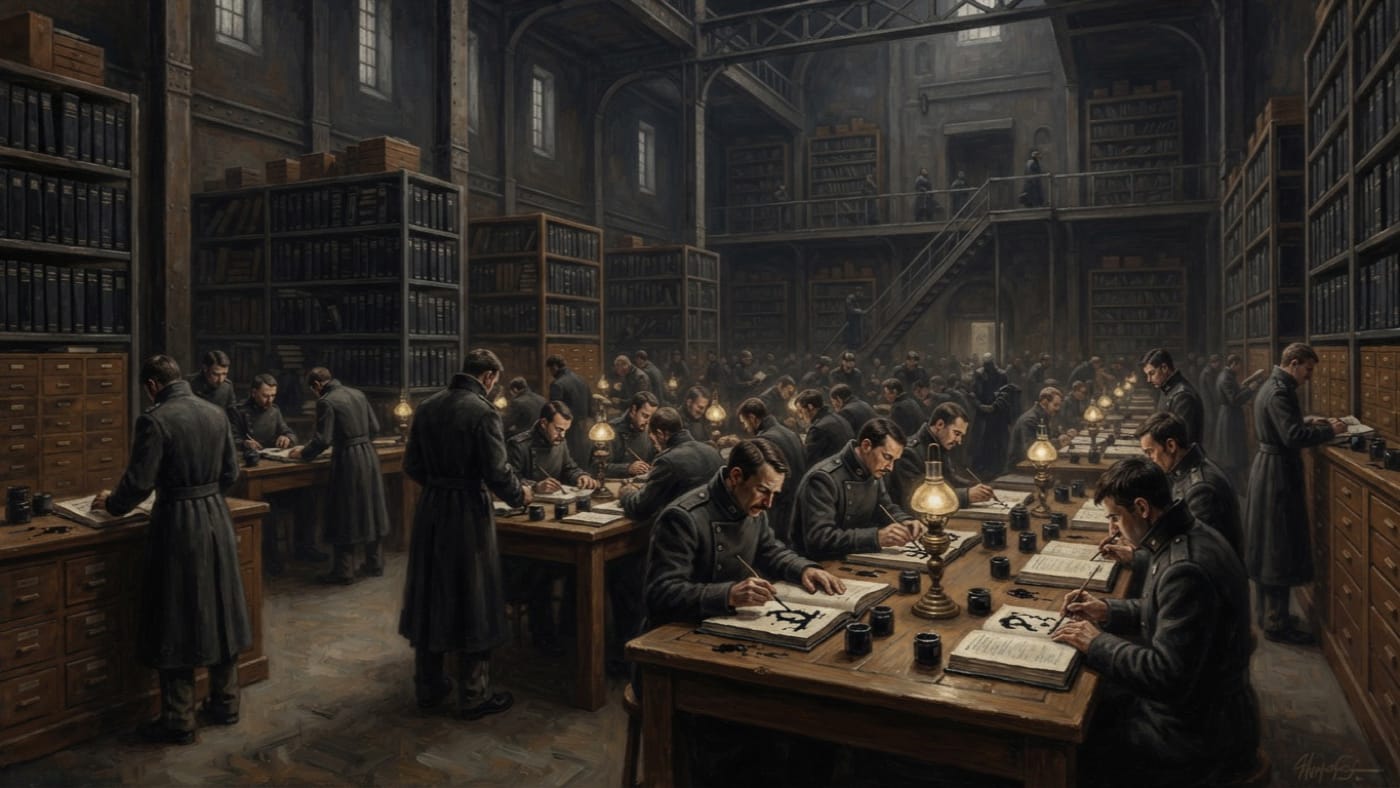
A book need not be destroyed if no one is licensed to read it. Silence licenses libraries and archives. A shelf without a licence is a shelf under audit, and the owner of a shelf under audit develops a sudden interest in gardening. A word need not be burned if it can be covered. Redactors strike dangerous passages with an ink so thick it bleeds through vellum, so the offending line and the back of the leaf go black together, and the reader of the next page inherits a bruise. A title need not be denied if no catalogue will acknowledge it. Consider a withdrawn entry, a citation that leads nowhere, a register that skips a number with perfect composure. Each leaves a gap that nobody is authorised to describe as a gap.
Fire could never manage this refinement. A burned book becomes a martyr. A book that was never catalogued has no feast day.
Absence also gives Silence the most valuable verdict in its vocabulary, which is delay. A text held pending review is neither condemned nor cleared. It sits, and its petitioner ages. The Younger prefers this verdict to all others, and it follows naturally from her grandmother's premise. If a word is dangerous because it is known, then a word that is always about to be ruled on has nowhere to go.
#On the Custody of Words
The Address did its most lasting work among the Bureaus. Doctrine defines what is true. Purity enforces it on the faithful. Records holds the Church's documentary authority, meaning the entry that makes a thing officially so. Silence followed the Elder's thesis to its administrative end and claimed the thing all three must sooner or later handle: the physical word, and the question of who may see it.
The results are kept in the Forbidden Stacks. Silence holds physical custody there, while every other Bureau keeps an interest, a grievance and a standing request. Purity may condemn a book, but Silence decides what stays legible. Records may enter a folio, but Silence decides whether the entry still refers to anything.
The current wording of this arrangement belongs to the Younger. I attribute it to her because she would notice if I did not. Silence, she has told me, has sole authority over the word, and Purity has sole authority over the soul. Where those domains meet, the most productive arrangement is mutual, considered suspicion. That is A.S. 201 speaking. Her private circular of A.S. 200, which calls the word an event and the page its crime scene, is also her own work. Clerks who credit either sentence to the Charter Address are flattering a grandmother with her granddaughter's prose. The Bureau does not correct them, because a confused clerk is an obedient one.
#On Its Continuing Use
The Address is one hundred and nineteen years old and has never been out of print. Redactors are trained on it, examined on it, and reminded of it whenever a supervisor finds a margin too generous. The Younger is the second of her line to hold the supreme office and the fourth to serve in senior Silence command. She inherited the chair and the doctrine together, and she administers the doctrine with less sentiment than most heirs show a family clock.
The doctrine has critics, though few of them hold a licence. The Ashen Circle makes its living in exactly the space the Elder declared closed. Its scholars buy half-burned journals in burn-pit districts and rub the ash until the embossed letters show through. They hide a forbidden text inside a commentary on an approved one and let the Bureau's own permissions carry it past the audit. Fire did not finish the words in the Elder's day, and a century of licensing has not finished them in ours. The Circle reads the gaps in a catalogue the way a poacher reads a fence.
Then there is the ink. Ink Batch 4,891-K, brewed at the Hollow-Script Scriptorium of Nemea, spreads one to three millimetres beyond the approved redaction lines. Production continues under Seal Amber. The Censor-Prelate's position is that the ink behaves as specified and that the specification has grown to include its present behaviour. Three Redactors have filed sealed depositions stating that, in particular candlelight, they can see words inside the black. Silence has classified the matter. I make no finding on the depositions. I note only that the Address promised an absence, and the Bureau's own pot now disputes where that absence ends.
Applications to consult any original should go to the Bureau of Silence. The Bureau will acknowledge receipt of the application and nothing further.