
#On the Scope of This Survey
This is a survey, made in A.S. 201, of the Census of the Living as the archive of the Basilica of the Ledgered Saints currently describes it. It is no history, because the Census has none I am able to print. I have been shown no charter and given no founding date. Nobody in Strasbourg will admit to having turned its first page. It has a location, a claim and a method, and those three I can certify.
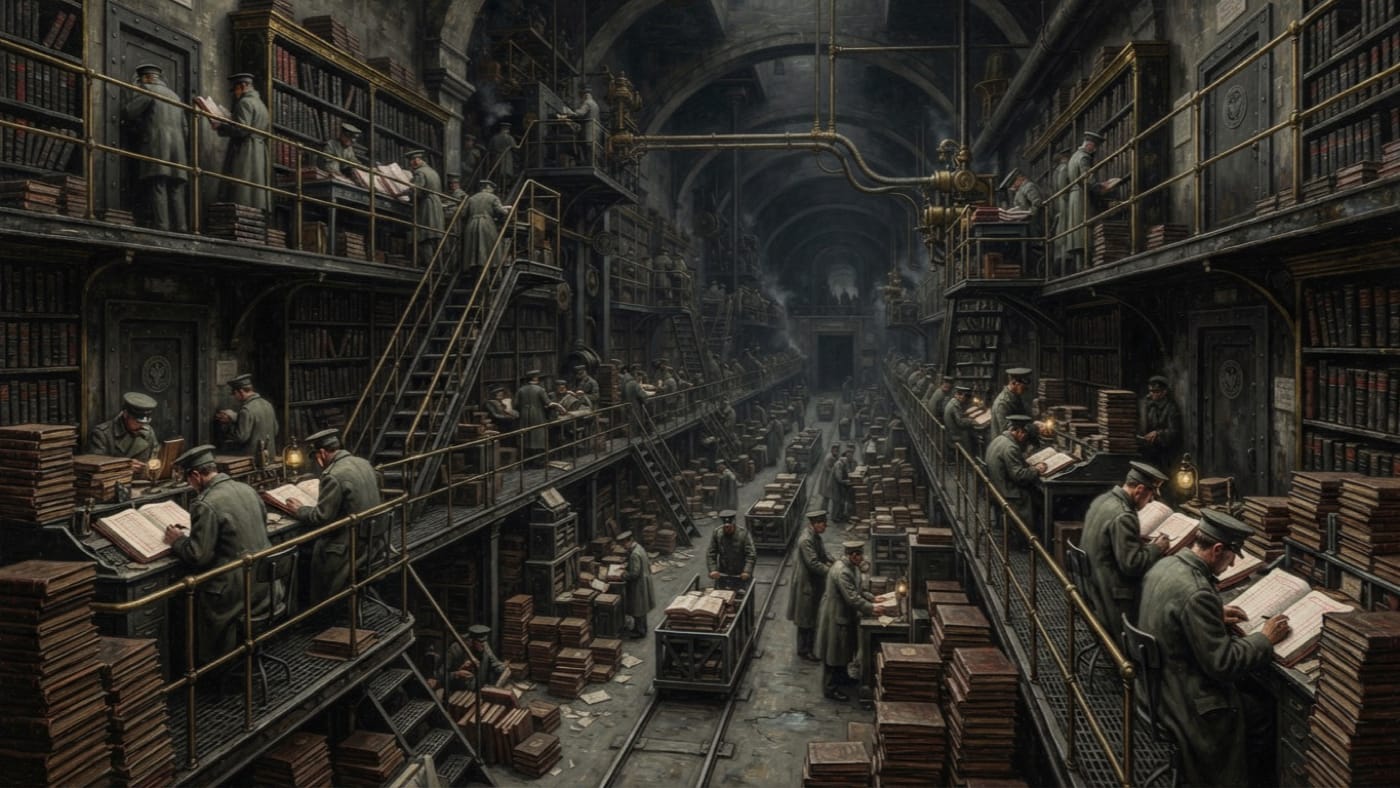
The location is the Basilica's second sub-level. The Recantation Vaults lie above it, the Absolutions of the Dead lie below it, and the Bureau of Records keeps it. The claim is that it records every baptised soul in the Theocracy. The method is an index of three columns. A fourth kind of entry was added later, and that fourth kind is why this survey went to a theologian and not to a bookkeeper.
I am Valerius Drax, Hieromnemon and Warden of the Sacred Ledger. I have defended worse documents than this one. I have seldom defended a more candid one. The Census has never once pretended to love anybody.
#On the Three Columns
A soul enters the Census through water and leaves the font as a line of crimson. The Basilica's account says that line is indexed by diocese, by parish and by tithe-class. The account gives it no other columns, and I will not invent more to satisfy a reader's appetite for detail.
The diocese comes first because the diocese is the Church's map. In the Theocracy a diocese is a province of grace, and it is also a supply grid. Its borders follow the carrying distance of a cathedral bell and the density of ink in the registers, and rivers and mountains have little to do with it. To be entered under a diocese is to be placed on that grid, within reach of its bells and its collectors.
The parish comes next. The parish is the font itself: the nearest altar, and the priest who poured the water and who may one day be asked to account for whatever it failed to wash away. A parish column sounds harmless. It is also the column that tells the Church which door to knock on.
The third column is tithe-class, and it shows where the Census comes from. A register that sorts souls by what they owe was opened by people who knew exactly why they were opening it. The account does not set out the classes, their bands or their rates, and I will not supply them. The column's existence is enough for this survey.
The pious will object that salvation is not a fiscal matter. It never has been. Administering the saved has always been one. Every bureau in Strasbourg is in some way a tenant of Records, and the levies of the Bureau of Tithes rest on Records' census work. A register sorted by tithe-class sits very comfortably in that house.
The faithful seldom know which tithe-class they belong to. They know only that someone in Strasbourg does, and that the someone is never wrong about the sum.
#On Sins Confessed and Sins Suspected
Under the reforms attributed to Procurator della Torre, the Census acquired known sins, the Basilica's account says, "confessed and suspected alike."
The account gives no year for this reform, and I will not make one up. Della Torre's wider work on Purity and the Index belongs to A.S. 80. That work is dated and this reform is not. The Bureau would thank me not to staple the one to the other, and for once the Bureau and I agree.
A confessed sin arrives with credentials. The sinner spoke it, a priest heard it, and the matter passed through the confessional screen in the sinner's own words. Whatever one thinks of the system that carries such words to Records, the entry has an author, and the author is its subject.
A suspected sin has no such pedigree. The account does not say who does the suspecting, on what testimony, or before what tribunal a suspicion might be weighed and struck out. It describes no appeal and no adjudication. It says only that suspicion is entered, and I must report the Census as I find it.
Let me now defend the column, since that is my office. An entry of suspicion is a true entry. Someone did suspect. The clerk who writes it down asserts nothing about the sin. He records only the fact of the suspicion, and the fact is beyond dispute. Records is in the business of facts, and a suspicion entered in proper form is as much a fact as a baptism.
Here the defence finishes and the ink carries on without it. Under della Torre's reforms both categories go into one register, written in one crimson, on the same level, under the name of one baptised soul. The ink makes no distinction between a sin a man owned with his own mouth and a sin his neighbour thought he looked capable of. Whether a careful reader can tell the two apart depends on the hand that wrote the entry, and the account says nothing about that.
Readers who know the rumours of the Codices Obscurae will want to link those whispered volumes to this column. I forbid it. The Census does not prove that those volumes exist, and nothing in its account claims it can read a thought that was never spoken. It records suspicions. A suspicion does not need the sinner's interior. It needs one other person, and the Theocracy has never been short of other persons.
#On the Clerks of the Second Level
The Basilica's account says the clerks who work this level are rotated every six months, and that the rotation exists for the Bureau's comfort, not theirs. A clerk who stays too long among the Census starts to correct entries on his own initiative, and in the Bureau of Records initiative is a disciplinary matter.
To be precise, six months measures the clerks. It does not measure the Census. The account gives no schedule for revising the register itself, and I give none.
The account also does not say what those clerks corrected, and I am glad of it, because every guess is worse than the one before. It might be a misspelt parish, or a soul filed under the wrong tithe-class. It might be a suspicion that a clerk, after months of reading it every morning, had come to think unjust. That would be the gravest case. A clerk who decides on his own authority that a suspicion is false has appointed himself a tribunal the account never mentions. He has done it with a quill, which is the one instrument in the building that cannot be cross-examined.
Archon Veyrault left Records a maxim, cut into the lintels of its offices: To misremember is to betray salvation. The Bureau's position is that ink may be altered only by ink properly authorised, and only a seal may undo what a seal has bound. A correction made out of conscience is still an unauthorised alteration, however kindly meant, and kindness is not a recognised grade of authority.
So the clerks rotate. They stay long enough to learn the hands of their predecessors and leave before they can grow sentimental about the names.
#On What the Census Is Not
Four neighbours crowd this register, and the careless confuse them.
The first sub-level holds recantations. Those volumes record what a soul renounced, line after line of I recant, each tremor of the hand fixed in wax. The Census records what a soul is, and since della Torre what it is accused of. The account describes no stair by which an entry climbs from one floor to the other, and I will not draw one.
The third sub-level holds the Absolutions of the Dead. The living lie one floor above the absolved. The account does not say whether a name moves downward when its bearer dies, and this survey does not move it.
The Pneumatic Census happens in the catacombs. On feast days selected congregants breathe into reliquary jars, which are sealed with the Triune Knot and labelled with a name and a date. It shares a word with the Census of the Living and, as far as I can document, nothing else. One counts names by diocese, parish and tithe-class. The other keeps breaths in glass. Anyone who mixes them up deserves to have his own exhalation filed under the wrong parish.
The Great Ledger of Souls is the Bureau of Records' wider archive of living adherents. It lists them by name, birthplace, baptismal date and last recorded confession, and its census-scribes update it daily. The sources do not say whether the Census of the Living is the Great Ledger, a copy of it, an annex to it, or a separate instrument that happens to cover the same ground. I decline to settle the question by eloquence. The Great Ledger's fields, its daily routes and its dated beginning stay with the Great Ledger.
An internal Records annal gave the Great Ledger of Souls' unbroken run as beginning in Year 180.
The Codex has published Year 80, and Year 80 stands. This correction concerns the Great Ledger alone. It gives the Census of the Living no date of its own, and anyone who borrows the figure for that purpose will be corrected in turn.
#Disposition
This survey covers the Census as the Basilica's archive describes it in A.S. 201. It sits on the second sub-level, in the custody of the Bureau of Records, and claims every baptised soul. It indexes them by diocese, parish and tithe-class, and under reforms attributed to Procurator della Torre it carries their sins, confessed and suspected, in a single crimson. What the account does not give, this survey does not give either: no founding, no headcount, no year for the reform, no appeal.
Those absences are not defects in the survey. The Census was built to hold names, debts and accusations, and it was never asked to explain itself. It does what it was built to do.