
#On the Cathedral's Station
"Assemble by parish. Begin at the cathedral. Do not stop." — Bureau of Festivals, Lyon variant schedule, as abridged by every parish clerk who has ever had to read it aloud
The Cathedral of Saint-Jean sits in the Ledger of Lyon under two headings. The first is the ordinary one: a cathedral of the Church in a major city of the western heartlands, Zone 1, where the Creator is worshipped on the usual days, at the usual hours, under the usual supervision. Under that heading it would hardly merit a Codex entry. Every city of consequence has a cathedral, and most of them have a great deal more to say for themselves about bones and benefactors than Saint-Jean has said to me.
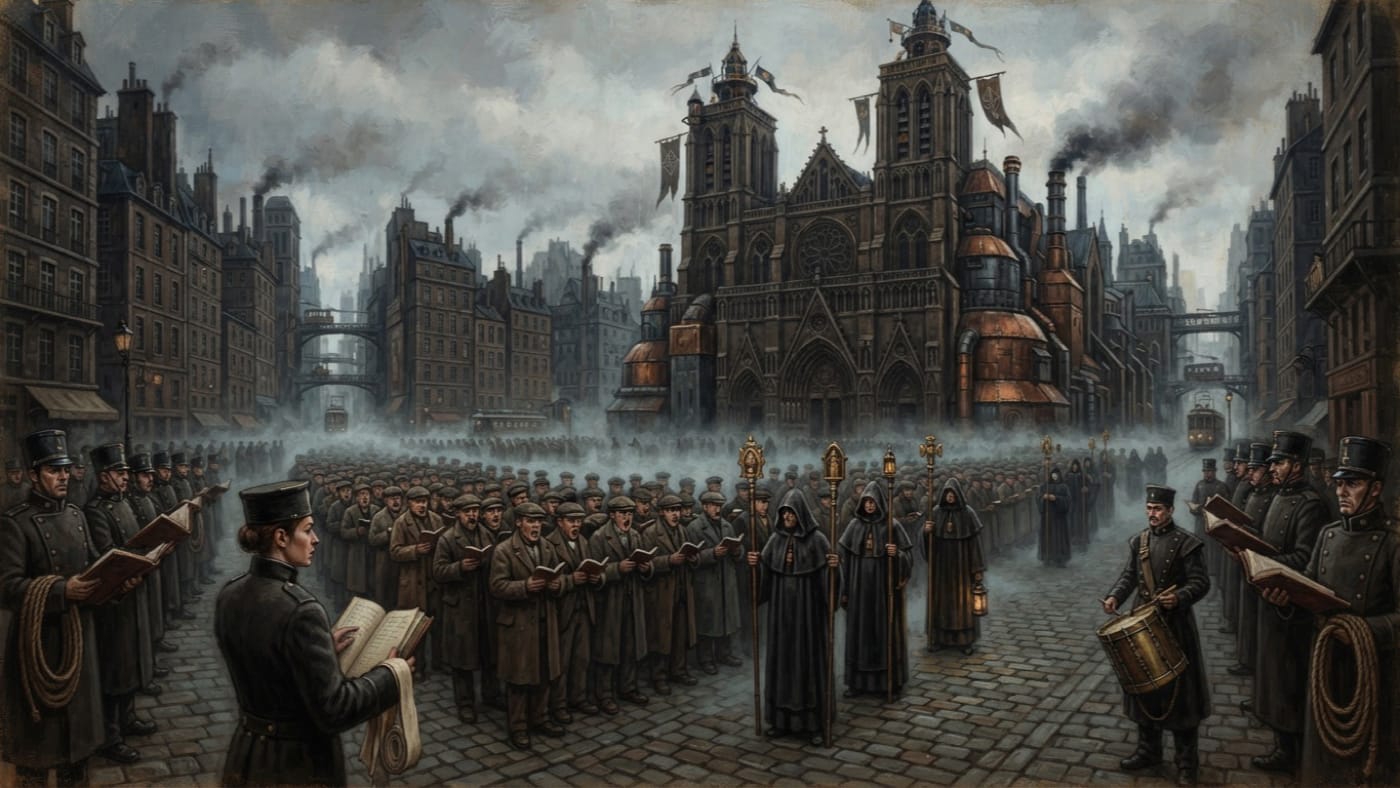
The second heading earns the entry. Saint-Jean is the departure station of the Lyon variant of the Procession of Tongues. Once a year its threshold stops being a door to worship and becomes the first mark on a route, the opening line of a ledger, and the place where a parish discovers how long its voice will last.
Lyon is a closely supervised city. Every Lyonnais knows the phrase. The Bureau of Festivals has chosen to administer some part of that supervision through song, and the song begins here.
#On the Departure and the Route
The schedule is brief, and it is complete. The route runs from the Cathedral of Saint-Jean to the Place des Terreaux by way of the Presqu'île (Unregistered), through the river wards of the city. Participation falls on the Third, Fourth, and Fifth Wards. Citizens are assembled by parish.
The schedule gives no streets, no doorway, and no measured length, and neither do I. Where the column turns and where it narrows is the business of whoever holds the rope on the day. The Codex is not that person. The three named anchors are fixed, and between them the Lyonnais have the remaining four hours to learn the rest with their feet.
Assembly by parish is the clever part. A city-wide crowd is a mob with hymnals. A crowd sorted by parish is a register. Each parish arrives as a known quantity, under its own clergy and its own clerks, beside the neighbours who will see whether it falters. At Saint-Jean these parishes are drawn up into order, the Creed is opened in unison, and the Third, Fourth, and Fifth Wards begin to walk.
The ordinary trade of moving a devout crowd belongs to the procession marshal, whose manuals list cathedral approaches among the profession's usual stations and whose tools are rope, chalk for step-marks, a drum or clapper, and a citation pad. The Lyon schedule names no marshal and assigns none to Saint-Jean. I record the general practice because a column of several wards does not keep its order by prayer alone.
#On the Feast of Saint Sabina
The Procession leaves Saint-Jean once a year, on the Feast of Saint Sabina, the third Sunday of Septimus. Every citizen of the three wards between the ages of fourteen and sixty is bound to attend. A boy of thirteen may watch from a window. On his fourteenth birthday he is issued the Creed, the route, and the obligation to say one all along the other.
The rite has one instrument, and every participant carries it. The Creed is recited aloud, in unison, for a minimum of four hours. I recommend that any reader who doubts the difficulty try it for one, alone, in a closed room, with no clerk present. The voice is a modest organ. It was made for speech, for prayer, for the occasional hymn, and it is unprepared for an afternoon of Articles shouted in step. By the middle of the route the unison has gone ragged and the vowels have gone flat. Voices crack. Throats bleed from repetition. A ward that left the cathedral sounding like a choir arrives in the Presqu'île sounding like a quarry.
When a participant falters, a Festivals clerk ties a linen strip, soaked in blessed oil, across the mouth. The clerk then enters two words in the ledger: vox defecit, "the voice failed." The gagged participant does not leave the column. The schedule requires the remainder of the route, and the remainder is walked in silence, oiled linen on the lips, among neighbours who are still chanting and who can see exactly what failure looks like.
The linen is the detail I admire most. The feast belongs to Sabina of Ghent, who tended the wounded at the Massacre of Saint-Malo, and whose memory the Bureau of Mercy claims for its own foundation. She is the saint of the bandage. On her day, in Lyon, a strip of cloth is tied over a bleeding mouth and the bleeding is entered as a deficiency. The schedule does not explain why Festivals chose her feast, and I will not invent a reason for it. The Bureau has never needed one. Linen is linen, and it may be put to more than one devotional use.
None of this happens at Saint-Jean itself, strictly. At the cathedral every mouth is open and every voice is whole. The clerks stand ready, their ledgers unmarked. The cathedral sees each parish only at its best, which makes it the most flattering post on the route.
#On Exemption and Authority
The Codex entry on the Procession of Tongues states that the Holy Bureaus were constituted two years before the Bureau of Purity's adoption of the Prague rite in A.S. 94. The Bureau of Doctrine corrects this as a compression. Earlier offices served before the formal Synod's constitutional settlement of A.S. 90, and they were reformed in stages afterward. No date in that entry fixes when Lyon received its licence or when Saint-Jean first saw the Procession depart.
The Lyon variant belongs to the Bureau of Festivals, whose remit covers which days may be celebrated, which costumes worn, which plays performed, and how public enthusiasm is managed. Festivals holds the ceremony. That gives it the morning at Saint-Jean. It does not give it the cathedral. The ordinary worship of the place on the other three hundred and sixty-four days lies outside this schedule, and I know better than to assign it to any Bureau by inference. Bureaus have gone to tribunal over less.
Exemption runs through the Bureau of Mercy. A citizen within the age and the wards who wishes to stay home must obtain Mercy's counter-seal before the feast. The schedule then adds its most quoted clause. Medical exemptions filed after the Procession are classified as retroactive cowardice and processed accordingly. That is the schedule's classification, and I preserve its wording. Mercy is not asked whether a throat that bled on the route was a sick throat. The order of the paperwork settles the question. A seal before the walk is care. A petition after the walk is cowardice. The body has the same injury either way, and the only thing that changes is the ledger column it goes into.
The comparison with Prague will be made by every reader, so it should be made correctly. The full rite in Prague belongs to the Order of Saint Ephrath and the Bureau of Purity. Its marchers are condemned heretics carrying doctrine tablets to which their tongues have been nailed. Lyon's marchers are citizens in good standing. Their instruments are recitation and the gag, and their route begins at a cathedral rather than a chapterhouse. The Codex entry on the Procession puts it in a sentence I can't improve on: Prague punishes the heretical tongue, and Lyon disciplines the faithful one. Purity regards Lyon as a dilution. Festivals regards Prague as a specialist. They agree that both routes end in silence, and they never argue about that.
#On the Present Condition
This survey is framed in A.S. 201, and it concerns Saint-Jean's standing duty, not its masonry. The Lyon variant is held annually. The cathedral remains its departure station. The Third, Fourth, and Fifth Wards are still assembled there by parish on the third Sunday of Septimus. The Festivals clerks still carry oiled linen and open ledgers. Mercy's counter-seal must still be obtained beforehand. I have no restoration to report and no crisis to announce. I have not stood on the threshold for this entry, and I will not pretend to describe a doorway I have not measured.
On any other morning Saint-Jean is a cathedral. On the Feast of Saint Sabina it becomes the only point on the route where the whole of three wards can still be heard, and at Saint-Jean that full chorus is recorded once a year. At the Place des Terreaux the Bureau counts the voices that failed, and vox defecit is the entry beside every name that arrived in silence.