
#On the Spiritual Commodity
Article 4 of the Catechism of Obedience governs the goods of the soul that a careless people once believed grew wild: hope, consolation, prophetic utterance, and prayer beyond prescribed liturgical forms. There are four items. The Synod lists them the way a quartermaster lists powder, salt, lamp oil and boots, and with the same tenderness.
The Catechism was drafted and ratified in A.S. 92, two years after the Concordat of Strasbourg, when the formal Synod was still new enough to smell of wet wax. Article 4 sits among its provisions. No separate ceremony attended it. No bell rang in its particular honour, and no drafter has come forward to claim it. In a clause I find that modesty admirable. In a man I would find it suspicious.
Its principle fits on a Catechism School slate. Hope is a spiritual commodity, and a commodity may be licensed, defined, taxed and audited. Whatever may be licensed may also be refused. Refusal is how a state teaches a people what the withheld thing is worth.
#On Definition and Assessment
Three Bureaus share the bowl. The Bureau of Doctrine, my own house, defines what hope may lawfully be: its approved objects, its permitted tenses, and how far it may stray from the liturgy before it becomes something else and must be named again. The Bureau of Tithes taxes it. The Bureau of Festivals presents it, with feast-day candles, licensed processions and sanctioned rejoicing at sanctioned hours, so that rationed consolation can pass for abundance one evening a season.
Doctrine interprets. Purity investigates deviation from the interpretation and enforces it on the deviant. This division of labour is the oldest courtesy in Strasbourg. My clerks never have to touch a suspect, and Purity's never have to read.
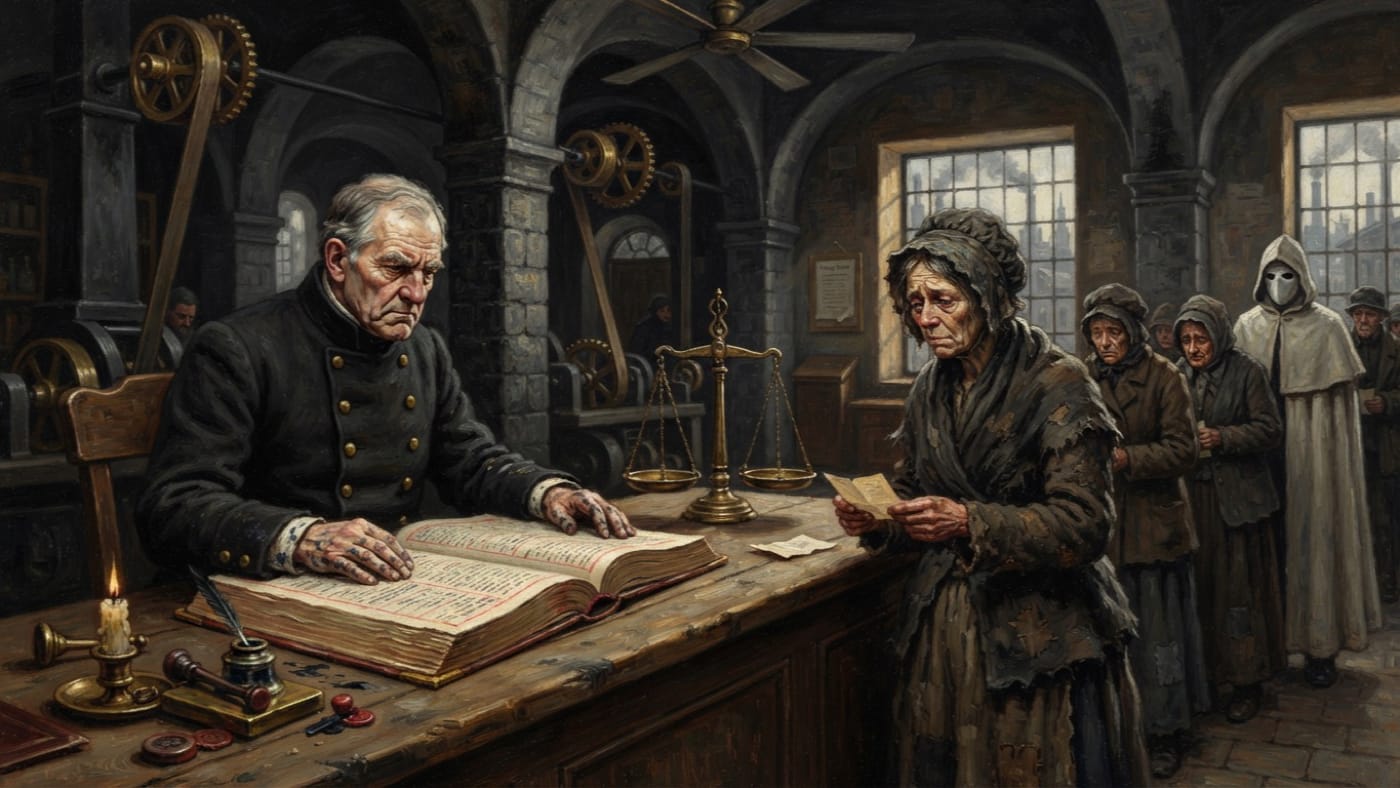
The administration is ordinary to look at, which is its genius. A parish counter holds a ledger with gilded corners, an ink-stained hand and a seal warmed over a candle stub. An Assessor's scales sit at one end of the counter. Nobody has ever placed hope in the pans, and nobody expects to. The scales attend as the mace attends a magistrate. Ceremony is the part of taxation the poor can see.
Consider a woman whose son serves on the Sagittal Line. She wants to hope he will come home. That hope has an object, a future tense and a private audience in her kitchen, and Article 4 has an opinion about all three. So she goes to the parish, where hope is offered in approved form. She pays her dues, lights the candle the Festivals calendar permits, speaks the prescribed words and takes her receipt. Then she walks home and hopes harder in the narrow space between the words, where no ledger has yet been ruled.
#On the Obsolete Gloss
Before A.S. 196, a gloss on Article 4, §7, held that private hope could go unexamined if it produced no speech, no writing, no gesture and no facial expression. The gloss's author is unrecorded, which is the first sensible thing he ever did. The full wording of §7 is not reproduced here and will not be reconstructed from rumour, because Doctrine does not quote what it has not sealed.
Understand what the gloss touched. It never exempted hope from licensing. Hope stayed a commodity, and the citizen still needed permission for its approved forms. The dispute concerned only the examiner's reach: whether an office could question a sentiment that left no trace on the tongue, the page, the hand or the face. Clerics argued about this for over a century, in the way clerics argue about fasting in leap years, with conviction and footnotes.
The gloss also bought nothing against Article 9, which had always held thought itself accountable from the moment it formed. Silence under §7 meant only that no one would come and ask. Whether there was something to answer for was a separate question, and the gloss never settled it.
Under Article 4, §7, silent private hope that is unexpressed in speech, writing, gesture or face lies beyond examination.
Struck. The gloss on §7 is obsolete, superseded by the Twelfth Amendment of A.S. 196. It always concerned the reach of examiners and never the licensing of hope. The examiners have since extended their reach. The heart may remain silent. It is simply no longer private.
#On the Twelfth Amendment
The Twelfth Amendment, ratified in A.S. 196, extended Article 4 to private devotional sentiment and closed what Purity calls the internal loophole. Its described scope covers unlicensed meditation, unsanctioned grief and unauthorised hope. Purity's phrase is ugly, and it is accurate.
The official line holds that the Amendment created no new guilt and merely recognised guilt that had always been there. I repeat that line with pleasure and sign it with my full title. As Archivist I also record what changed. Before A.S. 196, Article 4 reached what the citizen expressed. Afterwards it expressly reached what the citizen felt. The ledger acquired a new column, and the old entries were found to have been incomplete.
Approved private prayer survives. A citizen may still pray alone, in approved words, to approved purpose and in an approved frame of devotion. The approval is what makes it lawful. The solitude is a tolerated circumstance.
Appendix C, "Facial Indicators of Unsanctioned Contemplation," remains restricted. Its public abstract lists prolonged stillness, unfocused gaze, and an expression suggesting that the subject is contemplating an object the Bureau has not approved. That is all the public may read, and all I will repeat. The schedule is withheld so that no one can rehearse against it. I record my own exclusion from its full text without comment, and the reader may measure the restriction by my irritation.
The White-Mantled Inquisitor received referral authority under the Amendment. Keep the stages separate, as the law does. The Inquisitor observes. If a face shows the indicators, the Inquisitor refers. Examination follows the referral and may end in release, correction or further routing. Conviction, where it comes, rests on authority beyond the mantle's own. The Inquisitor cannot read the skull, though his glass chain and his sealing kit would like you to forget that. He reads the face, and the face has always informed on the skull.
#On Declaration and Denunciation
Article 4 supplies the subject matter, and its neighbours supply the blades.
Article 9, the clause associated with Exegete Hallam, reserves the definition of heresy to Doctrine and makes each declaration retroactive to the first formation of the accused thought. Set it beside Article 4 and the arrangement becomes clear. Unauthorised hope is a trespass against the commodity laws. If Doctrine later declares the object of that hope heretical, Article 9 reaches back to the evening it was first entertained, and the trespasser becomes a heretic of long standing who never noticed the change in his own biography.
The penalties that follow belong to Article 9: supervised recantation, public penance and immurement, in that order, with no fourth offence. Article 4 carries no penalty schedule that I can attest, and I have looked for one with the diligence my office deserves. Article 4 defines the goods and leaves the punishments to the articles beside it.
Article 19 belongs to a different hand and a different year. Severian added it at the Eighth Doctrinal Congress of A.S. 134. It requires any suspicion of heresy to be reported within twenty-four hours and treats failure to report as participation. After A.S. 196 the neighbour at the funeral has a reason to study your stillness and a deadline for describing it.
So there are three instruments, three dates and three hands. Hallam and Severian are not recorded as touching the text of Article 4. They did not have to. Its goods passed through their machinery anyway.
#On the Present Application
As of A.S. 201, Article 4 operates in its extended form wherever the Synod keeps a schoolroom, a parish or a workbench. Catechism instructors teach approved hope beside the morning recitation, so a child learns the permitted future tense before the multiplication table. Parish examiners note who stays too still at a graveside and who stays still in an approved manner. Factory chapels post the prescribed forms of prayer at the end of the shift, at a height chosen so that a tired man must lift his face to read them, and lifting the face is useful.
Licensed hope remains available. Consolation is dispensed at the appointed rites. Approved private prayer continues for those whose privacy has been approved. The Synod has never withdrawn the commodity. It has only fixed the terms of supply and the quantity anyone may hold before the holding needs explaining.
The citizens go on hoping. Every audit confirms it. They hope in the queue and at the counter, behind their receipts and in the space between the prescribed words, and the ledgers keep growing to record it. Purity calls this evidence. Doctrine calls it a market. I call it job security for the Sacred Ledger.