
#On the Preserved Citation
"Audible mirth from subject direction, duration three breaths, tonal quality: genuine." — entry of the Mirth inspector assigned to the Scale Gate, Case 112-MO-44
Case 112-MO-44 is the first preserved citation the Chaff-Winds of Wexel can claim. The word that matters is preserved. A surviving entry proves that one clerk's paper outlasted whatever might have contradicted it. It tells us nothing about the first gust that ever laughed across the basin, and nothing about when anyone first thought to call the thing Category One. Later offices asked those questions, and they had better stationery.
The citation was filed in A.S. 112, six weeks after the Dust Fire. The Grain-Gray Ration Parliament of Wexel was then fourteen years old, a consolidation town on the flat grain of the Heartlands. Its wooden silos had just killed three hundred and forty people in one eruption of flame and dust. From that ash the town took its Ration Prefecture and its joy discipline, on the principle that a careless mouth is cousin to a careless lamp. Six weeks is long enough to bury the dead and print a new code of conduct. It is nowhere near long enough to finish a ring of steel.
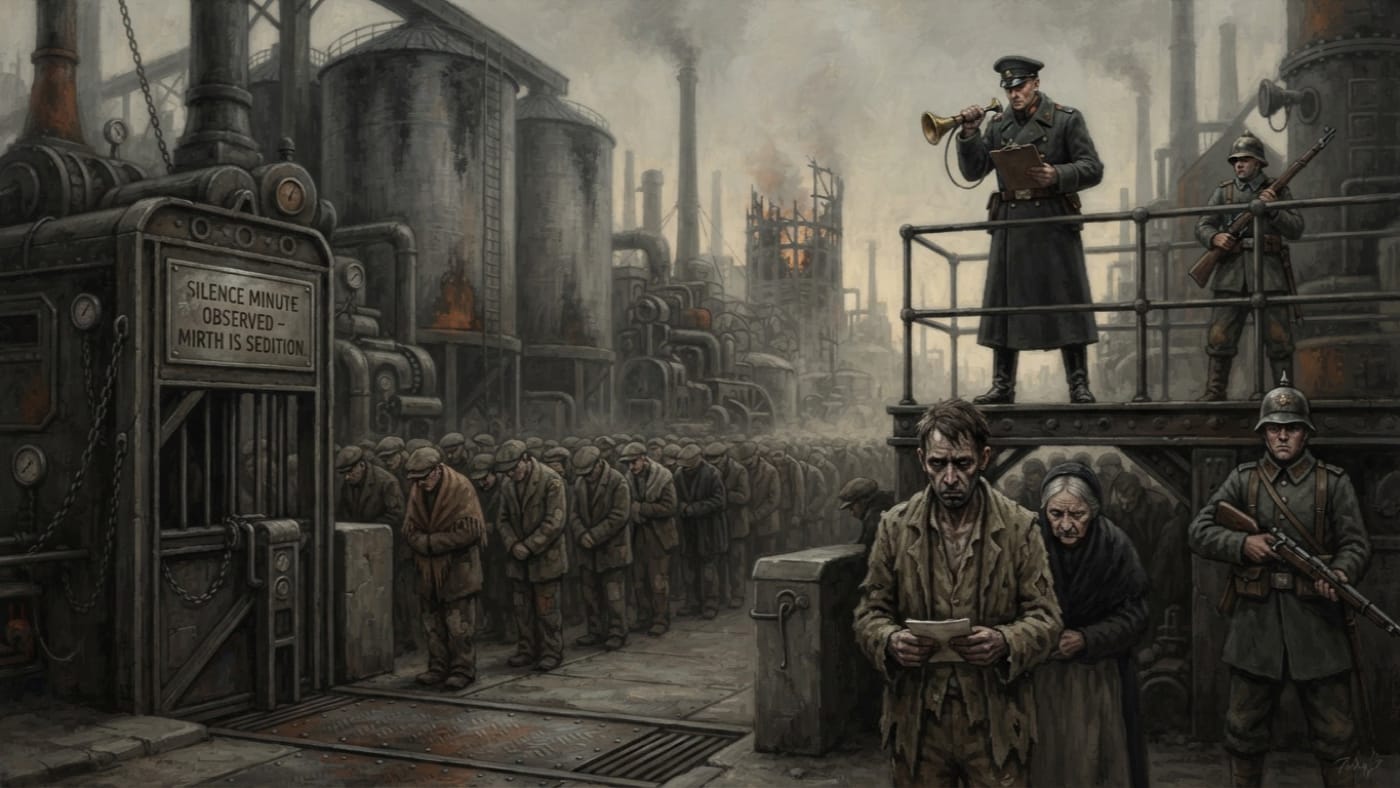
The charge arose at the Scale Gate, during the Silence Minute before the noon ration. In that minute a ration line stands with its chits presented in both hands and its eyes lowered toward the iron while the Mirth Office listens for unlawful amusement. A mill hand named Orven Tesch was within the inspector's hearing. He was fined for laughing.
#On the Evidence
The file holds one assertion and thirteen denials.
The assertion is the inspector's. It is quoted above and has been quoted everywhere since, because it is the only sentence in the case that sounds like a measurement. Read it slowly, the way a Records scribe is trained to read anything that will later be cited against a household. "From subject direction" fixes a sound to a bearing. At the Scale Gate a bearing runs through the accused, through whoever stood behind him, through the gate chains and the weighline sacks, and out across a basin where nobody has ever persuaded the wind to keep the Silence Minute. "Duration three breaths" is a count, taken by an official who was, we must assume, also breathing. "Tonal quality: genuine" is the inspector's verdict on the inner life of a noise, entered in the column where a number ought to stand.
The denials belong to Tesch, who said he did not laugh, and to twelve witnesses, who said they did not hear him laugh. Their statements are narrower than they look. The twelve vouched for their own ears. None of them could vouch for the whole noon.
Beside the citation, in the same ledger, the ink has dried into a loop curved like a mouth. The clerk who drew it insisted it was an accidental flourish, the product of poor nib control. The next seventeen entries in that ledger also bear smiling loops.
Lesser chroniclers have been careless here, so the matter needs stating exactly. The seventeen are further entries in sequence. Who stood in them, and for what, belongs to other files, and I decline to borrow their misfortunes to furnish this one. What the sequence does establish is a pattern in the ink: eighteen mouths in a row, beginning at a disputed laugh. It does not establish whose hand, whose humour or whose weather drew them. The loops sit beside the text and leave the figures alone. That is the cleanest line between this residue and Hungry Ink, which rewrites. The two must never share a drawer.
The file cannot say where the laugh came from, or whether a laugh came at all. The inspector's ear names a direction. Tesch names nobody. The twelve name only their own hearing. The wind crosses the weighline every noon of the year and has never been deposed.
#On the Household Account
Tesch paid in labour-hours. The surviving account does not give the number, and I will not invent one for the pleasure of making it cruel. Labour-hours are lawful tender in Wexel alongside chits and stamped paper. A mill hand who owes them owes the town his body's time instead of coin. The hours were rendered and the fine was closed.
Payment confesses nothing. A man in Wexel settles a citation for the same reason he presents his chit with both hands: the alternative gets examined at length by people with ash on their boots. The ledger records that an amount was rendered against a charge. It has no column for contrition.
The second penalty fell on the household. For two weeks its allotment was reduced. In Wexel a household allotment is a single figure in a single book, sealed in tallow-wax at the Chit Anointing, and that figure does not know which mouth in the house was accused. The reduction fell on every mouth the household ledger counted. The record does not say how many there were. It does say fourteen noons, which means fourteen Silence Minutes before a smaller ration. The porridge was thinner and the bell was the same.
#On the Authorization
Within the year the Mirth Office had begun recording "airborne mirth," and the charges multiplied. The Bureau of Records rejected them on procedural grounds. Air has no household ledger, and air cannot be summoned to tribunal. A citation without a summonable defendant is an entry without an account. Records abhors that more than any sin the Bureau of Doctrine has yet catalogued.
The objection lasted eleven days.
The Ration Parliament then approved an amended schedule of fines that classed wind-borne laughter as a civic hazard equal to open flame near grain dust. The comparison was well chosen. In a town that had lately buried three hundred and forty people for exactly that hazard, it needed no argument and received none. Records accepted the fee structure and Doctrine endorsed it. Tesch's fine was upheld retroactively. As far as the account records, nobody had asked for that.
The scruple deserves a closer look than its eleven days of fame usually earn it. Records' objection was never an argument for Tesch. He had a household ledger and could be summoned to anything. The defect lay in charging the wind. Parliament cured it by reclassifying the wind, and the cure ran backward over his file. A mill hand's disputed laugh entered the ledger as his own. It came out of the amendment as the first citation of air: a precedent that every later charge against the weather may cite, and that Precedent Curators may reconcile with whatever variant pays best.
A Ration Prefecture bulletin of A.S. 113 states that Chaff-Wind citations began only after the Mirth Office received formal authorization.
Incorrect. The citations came four months before the authorization, which was afterward backdated so that it stood in front of them. The four months run from citation to instrument. They have nothing to do with the six weeks between the Dust Fire and this file, or with the eleven days of Records' objection. Anyone who hopes to compute the authorization's true date from these three intervals may submit the result to the Bureau of Records, which will backdate it.
#On the Surviving Entry
By A.S. 199 the Mirth Office had put its position into an advisory: wind-borne laughter is not exculpatory, and all amusement remains accountable at source. The sentence would serve Case 112-MO-44 perfectly. It was written eighty-seven years too late to be needed.
That year I examined three citation ledgers and found every page smiling. Those ledgers are later than this one, and their loops are their own. I do not carry them back into a file from A.S. 112, though the temptation is considerable. One later loop bent a widow's fine from 9 to 0 and came back after it was corrected. Nothing of that kind is recorded beside Tesch's name. His fine stood. His hours were paid. His household ate less for two weeks.
As of A.S. 201 the Bureau of Doctrine holds the Chaff-Winds at Category One, with Mirth Office jurisdiction confirmed while Records and the Bureau of Rites still dispute who ought to have it. Case 112-MO-44 sits beneath that classification the way an old receipt sits beneath a newer seal. It is carried along by a category that nobody had drafted on the noon Tesch was cited.
What the file preserves is a contradiction kept in good order. An inspector's ear stands against thirteen denials, and a clerk's nib against the seventeen smiles that followed it. Behind both stands a procedural objection that defended the air for eleven days and never once defended the man. The Sacred Ledger does not resolve such things. It shelves them, and the Warden dusts the shelf.
The loop is still beside the entry. It has outlived the clerk's explanation and shows no sign of needing one.