
#On the Captain in the Record
"…according to Captain Orsik's deposition…" (the captain's entire surviving citation, Valenne dossier, A.S. 185 passage)
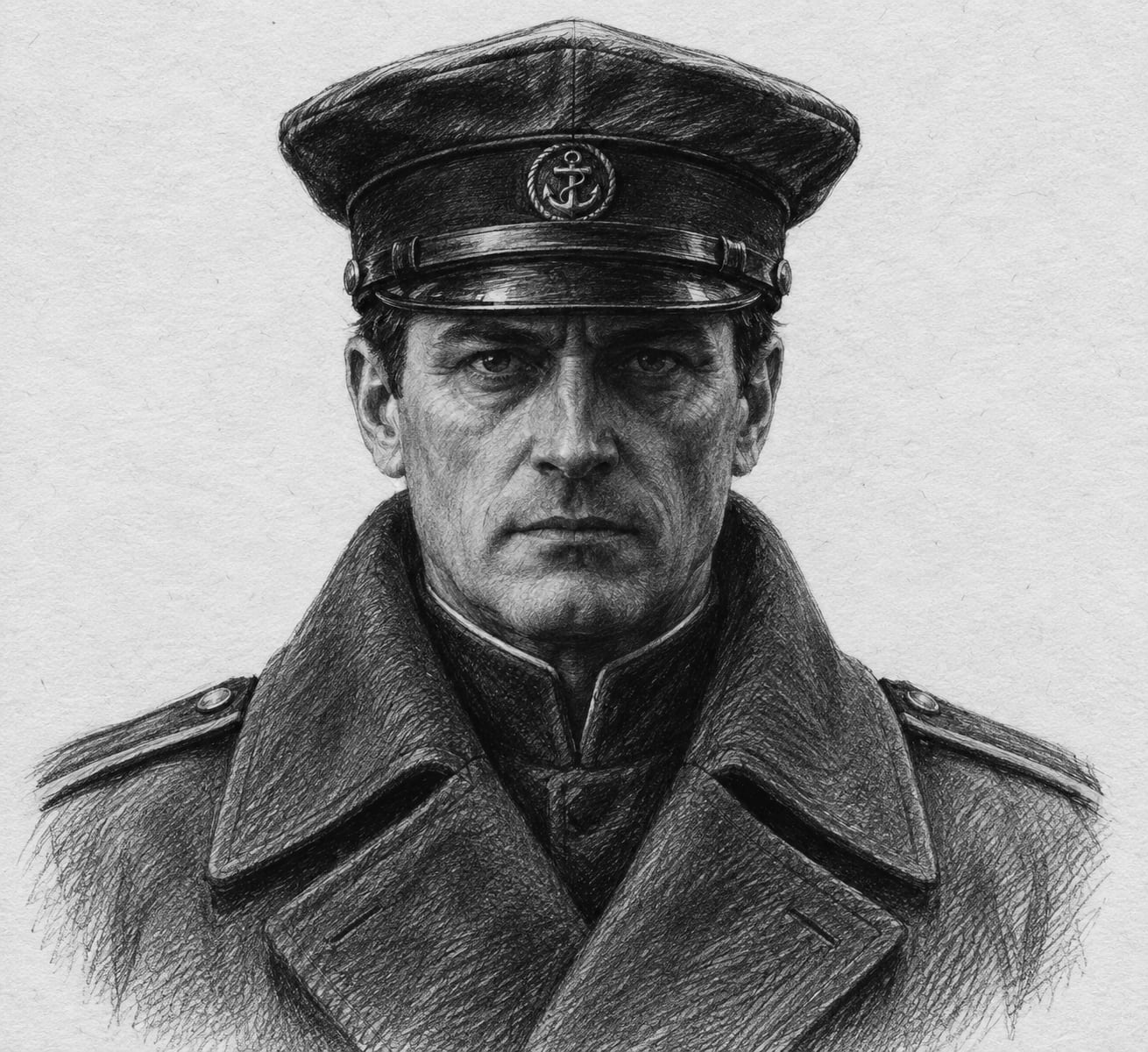
Captain Orsik enters the Codex by way of a subordinate clause. Most captains never get that far. The ravelins of Bastion-Constantinople go through officers at a pace the Bureau of War calls rotation, and most of those officers leave behind a powder return, a ration chit and a name misspelled on both. Orsik left a deposition. Strictly speaking, Orsik left a citation of one, set in the dossier of Gate-Warden Petra Valenne to support a single claim: during the second night of the Silence of Harbor Lamps in A.S. 185, the Gate-Warden read the withdrawal order by touch.
That clause is the whole of the captain's documented contribution to the history of the southern anchor. I have looked for more. The indexes give the name once, attached to that clause, and have nothing further to say.
The rank is the one the source gives. Captain. The source does not say captain of what. It records no ravelin, no battery, no harbor company and no staff appointment. It gives no given name, birthplace, age, face, decoration, wound or creed. Romancers will want me to fill these blanks. I decline, and I want the refusal on record. A dossier is an instrument of the Ledger, and anything invented to pad it is an act of forgery.
The setting needs one correction before it can hold anything. Constantinople is the southern terminus of the Sagittal Line, the Bosphorus anchor, in Zone 4. The six outer ravelins lie in front of it: Vigilance, Purity, Obedience, Fortitude, Sorrow and Correction. Valenne commands all six under the Governor-Praelate's seal, through the War command apparatus. Orsik served somewhere within that machinery of seals, as captains do. The record does not say where.
Older Ledger plates record the "Rise of Bastion-Lorraine, 331 A.S." as the keystone hinge of an eastern line, and a Cartography harmonization allowed regional plates to style the fortress "Western Anchor" according to audience.
Corrected. The fortress is Bastion-Constantinople, and Bastion-Lorraine is its deprecated refugee-community designation. It is the southern anchor at the Bosphorus, founded or designated in A.S. 68. The figure 331 belongs to no calendar this Bureau recognizes. "Western" belongs to men who drew the map facing the wrong way and then sanctioned the error as edifying.
#On the Second-Night Order
The order reached Valenne during the second night of the blackout. It avoided the vulgar word evacuation, as crisis language in the Synod must first be passed through perfume. It called for the precautionary withdrawal of nonessential personnel from harbor-adjacent ravelin sectors, pending clarification of luminous conditions. Valenne asked who had signed it. The courier named three seals and no person.
That is where the captain's clause belongs. Valenne's command chamber stands behind the Ravelin of Fortitude: a windowless room with six wall maps and thirteen speaking-tubes. Its lamp had failed along with every other approved light in the harbor, and she had refused a candle in case a single unauthorized flame set a precedent. She read the order by touch. The dossier gives Orsik's deposition as the authority for that sentence.
I distinguish carefully what the captain supplied from what the surrounding account supplied. The attribution sits on the tactile reading. The same sentence explains the dead lamp and the refused candle, and that sentence does not tell us whether the explanation came from the deposition or from the compiler who cited it. The folding of the order into a square small enough for a cartridge casing, its return to the courier, and the reply, "The gate does not step backward from darkness", all come from the wider narrative. The reply belongs to Valenne. It does not become Orsik's because Orsik is the nearest named witness, and Orsik is not made a witness to every gesture in that room by testifying to one of them.
Nor will I explain how the reading was done. The cited clause gives no method, and I will not invent one. Embossed orders, a gift of the fingertips, a saint whispering through the parchment: each of these would make the account more agreeable to pilgrims and less true. Anyone who needs the mechanism may petition Engineering. Engineering will produce thirty-seven appendices and no answer, and the matter will rest exactly where it rests now, which is acceptably.
The deposition is equally silent about the captain's own position. It does not establish that Orsik stood in the chamber, carried the order, read it aloud afterwards or heard of it the next morning from a clerk with a bad memory and a good collar. Fortitude's chamber is the attested setting of the episode. It is not attested as Orsik's billet. Plenty of depositions report what the deponent was told. The citation, as it survives, will not let me say which kind this one was. It lets me say only that it was cited, and for what.
#On the Harbor Around the Deposition
For seventy-two hours in A.S. 185 every approved light in the Harbor of Chains failed: pier lamps, pilot marks, chapel glass, chain beacons. The Chain of Saint Anakletos stayed raised and black. Signal traffic was reduced to touch, rope, bell-click and memorized hymn. In that harbor, a commander reading an order with her fingers was a field condition. Orsik's clause records it at command level, which is why the clause was worth citing.
On the same night the Ravelin of Sorrow, fifth of the six, lying between Fortitude and Correction and carrying the lower harbor guns, reported lights in the water below the quay in excess of every known lamp, and one reflection moving against the current. Sorrow asked to withdraw from its lower guns. Valenne's answer went back down the signal chain: hold, cover mirrors, count men, not lights. The ravelins kept their posts. Gun crews worked and sang from memory, and chain crews counted links by touch.
The rest of the incident is told elsewhere. Harbormaster Joram Clee entered one word, Weather, and has been hated for it in direct proportion to how accurate it is. The Bureau of Records supply galleon Saint Veritas vanished from its mooring during the blackout. It returned six months later, in A.S. 186, and its crew insisted they had never left. Its log went into the custody of the Bureau of Shadows, where it remains. Orsik has no part in any of this: no source puts the captain aboard the vessel, near its log, or at its return. I mention the ship only so the reader knows how crowded that week's paperwork was, and how much was required of one named clause to be heard above it.
#On the Limits of the Service Record
My judgment, and I give it as mine: Orsik's clause is worth more to the Ledger than most commendations.
The withdrawal order named seals and no signer. In the Synod's administration that design is deliberate. An instruction sealed by three offices belongs to none of them, and when it is refused, no particular person has been defied. Valenne's commendation was withheld from the public broadsheet because praising the refusal would have confirmed that the order existed. Withholding something from a broadsheet is not the same as destroying it. Internal files survived, the dossier compiler had sources, and one of those sources had a rank and a surname. Against an order that no one would own, the account of its refusal rests partly on someone who would.
That is the full extent of what can be said. The record does not establish when the deposition was taken, before whom, on whose order, or whether the captain wrote it unaided. It does not establish any promotion, transfer, censure, death or retirement. Valenne remains active in the command records of A.S. 201, sixteen years after the blackout. That is her status. It tells us nothing about Orsik's.
I add one caution for the conspiracy-minded. A short file is not proof that something was cut. Nothing in this record is redacted. There is no black bar in the Orsik entry because nobody has found anything to put under one. The Bureau of Doctrine suppresses a great many things, and I sign a fair number of the orders. Nobody suppressed this captain's biography. Nobody ever submitted one.
One rank, one surname and one clause, on an anonymous night, attached to an order nobody signed. Most of the officers in that harbor left less behind.