
#On the Canticle's Office
The Canticle of Measured Fire is known to the Codex almost entirely by one night of use on the Danube. In the ordinary course of the Church a hymn is sung to the Creator and audited afterward. This one was sung to a battery, and the battery fired on time. That is the whole of its fame. Most hymns carry less.
The work is recorded in connection with Saint Orla the Brass-Throated, conductor of a shrine-barge hymn-gallery, who sang it in full form while the gallery burned around her. The Bureau of Rites keeps that account. I keep the Canticle's file, which is thinner. No clerk has troubled to record what the work contains. Its verses, its stanza count, its key, its composer and its age appear in no folio placed before me. I have stopped asking. A gap in the Ledger is seldom an accident, and when it is an accident it is seldom corrected.
The file does establish what was at stake. On a Shrine-Deck the choir, the bell and the guns all keep the same time. Recoil rigs are tuned to the measure. Powder and shot are tied to hymn bars. A volley is lawful only on the sanctioned toll. When that shared timing fails, iron, powder and frightened men each begin keeping their own. The Canticle is remembered as the work that kept their timing for them.
#On the Fire Recorded
Rites places the fire aboard a Danube shrine-barge around A.S. 130, or about 1840 by the old count. The year is probable and no more. The record gives no season, no reach of river and no name for the barge, and I will not invent them for a reader's comfort.
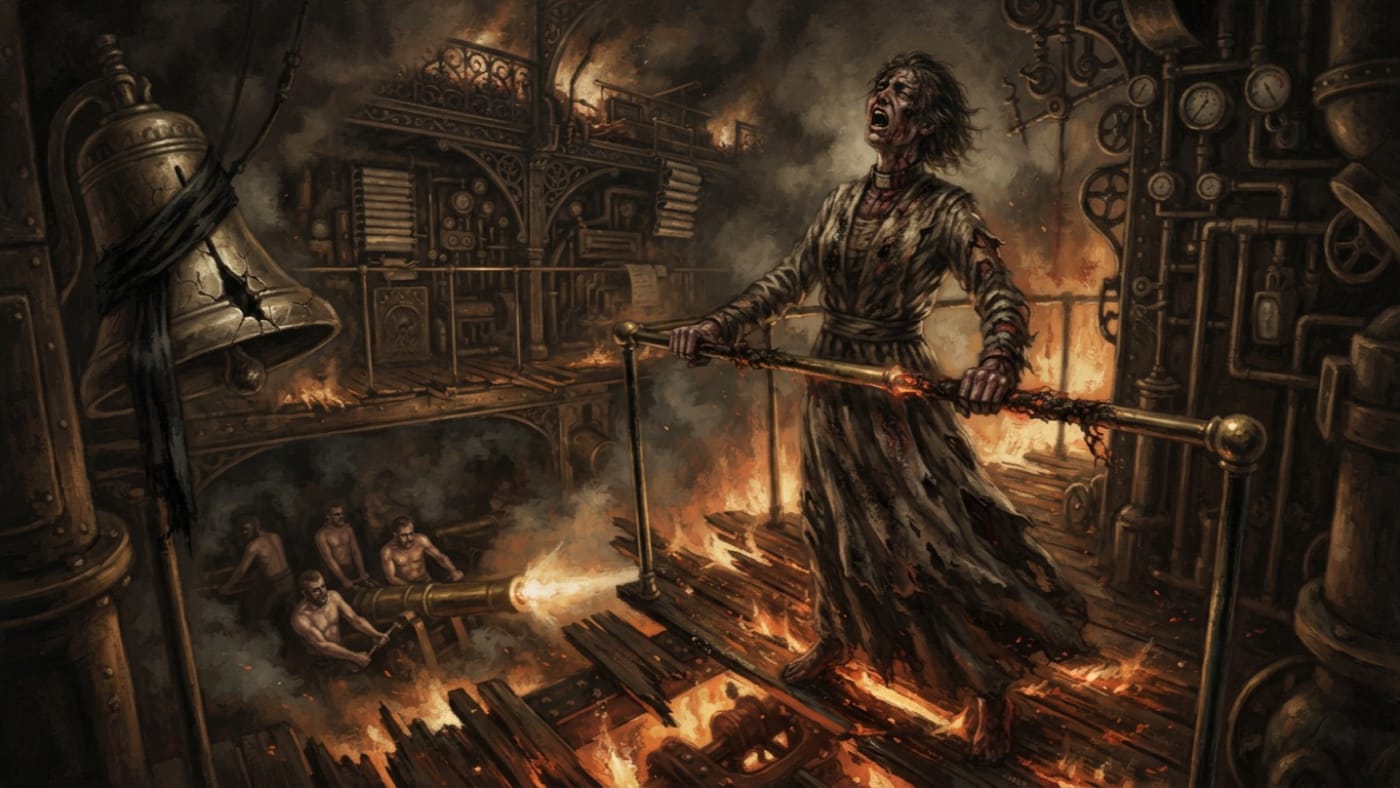
During a recoil sequence a powder-fire rose from the lower deck and climbed the side stair into the hymn-gallery. It took the curtains first, which Engineering had already marked as "decoratively combustible" in a warning that was filed and then ignored. It took the benches next, and then it began on the floor. The choir broke apart and the gunners lost measure. In that confusion the metronome bell fouled. The account does not say whether the clapper jammed or the casing cracked. Either way, the one instrument licensed to keep the deck's time stopped keeping it.
Orla stayed at the conductor's rail and sang the Canticle in full. The Rites account gives forty minutes by Cathedral reckoning, and the figure stands under that account's name. Her voice held the interval the bell had dropped. In the recorded account the guns fired true and the barge cleared the convoy. At the final line the gallery floor gave way beneath her.
She was recovered alive. The registries give her voice about four more years and her body about six, and they disagree even on that.
Choir-school frontispieces to the Canticle show Orla upright at an unscorched rail, the metronome bell ringing clean beside her, the gunners below lifting their faces to her in gratitude.
Correction: the bell had fouled, and that failure is why the Canticle is remembered at all. Recovery notes report burns over most of her body, inhalation damage, melted collar brass, and both hands contracted around the rail. The gunners below had no leisure to look anywhere but their guns.
#On What the Measure Holds
The general practice owes nothing to Orla and existed well before her fire. The crew renews the chalk-and-relic ward line. They tune choir and recoil rigs to the metronome bell. They load by measure and fire on the sanctioned toll. Before the barrel cools they log the shot type, the time, the purpose and the authorizing seal. Then they swab, purge the residue, and confess any fault. The Processional Arsenal and the Pilgrim's Ladder carried this discipline onto land. The Cadence Reforms, decades before the barge burned, had already given conductors authority over gunners. The gunners have not forgiven them.
Each office has its part. Choir Runners carry cues by slate and by hand. Cadence Callers stand between choir and battery and turn one into the other. Ordnance Deacons hold the seal, and without it no shot is lawful, however well timed. When the bell fails, the Runner has nothing to carry and the Caller nothing to translate. A measure held from the rail gives both of them something to count against. That much is ordinary mechanics and needs no saint to explain it.
What the crews claim beyond that is their own affair. They speak of cue drift exposing a deck to things that listen. They speak of guns fired between tolls and a deck that sounds hollow afterward, as if something had answered. War Directorate notices print Cadence Is Containment. Doctrine has filed the phrase without ruling on what is being contained. I have stood on such decks and heard nothing I would put under oath. I have also never hummed between tolls, and I do not intend to begin.
The cost is not in dispute. The choir pays in scarred throats and bitter tincture at the end of every shift. The standing rule is that if a singer coughs blood, the sequence is shortened, and it is a sound rule. The gunners pay in deafness, and you can see it in how they stare. Forty minutes held through smoke is the extreme case of a debt every choir pays in instalments.
#On Objections and Permissions
Four Bureaus have each filed an objection, and none has been answered.
The Bureau of Rites holds the saintly account and defends it. The Bureau of Bells disputes the tonal claims and maintains that the reported final pitch lies beyond any human throat after such injury. The Bureau of Engineering disputes how the fire spread: a gallery-fire moving as the hagiography describes would have compromised the ammunition lift earlier than the record allows. The Bureau of War disputes the casualty accounting and has not shown me its table. Doctrine has settled none of it. I record the disputes as filed and add nothing to them.
One limit has been drawn, and it was drawn by force. A Free Choir in Cologne taught that Orla's example let a singer authorize a shot without an Ordnance Deacon's seal if the singer's throat bled while giving the order. Their phrase was the bleeding throat outranks the seal. The Bureau of Purity suppressed the choir. The Canticle kept the measure and authorized nothing. However sincere the suffering, it cannot fill an authorization column. Any choirmaster who has forgotten this may ask Cologne, though there is no longer anyone there to answer.
The name also needs sorting. Saint Orla of the Seventh Line belongs to the Gasket-Hymn Mechanics and the last phrase of a pressure sequence. Orla of the Steady Note belongs to the Iron Choir Brand-Singers. Neither is the Orla of the Canticle. Workers mix the three, and Rites keeps three files. The Canticle appears in one of them.
#On the Voice After the Gallery
The folios do not say where the Canticle is sung now, or how often. Some choirs keep it. I hold no register showing that every platform does, or that any office requires it, and I will not draw one up out of enthusiasm.
What the crews remember is smaller and holds better. They tap the conductor's rail three times before the first cadence. They tie a strip of blackened cloth beneath the metronome bell after a deck fire. They say Hold the Measure, which Rites approves, or Sing Through, which the decks prefer. Neither phrase is known to be a line of the Canticle. A choirmaster who says otherwise is selling something, usually whistles.
The brass pitch-pipe in the Cathedral Arsenal Office at Strasbourg is Orla's relic. The Bureau of Relics holds it, and examiners report that it is warm. It is not the Canticle, and nothing in the record says it was sounded on the barge. Visitors to the case hum at it regardless, quietly, as though it might give them the pitch. It has not obliged me.
So the work survives without words or notes. What the record keeps is a fouled clapper, a rail too hot to hold, an interval held after the bell had failed, and a floor that gave way at the last line. On a shrine-deck that is enough to pray to, and the crews do.