
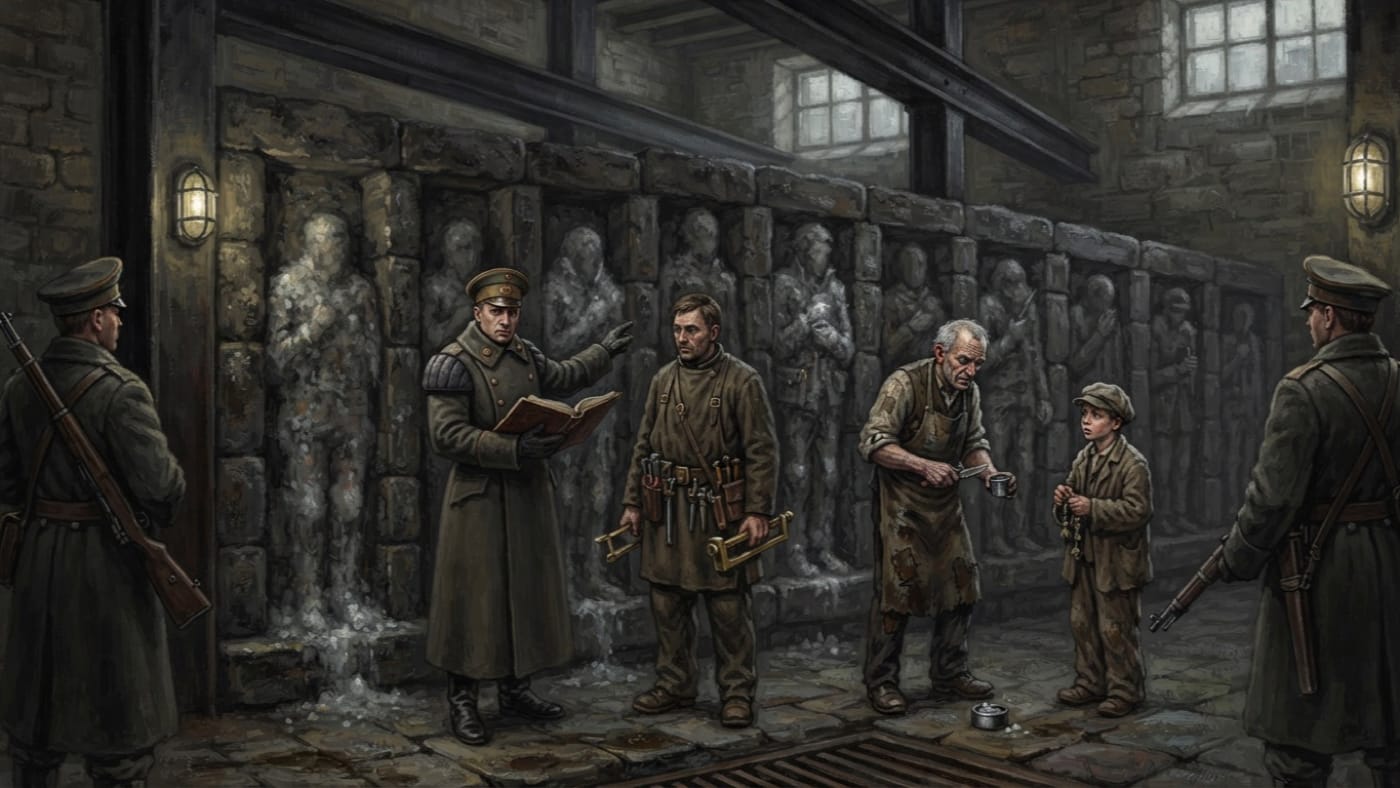
#On the Wall and the Day Named for It
This survey records Canticle Day as it stands in A.S. 201. On that day the supplier wall at Bastion-Przemyśl is inspected, and the registers attest no other observance under the name. The Codex looked for more, as the Codex always does. It found a wall, a residue that comes up in damp weather, a noise entered once in a ledger, four Bureaus with four opinions, and a number of mechanics carrying knives.
None of the registers consulted for this entry names the day's founder or its dedication. None gives its place in the calendar or the interval between keepings. The observance is local to Przemyśl, and nothing in the record carries it farther than the wall.
#On Why Przemyśl Keeps Fourteen Suppliers in Masonry
The Seal Standardisation Edict of A.S. 164 was written in the fright that followed the Unhymn Infiltration. It required blessed hymn-gaskets on resonance lines, sealed with purity wax that had cooled under the Sixth Canticle of Industry. Demand outran lawful supply within the season. The black market filled the gap with wax that matched the resin, the chalk, the sheen and the stamp. The one thing it lacked was the song.
At Bastion-Shipka and Bastion-Irongate, the principal theatres of the Counterfeit Wax Plague of A.S. 178, that unsung wax held its seals. This was the offence. Engineering's assay found the material compliant. Purity wanted poison and had to settle for an absence. If counterfeit wax gripped as well as lawful wax, then the Canticle was either a sacrament beyond measurement or paperwork with lungs, and no Bureau could afford either verdict in public. So the Bureaus chose enforcement.
Fourteen suppliers were immured at Przemyśl after tribunal proceedings remembered chiefly for their speed. Their workshops burned, and their stock went into sealed furnaces. The wax trade's shortage carried on regardless, because walls are poor manufacturers.
The immurement ledger dates the wall to A.S. 178 and dates nothing else. The name Canticle Day carries no signature in any register consulted.
Public notices state that the Counterfeit Wax Plague ended in A.S. 178.
Clarification: enforcement peaked in A.S. 178, and counterfeit practice continued afterwards. The wall at Przemyśl commemorates a peak of enforcement. That is a different kind of monument, and the Bureau of Doctrine asks visitors not to confuse the two in correspondence.
#On the Pearly Bloom
When the wall is dry, it is a wall. In damp weather it develops a soft pearly bloom, and that report is the only matter in this section on which every office agrees.
Pearly is an awkward word to find here. The Bureau's manuals use the same word, pearl, for the sheen of lawful purity wax, the approved dull lustre that the counterfeit cakes also reproduced well enough to fool the men who seated them. Any Gasket-Hymn Mechanic would know that finish across a workshop. Finding something like it on the face of a wall that holds fourteen wax-makers is the sort of resemblance that keeps a Bureau employed for decades.
Engineering calls the bloom mineral efflorescence. The phrase assigns the residue to the stone and to the weather, and leaves nothing over for anyone else. No assay published to the Codex names the mineral, and Engineering has offered none for this survey. On this occasion its confidence lies in the vocabulary rather than in a measurement.
Doctrine calls the bloom a warning. It has not said to whom, or about what. A warning that names no recipient goes to everyone, and that is the efficiency Doctrine prefers.
These two readings never meet. Engineering describes a surface, and Doctrine describes a message written on one. Both can be entered in the same report without either office conceding a syllable, and so far they have been.
#On the Hum at the Third Inspection
The Przemyśl immurement ledger carries an entry from after the sealing. At the third Canticle Day inspection, it records, the wall surface produced a low hum during verse six.
The entry does not name the hymn. The Codex will note only that the sixth verse of the Sixth Canticle is where the singers lower their pitch on yield, hold for two beats over memory, and strike the cooling tables once on seal. Coincidence has never yet been prosecuted.
The ledger gives no words, no pitch and no duration. It does not say whether the sound came again. It does record four official readings, one per office, set down without reconciliation:
Note that Engineering's word for the hum, settlement, is different from its word for the bloom, efflorescence. The office has assigned the wall two separate mineral habits and declined to connect them. The Codex follows its example.
Bells' reading deserves a second look. A sympathetic response requires something to respond. The same ledger records thirteen voices during the sealing, and a fourteenth mouth packed with wax "due to anticipated blasphemous persistence." Bells has not said which of the fourteen, if any, it means, and the Codex will not say it for them.
The vocabulary of the quarrel is borrowed from the wax sheds. The Sixth Canticle is sung to purity wax while it cools. Since the Plague, an opening phrase of the Boundary Litany is sung into molten wax, and a Bureau of Bells accountant then sounds the hardened seal with a licensed fork. The wall went through neither process. It was not cooled in a licensed shed, and the record shows no fork ever put to it. Whatever answered at the third inspection answered outside every procedure that the Bureaus know how to bill.
#On Lucky Wax
Mechanics scrape the bloom off the wall and sell it to apprentices as lucky wax. The Codex records the sale and finds no record of the luck.
The trade was ready for such goods long before the wall existed. A Gasket-Hymn Mechanic's protective charms already include a bell sliver, a notch in a bone ring, an inked sequence line inside the glove, and a dot of wax behind the ear. In the scarcity economy of the forward bastions, wax cakes serve as a unit of bribery. A substance that is pearly, damp and taken from a wall that four Bureaus cannot agree about is excellent stock in such a market. It costs the seller a knife, a damp morning, and a willingness to stand where Doctrine prefers apprentices not to.
No register consulted fixes its price, its composition, its holiness or its fitness for a flange. Engineering would call the scraping efflorescence. Doctrine would call it a warning, sold by the ounce. The sellers call it luck, and as far as the Codex knows they have never offered it for seating a gasket. An apprentice who buys it has paid for a story about the wall, and the Codex makes no judgment on whether that is worth more than wax.
Doctrine's instruction concerns touching the wall. The mechanics' practice consists of touching it on the apprentice's behalf and charging for the service. The two rules have reached a working arrangement, and neither party admits the other exists.
#On the Present Condition
As of this survey, the wall stands at Przemyśl and is inspected on Canticle Day. The bloom comes back with the damp. Engineering has not changed its word for it, and neither has Doctrine. The hum has its line in the immurement ledger, and no record consulted here gives it a successor. The apprentices remain under instruction not to touch the wall. The scrapings, by every account, go on reaching them anyway.
The fourteen suppliers made wax that held without a song. Przemyśl now keeps a wall that may or may not have sung without a supplier, and its surface is sold to boys at a profit.
The Plague was never cured. It was assigned an inspection.