
#On the First Causeway
"We collect what the road costs." — Oath of the Salt-Vigil, as recorded in the Ledger of Seasonal Dispensations
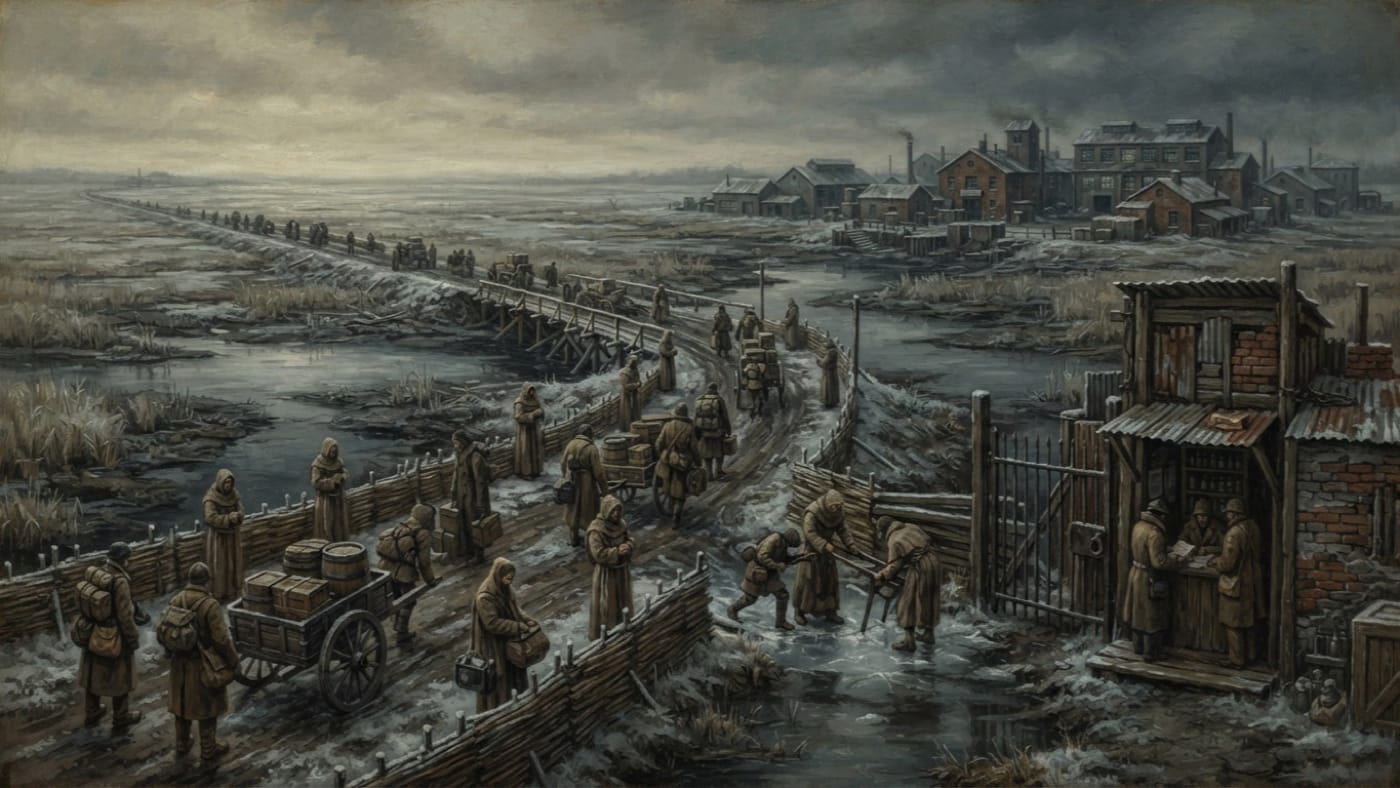
The Candlewick Spur is the First Causeway of the Salt-Vigil Causeways. It runs eleven miles of seasonal road between the canal gates of the Candlewick Palatinate and the marsh island of Brine Fork. It crosses three tidal channels on timber bridges. The Salt-Vigil raise those bridges every autumn, and the spring tides take them every April. Between those two dates the Spur carries more traffic than any of the other six roads and complains less. The Bureau of Engineering records this as reliability. I record it as the patience of a thing that knows exactly when it will be destroyed.
The Spur borrows its importance from both ends. At one end stand the presses, vats and chandleries that make the Church's paper true. At the other stand the toll courts of Brine Fork, and beneath them the Phial Cellar, where the road's unpaid debts are kept in glass. Few roads are so frank about what they carry.
#On the Road That Must Be Made Again
Every autumn the Spur is unmade from memory and remade from marsh.
Crews of the Vigil drive pilings of salt-hardened timber into mud that has not yet agreed to hold them. They lay reed fascines in courses and pack them with clay. Over the top goes a surface of crushed shell and salt, much of it from the previous winter's tithe. At the three channels they cut the bridge timbers, carry them out, pin them and brace them against the tide, with hands that will soon be bare at a toll-post.
None of this is a road until the frost consents. The Causeways run from first frost to final thaw. The Bureau writes this as November through March, and the marsh keeps to it when it likes. The Spur can sit on the map in good black ink while the ground beneath it is still soup. Boots measure the difference between the mapped road and the usable one: how far they sink, how a fascine shifts underfoot, where black ice lies smooth across the shell for a cart wheel to find before any eye does. The wind comes across the flats with nothing to stop it short of a traveller's face.
Then April arrives. The spring tides come up the channels and take the bridges the way a bailiff takes furniture: all of it, without apology, and fully intending to come back next year. Timbers float off or sink into the mud and become next autumn's footing. The clay softens. The reed bundles rot back into the marsh that lent them.
#On the Charter and the Crossings Before It
People walked the marsh before anyone chartered it. In A.S. 52, seven years after the Sundering, salt-hermits guided refugees across the frozen flats in exchange for salt and confession, and the earliest Brine Fork crossing grew up around their reed huts and clay tear-vessels. The surviving records do not say whether any of those paths ran where the Spur runs now, and I decline to improve them.
In A.S. 82, Veyrault's Bureau of Records chartered the Salt-Vigil and fixed Brine Fork as their central house. The authority that sealed that charter was not yet the Synod. The Concordat of Strasbourg would not constitute that body until A.S. 90. Anyone who speaks of a "Synodal charter" in 82 is speaking backwards, as the calendar itself does. From 82 onward the network was an office with a ledger. The ledger does not record when each of its bridges first stood.
Candlewick keeps its own chronology. A canal town of chandlers and dyers was trading long before the Palatinate's charter was ratified and the Records annex was installed in A.S. 92. The Spur served a market before it served a Palatinate. The paper came later and made the arrangement official, as paper does.
#On Cargo, Fees, and Grief
The Spur carries permission, both raw and finished. Brine Fork's own accounts name its traffic as wax-sealed chits, registry clerks and pigment wagons. That means barrels of registered wax, crates of sanctioned ink, bundles of watermarked paper, and the officials who will stamp all three into authority somewhere further down the line. Behind them walk the people whose passage depends on exactly those materials. A traveller holding a Candlewick chit carries cargo and fare in the same pocket. If fog smears the seal, both are spoiled.
The wider freight of the network, such as military provisions, fish, salt and pilgrims of varying sincerity, belongs to the Causeways at large. I will not invent a manifest for the Spur. The Bureau has enough forgers.
Two collections wait at the toll-house, and the ledger keeps them strictly apart. The Bureau of Tithes takes the crossing fee, payable in scrip, in salt tokens, or in the Palatinate's own wax-sealed chits. The Salt-Vigil collect their own tithe, of salt and of tears, and never touch the Bureau's coin. The traveller pays twice and is assured the two payments are entirely different. So they are, in the way a left hand differs from a right.
A traveller who cannot meet the salt is shown into the Weeping Chamber. It holds a bench, a table, a witness and a vial clerk, and there is no fire. The traveller confesses until the tears come, and a glass phial of Alchemical Standards issue receives them. The clerk stoppers it. The witness presses the wet seal. Date, station and origin field go into the record. The phial rests on a local rack until the weekly locked crate carries it to Brine Fork, through the salt store, past the plaque forbidding flame and song, and down to the racks. At the A.S. 199 inventory those racks held eleven thousand four hundred and six phials from every station in the network. The Spur's share of that figure has never been published separately. I see no reason to start.
Earlier editions of this Codex described the Salt-Vigil tithe of tears as ceremonial in nature and of no practical consequence.
Retracted. Ceremonies are not crated weekly under escort. A tithe that buys a crossing, carries a seal, and can be argued over before the Road Tribunal is a levy. The Codex will call it one.
#On Those Who Keep the Crossing
Each ascetic of the Vigil stands at a post for at least six hours of every winter day. They stand bare-handed behind a waist-high windbreak of stacked reed, with feet wrapped in salt-cloth that cracks like old leather. This is the Vow of Exposure. What it means for the traveller is that someone is always there to point out the soft stretch, to haul a cart off the black ice, and to say whether the next bridge is still standing. The order's charity is real, and it comes with an invoice.
Behind the ascetics work the timber crews, the vial clerks who keep the grief records, and the riders of the Road Tribunal, who can void a traveller's papers on the road and judge disputes of passage. Prior Idris of the Sixth Tide governs all of it from Brine Fork. The island's allocations and its index stay with that house, however much the Spur's traffic might prefer them closer to the road.
Fraud follows the freight. Wet seals are counterfeited. Phials are diluted. Merchants with dry eyes and full purses hire other people to do their weeping. A forged Candlewick chit presented on Candlewick's own road is a particular insolence, and the Vigil test such paper by smell. Access is unequal in the ordinary ways. Those who have salt pass quickly. Those who have only sorrow wait on the bench.
#On the Present Condition
As of A.S. 201, the Candlewick Spur stands within the network's seasonal assessment: Green, standard, and dependent on frost. The bridges are rebuilt, the toll-house is staffed, and the crates are moving.
Its neighbours are less tidy. The Fourth Causeway failed to freeze in A.S. 199. Traffic there has since resumed, but the route remains under Amber monitoring. When Assessor Maren Gault weighed the Fourth Post phials, she compared them with samples from other stations, the First Causeway's toll-house among them. On her scale the Spur's tears were the control, and they weighed what tears ought to weigh. For the Bureau of Alchemical Standards, that is the highest compliment a road can receive.
The Fading Winter reached the Spur through its cargo. A road that carries ink and wax carries exactly what the Fading eats. In the Cellar, origin fields have thinned while dates and debts held firm. On the road, a chit whose shade has drifted arrives at the toll-house as an argument when it was meant to be a fare. The order says that the road drinks what it is given. That is their phrase, and Doctrine has filed it under Unorthodox but Permissible.
In April the bridges will go. In autumn the Vigil will cut new timber, and the wax will come down from Candlewick, and someone without salt will sit down on the bench.