
#On the Canal and the Table
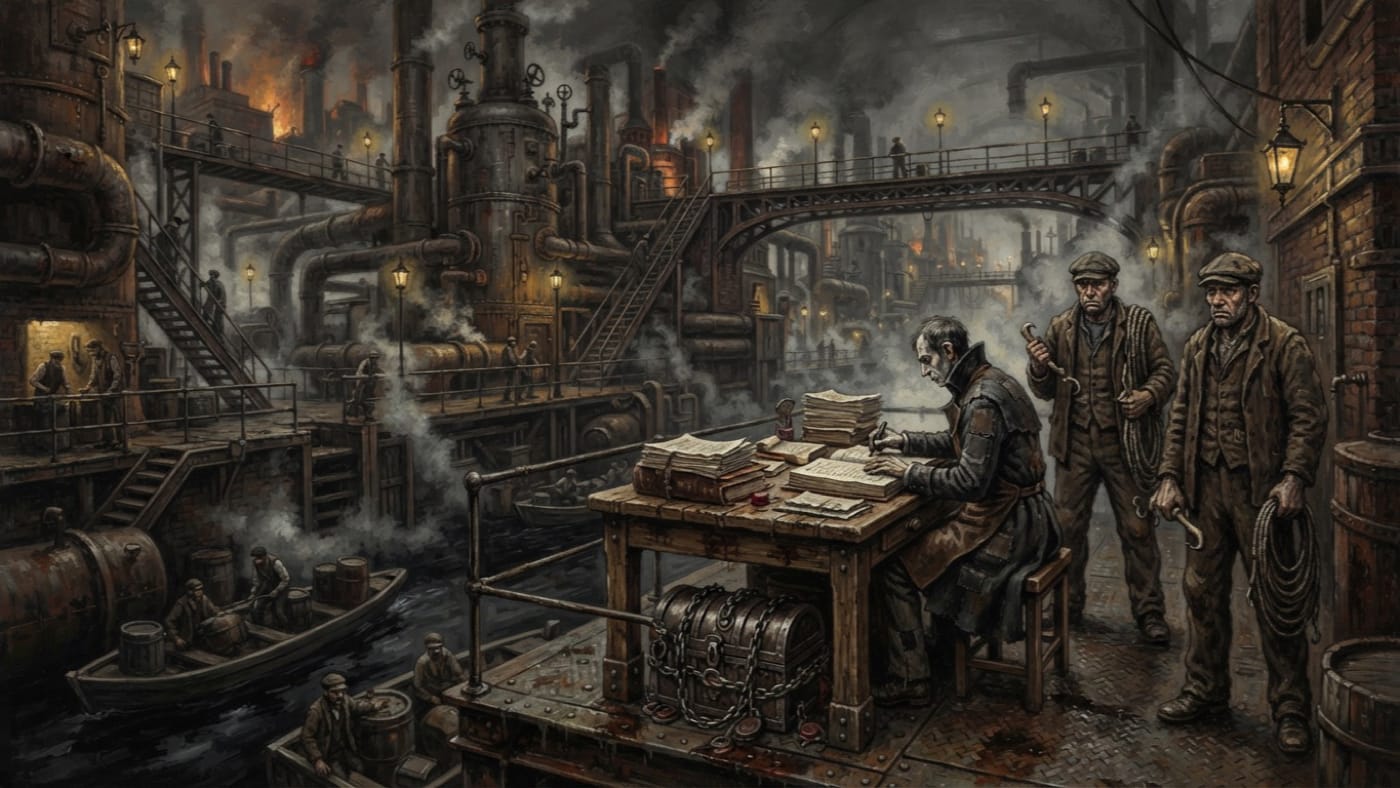
Canal South appears in the guild's books as a receipt margin and in conversation as a place. The Bureau of Records has never troubled to decide which it is. It lies among the Still-Canals of the Chrismole Furnaces of Brast, in the condenser country where the water runs black and smells sweet enough to tempt a child. No surveyor has fixed its boundaries. No chapter has blessed a founding stone, and nobody has yet shown me one to bless. Its single undisputed possession is a counting table.
All of its fame rests on that table. Beneath it, in a locked casket, the Distillers' Compact keeps the receipts for the substrate, and Guildmaster Pex Ruln holds the key. In Strasbourg a place would need a cathedral to earn an article. Brast makes do with furniture.
The reader raised on western towns should put the word canal out of mind at once. These channels carry no barges of turnips and reflect no painted shutters. They are condenser works cut into the ground and lined with iron: cooling troughs, lock-gates, sluice wheels sealed with wax, and long pipes that sweat partly refined distillate into the frost. The guns of the Sagittal Line drink what passes through them. Canal South is where part of that drink was paid for, and where the payment was written down.
#On Flow and Filter Work
Distillate leaves the early stages hot and foul. The canals cool it, the locks meter it, and the condenser filters take out whatever would otherwise ride in the drum to the front and pick a quarrel with a breech. Every screen clogs. Each clogged screen has to be drawn, scraped, burned or turned, then set back before the line floods its neighbour and the pressure bells start their small hysteria.
The men who do this work walk iron catwalks greased with condensate. They move between valve towers and pipe bridges, and they take a skiff when a housing sits below the walk. Rag-boys scrape residue with bone-handled hooks. Lock-turners heave at the sluice wheels until their shoulders crack like old vellum. Filter-men carry mesh in oiled sacking and can tell a screen is dying from its colour. They are paid in warmth. Their pension is ash lung, or a solvent burn that never quite closes, or the black water itself, which takes a man who slips without a splash worth reporting.
The Compact does not govern Canal South in law. Brast answers to the Ordnance seat, the Furnace Chapterhouse of Saint-Combust and the Rail Manifest Court, as it has since the Concordat ratified the city under Ordnance seal in A.S. 90. The Compact governs because it knows which screen sits in which drawer. Its power is made of drawers and keys. The law keeps the robes, and the Compact keeps the inventory.
Ordnance staffing rolls list the Canal South guard as "unskilled custodial posting, interchangeable on notice."
Corrected for accuracy. Either filter-man at the table could be replaced by supper. His replacement would also have to be illiterate, loyal to the guild and able to judge a housing's health by smell. Ordnance is welcome to find such a man on notice. The roll gives no instructions for doing so.
#On the Casket Beneath the Count
The casket is small, and so is the key. In my experience large crimes often prefer small furniture.
Two filter-men who cannot read stand guard over it. One clerk who reads too well sits at the table and enters receipt codes. The custody is elegant in its way. The guards cannot betray writing they cannot decipher. The clerk can decipher everything and is watched by men who would recognise his treachery only by its gait. Ruln, who holds the key, has arranged to need nobody's honesty, only their limits. Whatever the Bureau of Doctrine thinks of his soul, I admire the carpentry.
The receipts follow a chain that begins elsewhere. Grey drums with no maker's marks arrive before dawn. In the first-stage works they are weighed under hooded lamps, opened behind solvent screens, stirred with bone paddles and poured into the charge before the pressure bells bring out witnesses. No record I have seen places that work beside the table, and I will not move furniture for the sake of drama. The table's part comes afterward and is quieter: a code, a weight, a countersignature, a mark from the Chapterhouse witness and Ruln's slow, oily hand.
A man who opened the casket could match a delivery to a batch, the batch to a signature, and the signature to a living officer. That is what the casket is worth. The thing in the drums is classified, and these pages leave it classified. What the paper offers is a sequence, and a sequence is what auditors use to hang people.
Bureau of Alchemical Standards, Report 7741-B, A.S. 194. Finding: ████████████████. Receipt chain for tested batch: Canal South series, entries ████ through ████. Countersignatures: ████████████, Chapterhouse witness mark, Guildmaster. Request for originals: ████████████████. Originals retained beneath the count.
The report exists and carries its date. Its findings remain under their bars, and I have ordered the bars waxed. The useful reader will notice that the last line of the block needs no redaction. The originals are exactly where everyone already knew they were.
#On Permission and Delay
Ruln works three valves at Canal South. One is the filter stock. Another is the lock inspection, which can last one bell or six depending on how courteous the asking office has been. The third is the casket. He opens none of them in public, and every office in Brast schedules its business around all three.
Commander-Auditor Sorn Vale audits by column. He sets weight against seal, seal against dispatch, dispatch against certification and certification against filter lot. Each column ends at the counting table, and the table, being furniture, does not answer. Vale has asked for the sealed receipts. That is to say he has filed a request, and the request has been answered in fine grammar and to no purpose whatever.
Choirmaster Ilyra Kest of the Calibration Choir wants the receipts for another reason. She hears it when a batch answers differently under the Measures, and she would very much like the paper to say which batch it was. Ruln hears invoices. Between her ear and his ledger lie the casket and its key.
The Furnace Chapterhouse blesses the grey drums and does not ask where they come from. Asking would turn useful ignorance into punishable knowledge, and a chapter that blesses by the drum knows to the ounce what its ignorance is worth. It wants the casket shut. It says so in the warmest terms, and those terms include a winter's supply of candles.
Around the edges of all this the wider district keeps its other trade. Siphon routes run under certain locks. Warmth Thieves in the Still-Alleys move drums by skiff when the furnaces roar loud enough to cover them. The Compact hates these people as vulgar plagiarists of its own methods. It has never had to raid the counting table to prove that hatred, and I record no raid there.
#On the Present Condition
The A.S. 199 misfire year still hangs over every housing in the Still-Canals. A Brast-fed battery at Bastion-Przemyśl put four rounds into a friendly rail junction. Eleven died, a supply train was crippled, and three institutions each found someone else to blame. Ordnance alleged sabotage. The Choir blamed degraded feedstock. The Compact blamed the Choir. The guns gave no testimony and showed more discipline than anyone else in the matter. I do not settle the question here, and I would be disciplined if I tried.
Since then the mesh has worn faster. Condenser residue has thickened in its troughs. Three emergency screens fitted in spring buckled within two cycles. Canal workers report sweet algae growing in the lock corners in shapes they compare to scriptural punctuation. I record the comparison as theirs. A filter-man's eye for a semicolon is an informed opinion, not a finding of the Bureau. Ruln calls all of this "within tolerable attrition." The guns at Bastion-Constantinople have not yet been asked for their view.
Seven sealed drums of finished chrismole are missing from the Manifest Court inventory. No receipt I know of places them at Canal South. They are sealed fuel and have nothing to do with raw grey drums, and no arrest I have read names the two filter-men or the clerk. Vale has produced confessions and no drums. Kest has sealed her night-syllable cylinder, and its contents stay with her. Inquisitor-Mechanic Lux Thane Mire is expected from Strasbourg with authority to test substance by heat, oath and resonance. He has not arrived. He has examined nothing. No tribunal has yet had the pleasure of choking on a partial truth.
He will want to see the table when he comes. The table will be there, and the casket beneath it. The key will be wherever Ruln happens to be standing.