
#On Their Station
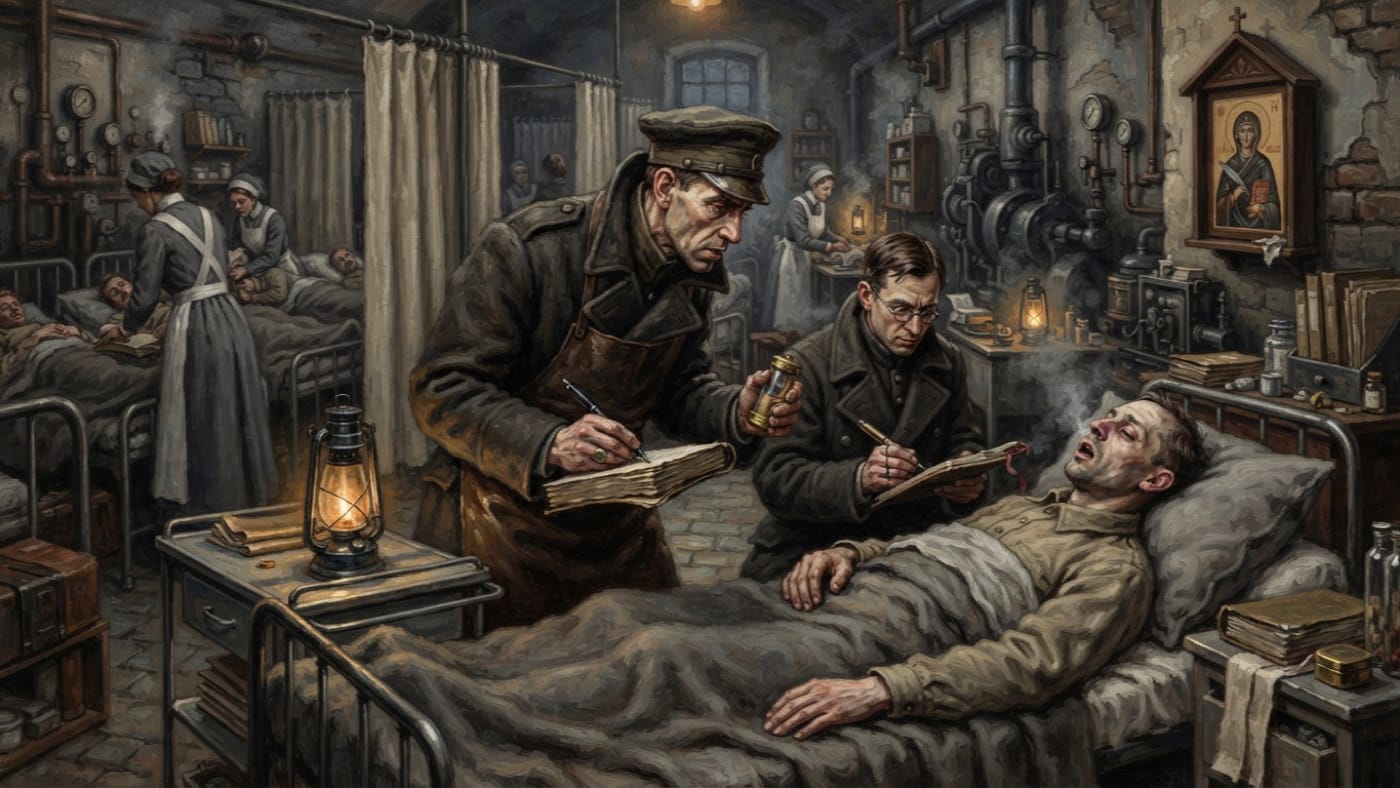
The Butchers are the Deathbed Confession Harvesters who ask for names first and keep asking. That is the whole of their creed. Most creeds need more pages to say less.
They hold the same licence as every other Harvester. They carry the same seal-ring, count the same witness ribbons, and sit on the same stool beside the same cot. No charter sets them apart and no bureau employs them by that name. They have no hall, no master, no badge sewn to the grey apron, and no column of their own in any muster roll. The word is ward speech. Like most ward speech, it was coined by someone with wet linen in both hands and no time for euphemism. The Bureau of Mercy prefers "method variance." The patients prefer, where they are able, to be elsewhere.
A Butcher is known by the order of his questions. Names come first, then dates, routes, amounts, accomplices, caches, the debt owed and the debt concealed. The daughter, the orchard and the mother's kitchen wait until the Ledger has been fed, and often they wait longer than the patient can. The resulting transcripts are short and hard-edged. The Bureau of Records receives them as a quartermaster receives a full crate.
The name suggests a blade. They carry none. Their instruments are a quill, a minuteglass, and a voice kept level enough that panic cannot get into the testimony.
#On the Order That Gave Them Work
In A.S. 78 plague moved through the southern trench infirmaries faster than clerks could count. The dying carried names, routes and debts out of the world unrecorded, and the archives remember the year as the Lull of Names. Two years later, Standing Order 22-C made terminal confession mandatory. It was issued by the Mercy and Records offices of that day, which the Synod constituted at Strasbourg in A.S. 90 later absorbed into its law and its histories. The Confession Reform of A.S. 104 fixed the six steps of the work in their present order.
That is the history of the profession. The Butchers have no separate history. No founder is recorded and no first Butcher is named. No year marks the day the word was first used of a colleague. The tendency is as old as the minuteglass. It began the first time a clerk saw the sand running faster than a dying man's breath, cut short his story of a brother's wedding, and asked where the powder was kept. Nobody thought the moment needed a witness ribbon.
#On Names Before Comfort
The six steps are access, stabilisation, framing, extraction, authentication and packaging. Butchers observe all six. What sets them apart is how much breath each step is given.
Access belongs to the Ward-Sisters and Ward-Brothers, who hold the curtain, the basin and the patient's trust. Nothing passes the curtain without them. A Butcher does stabilise. He props the pillow, wets the lips, lowers his voice and paces the breathing, because a man who is choking names nobody. A Shepherd stabilises in order to comfort. A Butcher stabilises in order to keep the patient able to talk. The sponge is the same in both cases.
His framing is brief: Tell the truth and leave clean. Extraction is where the ward name is earned. The Butcher interrupts every evasion and steers each wandering memory back to names. He repeats every name twice, once softly and once as ink. The minuteglass is turned only while the patient breathes, and a Butcher reads the falling sand as a creditor reads a calendar. Some patients die in the middle of a list, and the last line in their file is half a street number.
Authentication is the same for everyone: witness ribbon, seal impression, a mark or signature, and the bell-time entered in a second hand. Packaging is where the work leaves the room. The parish and the family receive a clean copy. Records receives the internal transcript with every name in full. Where the dying spoke of heresy or of contact with the Great Deceiver, a sealed addendum goes on to the Bureau of Purity. So a widow may be handed a tidy page saying her husband died confessed and at peace while, three streets away, men he named in his last minutes are opening their doors to visitors. Both documents are accurate.
#On the Quill and the Compress
The Butchers pray to Blessed Vellum-Anna as earnestly as anyone in the wards. Every Harvester touches the quill in her image before a shift. The Butcher touches it longer.
They ask her to keep their questions sharp. The Shepherds kneel at the same shrine and ask her to keep their hands gentle. Neither faction owns her cult, and neither would survive an audit that tried to give it to them. Her approved image suits them both. In it she holds the compress in one hand and the quill in the other, and the quill is always nearer the mouth than the compress is to the wound. Shepherds call this a painter's habit. Butchers call it instruction.
Each faction keeps its preferred story. Shepherds tell the gentle ward tale, in which a Mercy novice heard a dying soldier whispering and tore a flyleaf from her prayer book so that his words would not be lost. Butchers prefer the older and harsher version, in which Anna wrote while men begged for water and held the compress only after the confession was sealed. The Bureau of Doctrine has condemned neither. The Bureau of Relics has authenticated nothing of hers: no quill, no apron, no stool, and no thumb. None of the devotees cares. A saint can be useful without being proven.
On her feast the Ward-Sisters lay a clean compress beneath the shrine lamp. Some ask her, quietly, to forgive the order in which the quill and the compress appear. Some ask her to forgive the Butchers. Since the Sisters keep the curtains, the Bureau thinks this an accurate prayer.
#On Shared Seals and Divided Mercy
The Shepherds are comfort-first. They take down the barley memory, the lost boots, the bad officer and the spring mud, and they file the names as well. Shepherds keep records, and their transcripts reach Records with full names like everyone else's. The difference lies in priority, and in how long a dying man is allowed to remain a man before he becomes a source.
Purity likes the Butchers. Records admires them. When there is time, Ward-Sisters hide frightened patients from them behind laundry carts, in fever curtains, or under a sudden need for a fresh poultice. Not every Sister is a Shepherd. The Sisters answer to the patient, and so they take the side of whichever practitioner the patient fears less.
The Butchers do not hate the dying. Hatred wastes breath. To them a closing mouth is a gate under attack, and it has to be held while there is still something behind it to take. The hazard lies elsewhere. A Harvester who asks for names quickly may also ask for particular names, and a question can carry its answer inside it as easily as a ribbon carries a seal. Questions directed by a patron, fabricated testimony and the selling of redactions are hazards of the profession as a whole. When the Mercy Ward Purge of A.S. 134 convicted seventeen Harvesters in the Rhine ward circuit, the court records did not say which faction any of them belonged to, and I will not say it for them. A Shepherd can sell a softened line as easily as a Butcher can sell a sharp one, and a softened line usually fetches more.
The remedy applied to everyone. There would be no confession under solitary seal. A Witness Clerk or ward officer would observe, countersign the ribbon, and enter the bell-time in a separate hand. Stools came in pairs. The Butchers hated the second stool, since a witness settling in costs breath. Then they found that testimony witnessed twice convicts twice as quickly.
A Bureau of Mercy training circular stated that "all Harvesters operate under a unified pastoral evidentiary ethos."
Withdrawn from internal training. Shepherds and Butchers exist. The approved language is "method variance under shared seal discipline," and it has always been the approved language. The Bureau thanks the wards for their patience while it noticed them.
#On Their Present Use
As of A.S. 201, approximately two thousand four hundred Harvesters serve seven hundred and twelve registered wards. These include forty-three wards that have filed no report in years and are presumed compliant because presumption costs less than inspection. How many of those Harvesters are Butchers is unknown. No return records it, and no form has a box for it. Ward-Sisters can point them out by the way they hold the quill. Records can identify them from the length of their transcripts. Purity has never needed to ask.
They work wherever the Order runs, from the curtained wards of Marrowgate to the trench infirmaries of the Line. They work at the pace the sand sets. The Bureau of Rites still calls terminal confession a sacrament, Mercy still calls it care, and the Butchers call it the next cot. All three are correct. Only the Butchers will still have a name on paper when the patient stops breathing.