
#On the Name and Its Claimants
“Provenance is a spine.” — relic-office saying, usually spoken over objects that have none
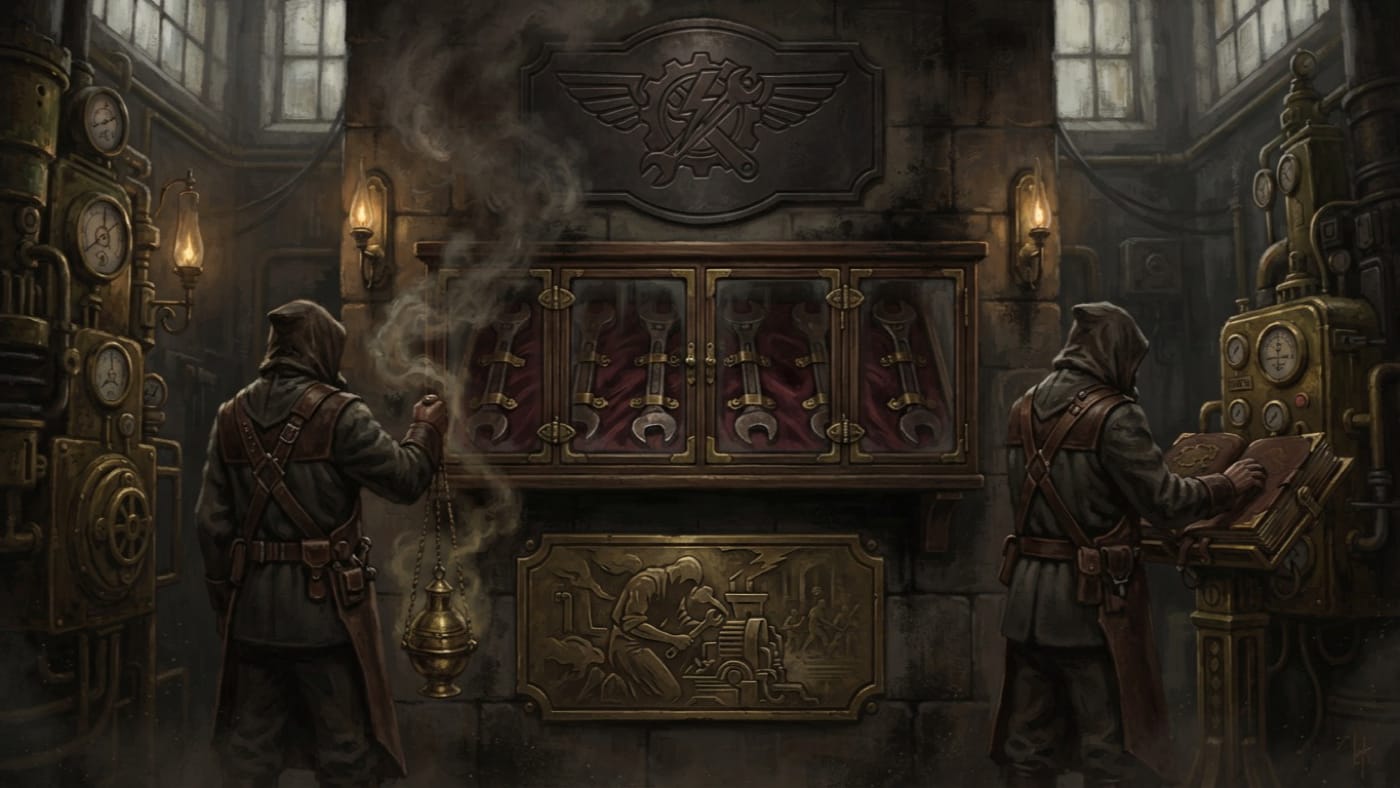
The Burned Wrench is a principal relic of Saint Edrin of the Eight Strokes, patron of the Litany-Engineers and of every apprentice who has learned engine-cant with a split lip. It is also kept in six places at once. Doctrine has a vocabulary for a saint whose bones turn up in several cities. It has none for a tool.
The claimants are kept at Strasbourg, at Bastion-Irongate in the Danube gorge, at Bastion-Brest above the Bug, at Prague, at Lyon, and in a private Engineering chapel beneath Munich. Each house possesses a wrench. Each wrench is dark from heat. Each congregation will tell you, with the serenity of people who have never been audited, that theirs is the one Edrin held on the Kalnik Road.
The Bureau of Relics has ruled, after its fashion. It recognises one claimant as primary, two as secondary, two as devotional, and one as “pastorally useful pending metallurgical review.” The register available to this office gives the grades. It does not tie them to the houses.
The wrench belongs to this Edrin alone. Saint Edrin of the Three Nails keeps his nails, his doorbars and his plague-house, and any pilgrim stall that sells both saints' relics from one tray has earned the fine.
#On the Tool at Kalnik Road
The originating account belongs to A.S. 48 / 1758 CE, early in the Great Retreat, when columns moved west and left the dead uncounted behind them. Edrin was an engine hand attached to one such column. The titles came later. The Bureau of Engineering had not yet acquired its present form, the profession he would be made to patronise had not been constituted, and no certificate in the Church bore his name. He had a wrench because engine hands carry wrenches. That was the whole of its original dignity.
The generator failed near dusk. Depending on it were field lamps, a mobile pump, two ammunition carts, a reliquary chest, and sixty-three wounded who needed light and dry ground more urgently than they needed theology. Edrin opened the housing. He found fouled injectors and a bent timing pin, and he set the pin by thumb because the gauge had cracked. His hands did the mechanical work while his throat sang the Eight Strokes of the ignition litany. Prayer and wrench, together, under rifle sound.
A sealed deposition, given by a retreat engine-hand whose name the damp has eaten, supplies the one moment in which the wrench becomes more than kit. At the seventh stroke, the witness says, the casing answered in Edrin's voice before Edrin had sung. Edrin struck its side with the wrench and said something the deposition records and Engineering's auditors keep sealed: █████████████. The answer stopped. The eighth stroke followed. The engine caught.
That is testimony, filed as testimony, under restricted access. The Bureau of Doctrine reads the blow as a rebuke to whatever had begun speaking inside the metal. Engineers read it as a man hitting a machine, the oldest diagnostic procedure known to the trade. The deposition does not say what the blow did. It says what came after. Theologians have built careers in narrower gaps.
The lamps held. The pump worked. The column crossed the ford. Edrin's hands had been scalded by spat oil and his throat torn raw by the Strokes. He died three days later of burns and fever, having asked whether the engine was still turning. It was.
#On What the Metal Can Prove
Authentication runs in a fixed order: intake and quarantine, reconstruction of custody, physical examination, a test of fit against authorised doctrine, response testing under lamp and bell, a drafted verdict, notarisation. The notaries' saying quoted above belongs to the second step, and they repeat it because they know how often the spine is missing.
Consider what a true custody chain for the Burned Wrench would need. It would name the hand that took the tool from a dying engine hand. It would follow that tool through seventeen years of retreat, when men abandoned boots, children and the occasional bishop at the roadside. It would cross the decades before the formal Synod's constitutional settlement in A.S. 90 / 1800 CE, when nobody thought a mechanic's wrench worth a ledger line. No such chain appears in any register I am permitted to cite. Six houses each hold a story. Stories are cheap. Wax costs money.
Physical examination fares no better. Every wrench that has served in an engine shed is darkened by heat. Every one carries oil in its jaws and nicks along its shank. Burned hands do not sign what they hold, and no examiner can read Edrin's fever in the grain of a handle. A metallurgical review can ask whether the metal belongs to the right decade and the right workshops. It cannot ask whose palm blistered on it. The sixth claimant awaits such a review. I have no result to report, and I will not invent one for the comfort of pilgrims.
The generator has the record the wrench lacks. Registry later labelled it KAL-ROAD AUXILIARY 6. It served for eleven years after the restart and was decommissioned in A.S. 59 / 1769 CE after its belt housing cracked. That is the engine's service book. The wrench has none, and the shrines borrow those eleven years for their reliquaries anyway, as though one night's use earned a share of a decade's labour. The Timing Wheel of Kalnik has its own grading from Relics, probable, and its own Engineering description, “operationally resonant.” Those words belong to the wheel. Wrench-keepers who quote them have been reading over another reliquary's shoulder.
#On the Six Recognitions
An A.S. 134 shrine catalogue lists the Burned Wrench of Saint Edrin as singular and housed at Strasbourg.
Corrected. Strasbourg holds one claimant among six. The catalogue's singular confers no primacy and authenticates nothing; it records only what a shrine wished to see written down. The grades stand as stated in the summary above and remain unassigned in this entry.
The pilgrim trade still prints the old singular. Cards are cheaper to reuse than to correct, and a capital does not hurry to tell visitors that its relic has five rivals.
Recognition and provenance are different instruments, and the Bureau plays them in different rooms. Recognition grades what an object does for the faithful: whether apprentices kneel straighter before it, whether a chapel keeps better discipline, whether Doctrine's account of obedience is served by its presence. Provenance asks a ruder question. Was it there? The Bureau of Relics has answered the first question six times. It has not answered the second publicly once. This is economy, not incompetence. A primary grade can be revised quietly. A proven forgery has to be carried out of a chapel in front of the men who prayed to it.
The geography adds its own sermons. Irongate lives by calibrated voice and pressure, and a saint of sung procedure suits a gorge that measures breath. Brest keeps its wrench in the bastion where Black Start burned half the port and gave Edrin's cult its second life, so its relic of obedience needs no preacher. The Munich claimant sits in a chapel private to Engineering, which makes it the least examined of the six and the most confidently held. Prague and Lyon keep theirs with the composure of houses that know a grade is safer than an argument.
None of this tells you which wrench Edrin held. It tells you what the Church can use while the question stays open.
#On Its Use Among Engineers
Before the Black Start Catastrophe of A.S. 97 / 1807 CE, Edrin was a shed legend and his wrench a story told by men with oil on their cuffs. Then an uncertified operator at Brest restarted a harbour generator without the ignition litany, and forty-three men died. Standing Order 14-E made cant certification mandatory and gave the Litany-Engineers their formal constitution. Doctrine needed obedience to look ancient. The Bureau of War needed frightened mechanics to accept discipline. Engineering needed a repeatable procedure with a face on it. Edrin's relics multiplied with the need. The register does not date each claimant's first appearance, and neither will I.
The cult is authorised for Engineering and War chapel use, and public procession requires a licence. That restriction governs the saint, not any particular wrench. No register I can cite records a claimant carried in procession, touched in a rite of its own, or credited with a miracle of its own.
Workshop devotion goes on without it. Apprentices touch two fingers to the casing before first ignition. Throat wraps hang beside the gauge board on Edrin's feast. Burned men chalk the eight strokes down their forearms. The feast itself is kept with eight hammer taps on cold casing. None of these requires a relic at all. They need a casing and a man willing to stand beside it.
The miniature wrench medals sold at chapel doors are brass merchandise stamped by the gross. They are not a seventh claimant, though one seller at Irongate has been warned for implying it.