
#On the Memorandum
Bureau of Shadows Memorandum 441-V is classified OBSIDIAN. I may not discuss it, the reader may not have read it, and this entry about it therefore sits on a shelf the Bureau of Records has not yet been told to build. I have been asked to survey it in A.S. 201. A survey is permitted. A surveyor looks at the outside of a thing, counts its seals, notes which pages are heavy with stamps and which are light with ink, and leaves the binding alone.
I have read what my clearance permits. It permits more than my colleagues suspect and less than I would like. The difference is recorded somewhere, under a classification I am not cleared to know exists.
The memorandum governs the three expeditions sent into the deep Balkans to find the Shadow Court. No portion I have seen gives its date of issue or the hand that signed it. A lesser archivist would borrow a date from the expedition years. I decline. A file is not born on the day of the thing it describes. Addendum 3 is undated as well. The Bureau of Shadows prefers its documents to have always existed.
#On the Earlier Expeditions
The first came back whole. The second came back as one man and a seal.
Both earlier expeditions marched before the Concordat of A.S. 90 gave the Synod its constitution, and so before the Bureaus under whose names the file now arranges them. The memorandum speaks of Doctrine's theologians and Records' clerks in A.S. 72 as if those offices already held charters. They did not. The work existed, and the later names were stamped onto it backward by a stamp that has never been asked its age. I use the file's names and note the anachronism once.
The First Expedition left in A.S. 72 under Colonel-Inquisitor Aras Venn. It took forty-two soldiers, six theologians, two cartographers, and a hymn-priest whose only duty was to keep singing. It crossed the Sagittal Line south of what is now Bastion-Irongate, entered the Iron Gates gorge, and went east. It returned on the fourteenth day with every man accounted for. Each identity was confirmed by wax-seal comparison, hymn-memory examination and bone-density measurement. The cartographers brought back maps that agreed with each other in every particular and with no known geography in any.
The debrief runs to fourteen pages. The fourteenth is sealed. What befell three of the theologians in the six months after their return is classified, and in this entry I have called it nothing else.
The Second Expedition left in A.S. 80 under Warden-Captain Elise Morr. It took one hundred and twenty soldiers, Bureau personnel, and a choir of sixteen voices singing in rotating shifts. It was gone forty-one days. On the forty-second, a single soldier appeared at the forward post south of Bastion-Irongate. He wore the Second Expedition's uniform and carried Warden-Captain Morr's commission seal. He could not speak, because his tongue had been replaced by a small, perfectly formed key of black iron.
The file holds that the remaining one hundred and nineteen have not returned. I am not authorised to reproduce their designation. A colleague who read it before his clearance was revoked rendered it, loosely, as "consumed by the assignment." The translation is his, and he may keep it.
#On Addendum Three
The key came out of the soldier's mouth and went into the file. Everything after that is Addendum 3. I reproduce it exactly as it is permitted to circulate, black bars included.
Bureau of Shadows Memorandum 441-V, Addendum 3: The key removed from Corporal ████████ was tested by the Bureau of Relics and found to be ████████████. When placed against ████████████, it ████████████ for approximately ████ seconds before ████████████. The key is currently held in Vault ████ at ████████████ under Seal Obsidian. Its lock has not been identified. Three Bureau of ████████████ have requested permission to search for it. All three requests were denied. Two of the three requestors have since ████████████.
The bars are not a cipher. I say so because every junior clerk who sees the addendum measures them with a rule and tries to fit names into the gaps. A bar is as long as the censor's hand happened to make it, and the junior clerk's theory goes to his confessor.
What the addendum allows is small and exact. A key was removed. The Bureau of Relics tested it. It was placed against something, and for a counted number of seconds something happened, and then something else did. It now lies in a vault under Seal Obsidian. Its lock has not been identified. Three requests to look for the lock were refused. Of the three people who asked, two have since, and there the bar falls.
What the addendum withholds is everything a sensible man would want to know. I want to know it, and I have not asked. Three requests refused and two requestors reduced to a black bar: the Bureau of Shadows has never written me a plainer instruction.
#On the Assignment That Continues
Personnel status: on assignment. Return date: not specified.
The Third Expedition departed in A.S. 87. It was larger than the first two combined. No portion of the memorandum I have seen gives a figure, and I will not supply one. "Larger than the first two combined" is all the Bureau has authorised, and the reader may draw what fright he likes from it.
Its commander's name is classified. So are its route and its objective. Every name on its roster is classified, from the commander down to whatever wretch carried the hymnals. I infer that the roster exists because someone is paying the people on it.
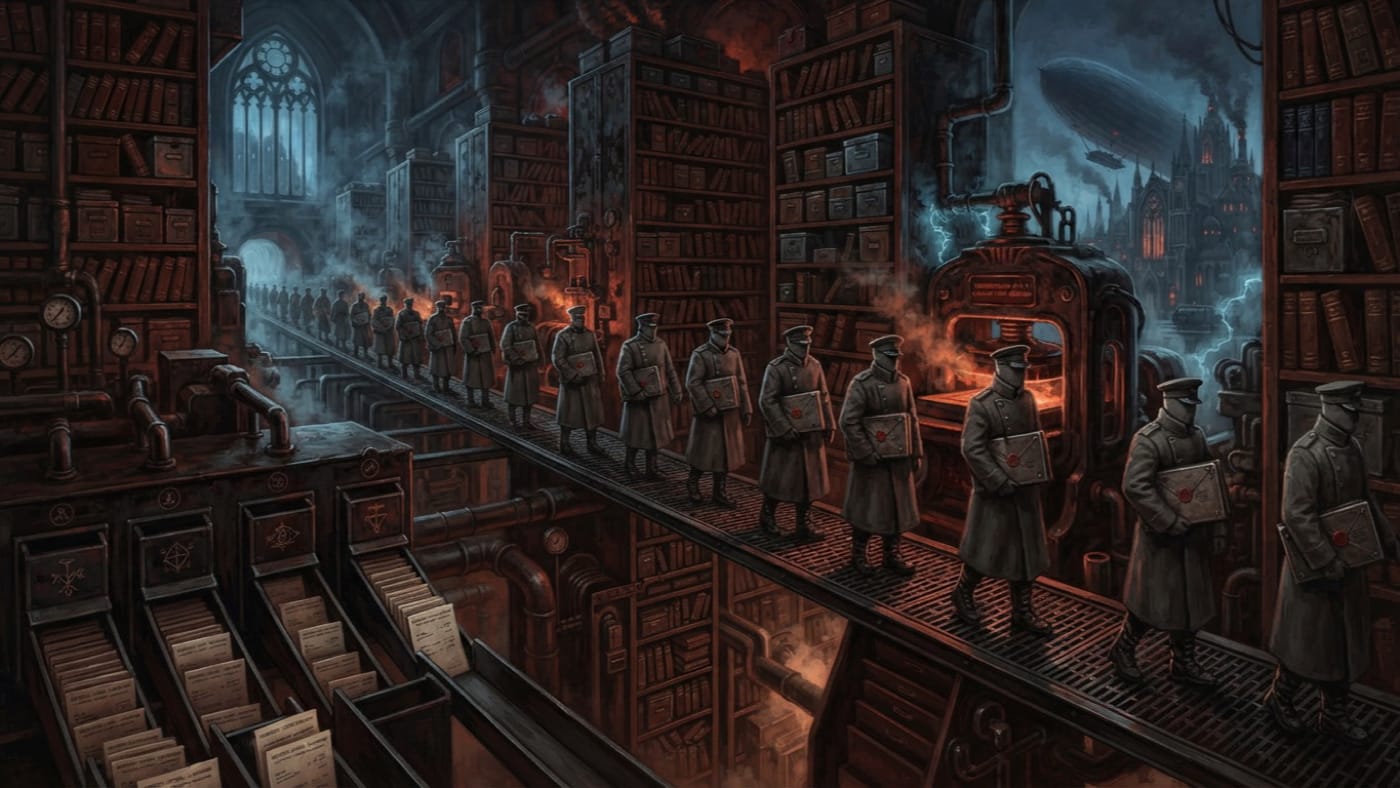
Someone is. This part of 441-V is less a memorandum than a ledger still in motion. The Bureau of Records lists the personnel of the Third Expedition as "on assignment." Every quarter their pay slips are processed. Every quarter their families receive stipends. The Bureau of War, which did not exist under that name when they marched, allocates their rations. The rations go to a warehouse in Strasbourg, hundreds of leagues west of any road the expedition could have taken.
No one enters the warehouse. No one has been observed leaving it.
The Bureau makes no claim that "on assignment" means alive, and it makes no claim that it means dead. It is an administrative designation. It certifies that the Third Expedition has not been struck from the Ledger, and that is all it certifies. The pay slips are drawn in that space. The stipends are paid in it. The rations are carted in it, unloaded at a door, and entered as delivered.
To whom the stipends go, by what line of descent, and in what amount, no portion I have read records. The Bureau of Records would count my guessing as a form of theft, and for once I agree with it.
These men marched for a Church that had not yet sealed its Concordat. Three years after they left, the formal Synod was constituted at Strasbourg. It is now that Synod's treasury that pays them and that Synod's capital that receives their bread. They marched toward the Great Deceiver's court and are provisioned in the house of the Creator's administration. I find that arrangement more alarming than anything under the black bars, because I can read every word of it.
One hundred and fourteen years have passed. I call them overdue. That is my word, and the file does not share it. An assignment with no specified return date cannot run late, and every clerk in Records will explain this to you with the patience of a man explaining water.
An illustrated plate attached to the Shadow Court entry was captioned: "Expedition Three at the perimeter, A.S. 189. Six returned."
The caption is withdrawn. Memorandum 441-V records the Third Expedition's departure in A.S. 87 and records no return, of six or of anyone. No expedition in this series departed in A.S. 189. The plate's caption-writer has been invited to explain his source and has not yet been located.
#On the Present Review
The three expeditions are held under a joint assessment by the Bureau of Shadows and the Bureau of Records. Status: under review. Review frequency: decennial.
Payroll runs every quarter and review every ten years. I have looked for a document linking the two schedules and found none. I record the absence and leave it empty, which is the most disciplined thing I have done this year.
Eleven reviews have fallen due since the Third Expedition marched, if one counts as a lesser archivist would. I do not know how many were held, and the file does not say. The Bureau of Doctrine has not asked me for an opinion. When the next review convenes, it will open a folder whose newest pages are pay slips.