
#Bulgarian Orthodox Tradition in Sofia
On three churches that kept their stone and surrendered their voices, and on a city that has never once let the Bureau forget the difference.
#On the Inheritance
The Bureau of Doctrine enters this survey into the Ledger in A.S. 201, and enters it with some impatience, because the subject does not exist in the form its old file label promised. Sofia contains no Bulgarian Orthodox Church as an institution: no hierarchy, no separate jurisdiction, no bishops kneeling beneath ours or pretending otherwise. Anyone who opened this folio hoping for a sister communion with a grievance and a seal may close it now and spare the wax.
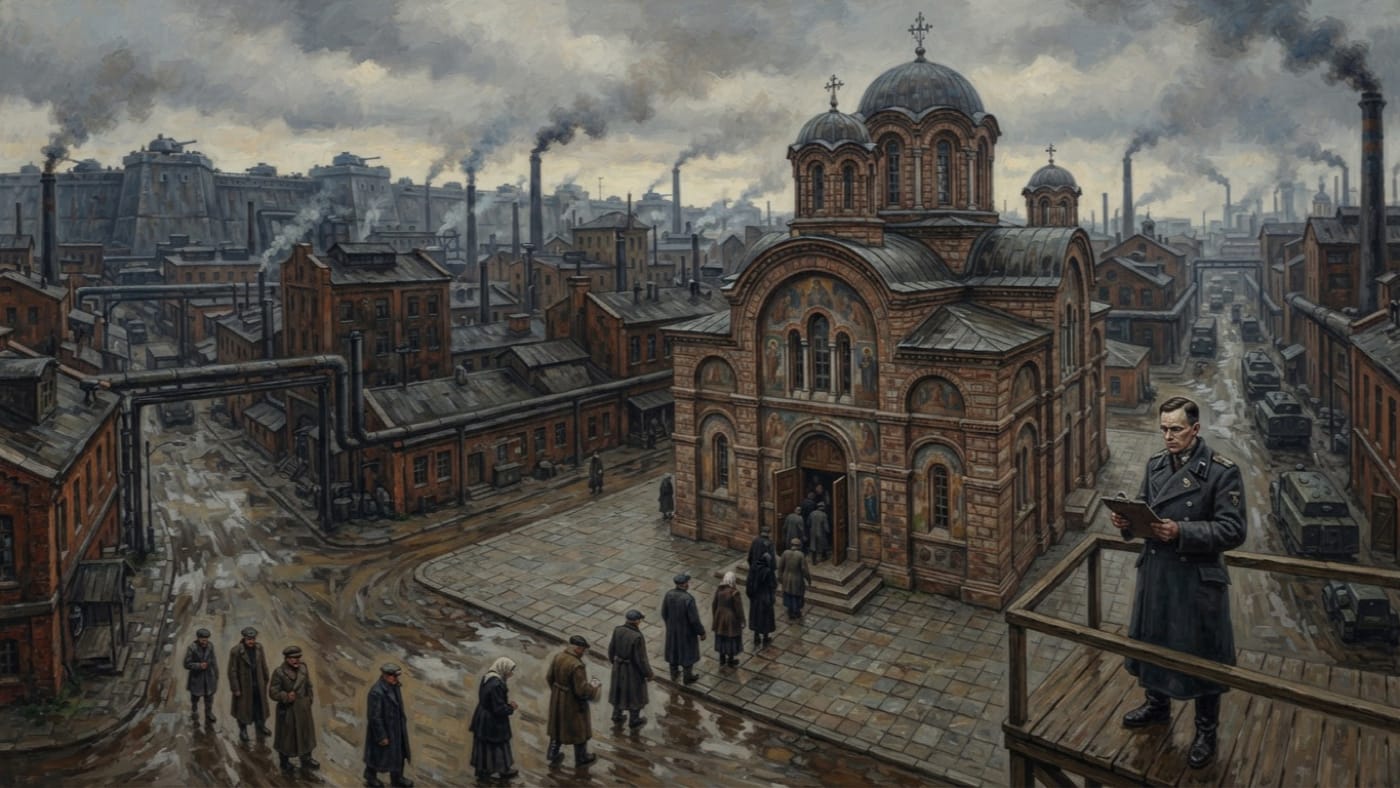
Sofia has three churches still operating. Their architecture is Bulgarian Orthodox. Their liturgy is Synodic. The stone was laid in one tradition and the words spoken beneath it belong to another, and the population of the city attends both because it is required to attend the second. That is the whole of the inheritance as the Ledger can certify it. The Ledger certifies nothing it cannot count, and it can count to three.
#On the Three Churches
The record before me does not give their names, and I decline to invent dedications for buildings that have survived perfectly well without my help. Nor does it supply their ages, their builders, their congregations or their positions inside the three rings of the city's walls. What it supplies is the fact of them, and the fact of their style, and in Sofia that is no small amount.
Consider where they stand. Sofia sits in its valley between Bastion-Irongate and Bastion-Shipka, and everything that feeds those two positions passes through its rail junction and road nexus. The city exists, in the Bureau's accounting, to be passed through. In A.S. 142 a filing error at the Bureau of Records sent the city council its own municipal status document, which contained the phrase "acceptable losses in the event of southern-corridor breach: total." The Bureau's correction called the phrase a typographical artifact. The correction did not say what the phrase should have been.
A city told that its loss would be total grows attached to whatever has not yet been lost. Sofia's oldest fortification ring was raised by desperate men out of whatever stone lay to hand, church rubble among it, so the city has already watched sacred masonry become wall. The three churches are what did not become wall. They stand with their Bulgarian Orthodox lines intact and their pulpits furnished with the Synod's approved texts, and every resident who walks past them sees a building the Bureau has permitted to remain exactly as foreign as it looks.
#On Attendance and Recitation
Attendance at services in Sofia is mandatory. Recitation of the catechism is monitored. The Bureau has never required more of the city than this, and has never received less.
Compulsion leaves a record of bodies. It registers who entered, who stood, who recited and whether the recitation was correct. It has no column for what the reciter meant. Doctrine is untroubled by this omission. The Creator reads hearts; the Bureau reads registers; the division of labour is ancient and I see no reason to disturb it on behalf of a provincial junction town. A sound catechism spoken in a sullen voice is still a sound catechism. The ink does not record the tone.
I will say plainly what the register cannot. No one in Sofia knows how many of those in the pews believe the Synodic liturgy, how many remember another, how many believe nothing and recite anyway, and how many have stopped asking themselves the question because the answer changes nothing about Sunday. The Bureau does not know. The council does not know. I suspect the congregations do not know about each other, and are wise enough not to inquire. Any writer who tells you Sofia is secretly devout, or secretly faithless, or secretly loyal to some lost Bulgarian rite has invented a population to suit his thesis. The Ledger forbids it. I forbid it.
What can be stated is the shape of the act. A Bulgarian family enters a building its own tradition raised, hears words its own tradition did not write, recites them correctly under observation, and leaves. They attend because attendance is mandatory. They recite because recitation is monitored. That sentence was first written about this city in the Codex's own entry, and I have found nothing that improves on it.
#On Subjects and Occupation
The Bulgarian population of Sofia regards itself as occupied. The Synod regards it as subjects. Both positions are on record, and both are held with total conviction, and they describe the same people kneeling in the same three buildings.
The churches make the disagreement visible. A subject worships in his sovereign's church. An occupied man worships in his own church under his occupier's words. Sofia's three buildings accommodate both readings without adjustment, which is why the Bureau finds them tolerable and the city finds them unbearable and neither party has proposed a remedy.
In A.S. 143 the council adopted Adhuc Stamus, "We Still Stand," by unanimous vote. The Bureau of Heraldry approved it without comment. A motto of that kind, adopted one year after a city learned its acceptable losses were total, is a liturgy of its own, though it requires no altar and the Bureau of Purity cannot fault a word of it.
"Sofia's population is largely content under Synodic governance."
The Bureau of Doctrine withdrew this sentence from its description of Sofia after the Council of A.S. 195, at which the Sofia municipal delegation presented a fourteen-page document titled "On the Distinction Between Contentment and the Absence of Alternatives" and asked that it be entered into the official record. It was entered. It was classified. The delegation filed an objection to the classification. The objection was denied.
#On the Exact Letter
What follows is Colonel-Prefect Anya Dzhurova's account, given to me during my residence in the city and entered here as hers. I have no independent record of the incident, its year, or the church concerned, and I will not supply them on her behalf.
The Bureau of Purity ordered the demolition of an old church to improve the sightlines of the eastern wall battery. The city council approved the demolition. It scheduled the demolition. It hired the demolition crew. Then, through a sequence of administrative delays that no individual office could be blamed for, it postponed the demolition seventeen times over four years, until the Bureau of Engineering redesigned the battery placement and the demolition was no longer required.
Seventeen postponements. Four years. Not one act of disobedience anywhere in the file.
The account names no priest, no congregation, no clandestine petition and no sermon. Agency lay with the council and its clerks, and with whoever wrote the forms that caused the delays, and with nobody who could be summoned to explain them. Whether that church is one of the three now operating, Colonel-Prefect Dzhurova did not say. I did not ask. She told the story without expression, and I knew better than to ruin it with a supplementary question.
The method was not invented for the occasion. The council has filed an objection to every levy increase since A.S. 118: properly formatted, correctly stamped, submitted through appropriate channels and denied within the regulatory timeframe. It files again. The Bureau denies again. The cabinet in the council chamber that holds the denied objections stands seven feet tall and requires a stepladder, and the council regards it as a monument. Residents follow every regulation to the exact letter, interpret every ambiguity in the direction least convenient to the Bureau, and submit every form in triplicate, each copy slightly different in ways that require clarification. Clarification requires time. Sofia has had a great deal of practice with time.
The Bureau has no instrument for punishing a citizen who obeys too carefully. It has spent two centuries building instruments for the other kind.
#On the Present Condition
In A.S. 201 the three churches stand and operate. The liturgy is Synodic. Attendance is mandatory and recorded. The catechism is recited and heard. The architecture remains Bulgarian Orthodox, because nobody has found the budget, the labour or the will to make it anything else, and because a city ranked expendable is not a city on which the Bureau spends renovation money.
The congregations come in, recite correctly and go home. The council files. The cabinet grows. The Bureau's records show full observance in a population that calls itself occupied, and the records are accurate, and they settle nothing.
Doctrine certifies the survey. The Synod's liturgy is sung in Sofia under roofs it did not raise, before people who did not invite it, with a correctness that no inspector has ever been able to fault.