
#On the Divided Password
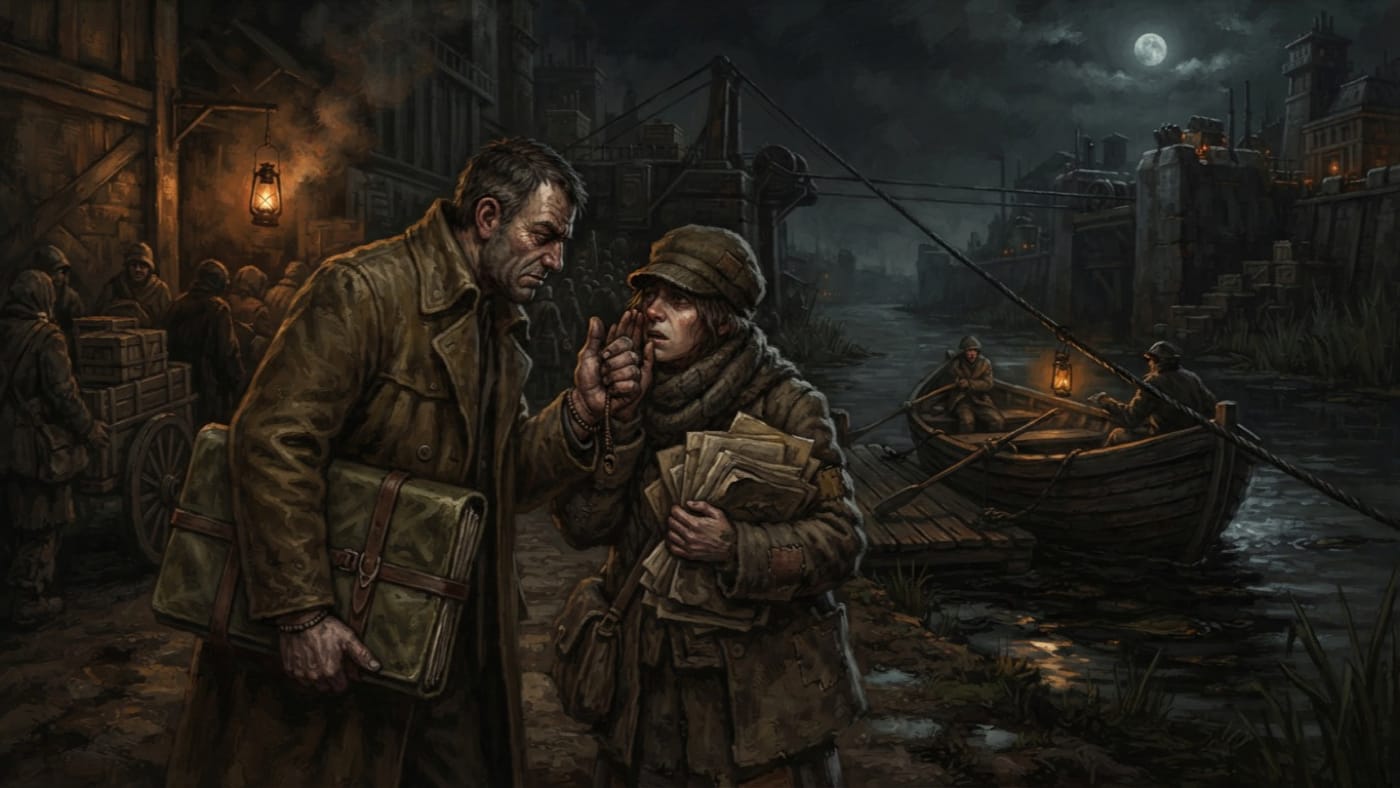
The Broker's Split Prayer takes the name of devotion and none of its duties. It is a passage password divided between two holders. The client is given one part and the broker keeps the other. The trade states the purpose plainly enough to shame a confessor: it limits informing. A client who holds half a phrase can sell only half a phrase.
The trade has no fixed wording for it. There is no bankside missal and no chapter copy, and no archive holds a master text that a clerk could lose, which is the point. The words change with the codes they serve, and what survives each change is the arrangement: two mouths, one crossing, and a fee for joining them.
On its own the phrase gets nobody across. Crossing a river under the Synod's discipline is a clearance transaction, and a clearance is built from many parts: a name that can be defended, a slip that agrees with it, witnesses willing to swear to it, a donation receipt, a paid clerk, a paid guard, a boat slot, and ferrymen who stay sober long enough to row. A traveller who completes the password without the papers has recited something and is still standing on the mud.
#On the River's Missing Records
The trade remembers the practice in connection with Silt Week, the spring flood of A.S. 78 that struck three Rhine tributary crossing nodes and turned their transit ledgers to pulp. The flood was administratively ruinous and otherwise ordinary. Bridge records, passage ledgers and queue warrants were dissolved overnight. By the second day thousands of travellers were unverifiable. They still had faces, carts, debts and fevers, and none of them had paper.
The record-keeping offices of the young Church were then halfway through the transformation that later Synodal habit tidies under the name Records. They demanded that crossings halt until identity could be rebuilt. War wanted grain and powder moving. Purity wanted to inspect anyone whose papers had softened. Between those three appetites the bankside touts found a profession. They knew names by ear. They knew which oarsman had carried which family, which queue neighbour would swear to which cart, and which guard drank. Memory became evidence, and evidence went to whoever could pay.
The solvent crossed first. The rest learned to wait.
The brokers took one lesson from the water that Records took more slowly: a name written down once can drown, and a name carried in living mouths can be priced. The Split Prayer belongs to that inheritance. It keeps knowledge in mouths instead of on paper, and it keeps one of those mouths on the broker's side of the ledger.
"From that lesson came … the Broker's Split Prayer" (Silt Week, On the Pedagogical River).
Amended. The practice is associated with the flood's lesson. No author, original wording or first crossing under it is recorded, and this office declines to invent one for the sake of a tidier genealogy.
#On the Half Retained
How the two halves meet at the plank depends on the crossing, the season and whoever the broker has paid that week. The trade has never written its order down for my convenience, and I will not write it down for the trade's. What can be stated is the dependency. The client's half is worth something only while the broker remains somewhere in the chain to supply, deliver or arrange the rest. If the broker is absent, arrested, drowned or bought, the client is left holding a fragment that matches nothing.
The fragment also goes stale. Under the Password Reforms the codes rotate at sundown, so a half learned at noon may be worthless by vespers. Guards are known to change the phrase early in order to take a second round of bribes, and the broker usually learns of the change when a client is dragged off the plank. Rival brokers deliberately feed out false halves. Pronunciation can kill as surely as forgery: the trade still tells of a mispronounced saint-name at Nominalist's Gate that brought a mass denial, after which brokers began carrying phonetic prayer cards in their folios. The Gate trusts documents above voices, and it still listens. A traveller can carry perfect papers and be refused for one wrong vowel.
The broker carries the whole phrase, or the means of completing it, on a password ring. This is a string of threaded beads, one per phrase, gate or risk, and it is worked with the thumb in the dark. It has no supernatural virtue. It is a rosary for the forgetful and the hunted, and it is more honestly used than most rosaries.
#On Confession and the Ferry Call
An interrogator who takes hold of a client finds that the Split Prayer protects one thing and leaves everything else open. The client cannot recite the whole phrase. The client can still describe the broker's face, the tavern bench where the deal was made, the reedbed where the half was whispered, the clerk who stamped the slip and the boat that was promised. An inquisitor has no need of the password when the person who knows it can be fetched. Once the broker is found, the sundown rotation burns the rest. It limits what can be confessed and gives no immunity, and the trade has never claimed otherwise. Brokers have watched too many runners hanged to believe in immunity.
The profession keeps a second instrument that clients confuse with the first. The Drown Clause is the broker's retention of a client's true name as leverage. It is a different mechanism with a different victim. The Split Prayer withholds part of a password so that the client knows too little to betray the network. The Drown Clause holds a whole name so that the client remains answerable to the broker for years after the boat has landed. The first controls the client's tongue on the bank, and the second controls the client's life. Brokers who use both keep them in separate parts of the folio.
There remains the matter of the call. The Bellwater Breach is part of the profession's remembered history: water-demons learned to imitate the ferrymen's calls, the Church answered with sanctified call-and-response, and brokers now forge that as well. The incident taught every bank one thing worth fearing. A call can sound exactly right and still come from something with a cold mouth. Whether a divided password guards against such imitation, no record I have seen establishes. Brokers say the river keeps true names spoken on its banks and that demons follow them. That is professional superstition, attributed here as superstition. I record it because the people who believe it have kept more clients alive than the people who mock it.
#On Its Present Employment
As of A.S. 201 the practice runs wherever the water narrows. Each side of the trade uses it on its own ground. The Clean Slips work in daylight among tolerated paperwork, small corrections and softened clerks, and there the divided password is one more courtesy in a clearance that mostly holds. The Black Oars work curfew water, unnamed hulls and reed channels, and there the withheld half may be the only thing between a client's confession and a whole night route. Neither faction owns the method, and neither has issued a standard form of it. Each crossing keeps whatever shape it has paid for.
Along the Rope-Ferry Chain and its smaller tributary crossings the setting is familiar: lantern codes on the bluffs, timed queue lanes, tarred cable groaning on the winch, and white lanterns lit for inspection, at which every forged seal in a folio becomes evidence. The broker's folio is oilskin and holds slips, names and phonetic prayers. A broker can be recognised by wax on the thumb, ink stains, and a reed-knot bracelet at the wrist. Every client hears one rule before any other: do not sing, not even to pray. Half a password may be whispered. A hymn on the bank draws guards, rivals and whatever else is listening in the water.
The folios also contain the legend of Mother Vellum-of-the-Reed, the scribe who sold names to the nameless and vanished halfway across a river. Her legend says nothing about the Split Prayer, and I have not given her credit for it. Inventing patron saints is the business of a different office.