
#On Licensed Protection
"Protection is obedience." — Propaganda line of the Road Chapter of Peregrine, as recited across the broker desks
The Broker Compact of Peregrine Row is a guild of licensed insurers. Pilgrims call it the Choir-Broker Compact, and the filings of the Bureau of Pilgrimage give its governing body as the Licensed Broker Compact Council of Peregrine Row. It holds the only lawful trade in safety on the eastern canyon of the Pilgrim Roads, and the thing it sells is a window. Each contract buys one bell-interval during which an escorted pilgrim may cross the eastern defile with a broker's signature behind them and a bonded company in front. Outside the window, the canyon belongs to whoever happens to be standing in it.
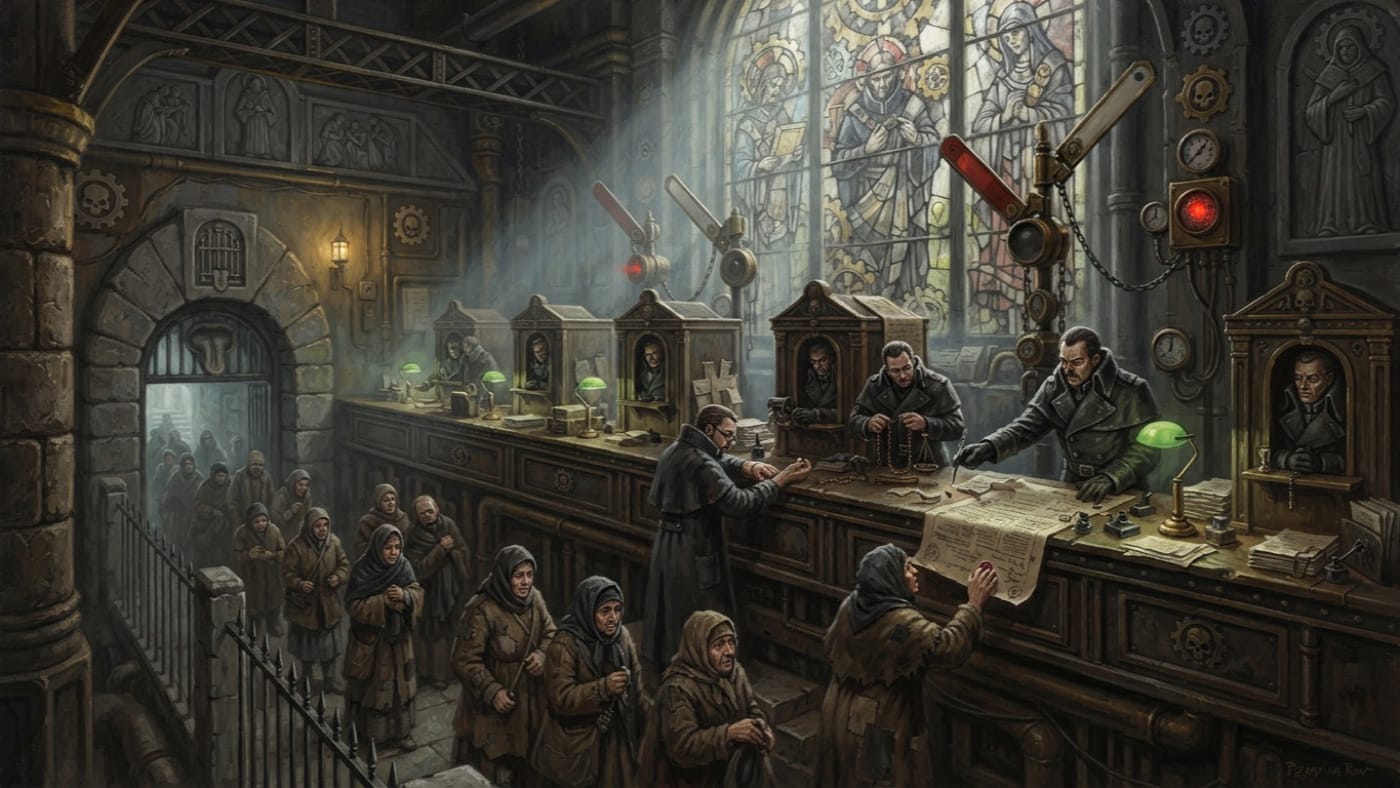
The trade is done at seven desks on the raised dais at the centre of the Choir-Broker Hall. Each desk has its scales, its wax and its inkwell. The arcade below is narrow enough that the queue can only move one way. Nothing can be bought at the dais until the pilgrim has cleared the Gate of Clean Tongues, because a voucher issued to an unsound tongue would insure a heretic. The Compact does not insure heretics. It insures scores.
#On the Charter and the Seven Seats
Before there was a Synod, there was a shrine, a cistern and three families who charged the mule-trains for water. No record gives a year for that arrangement, and this office will not invent one on the families' behalf. They charged a toll at the well, a toll at the narrows, and a fee to be told which narrows were safe. The canyon made the monopoly for them. The water was scarce and the passage tight, and the families only had to stand in the right places.
In A.S. 94 / 1804 CE, four years after the Concordat of Strasbourg gave the Synod its constitution, the Road Chapter of Peregrine received its charter. The Peregrin, Voss and Haelke families were absorbed into licensed administration under a Cantor-Auditor sent from Strasbourg. Absorption here meant that the families were given titles, lost their independence, and were allowed to keep their revenues under audit. Until then they had been robbers who owned a well. Afterwards they were brokers holding a licence. The Bureau records this as reform.
The Council has seven seats. Three are hereditary and belong to the three families. The other four rotate among licensed brokers. This office has no record of how the rotation turns, and the brokers who turn it have not offered one. Seven seats do not mean seven brokers. The licensed trade is much larger than its dais, and most of its members will never sit at a desk under the lamps.
The charter divides authority in a way that was meant to look like restraint. The Road Chapter holds the gates, the creed tests, the permits and the warrant to detain. The Compact holds the prices, the bonds and the purse. The Chapter decides who is pure, and the Compact decides what purity costs.
#On the Voucher
The premium is calculated from four inputs: the season, the threat posted from the ridge lanterns, the pilgrim's declared sin-count, and the Canyon Premium, which no one has defined in writing. Rates are never posted. At midday the brokers auction the bell-windows, and a window sold to the highest bid may already have been sold to the second-highest. Escorts are rented twice, and so are the windows. Gratuities to a broker improve one's place in the queue, and the Compact files them as fees.
The ordinary transaction goes like this. The pilgrim comes up to the dais with a wax-stamped forearm and a carbon receipt of their creed score. The broker weighs the bead string, notes the declared count, checks the lantern posting, names a sum and takes it in coin or water chits. In return, the pilgrim receives four pages of dense notarial script. They usually cannot read it, and they must sign it.
Three provisions decide what the money has bought.
The grief clause sets the price of the pilgrim's death in advance. Compensation is paid to the broker, who deducts administrative fees and passes a portion to the bereaved. The family receives whatever is left once the Compact has been paid for the trouble of the death.
The syllable guarantee makes the insured passage depend on the pilgrim's gate score meeting the threshold. If the score is found deficient, whether at the gate, on review, or by a proctor whose standards have tightened since breakfast, the contract is void. The premium is not refunded.
The canyon waiver excludes all liability for acoustic distortion "indistinguishable from heretical mispronunciation." The canyon returns a prayer with one vowel wrong. The proctor hears heresy. The guarantee voids the contract because of the failed score, and the waiver refuses liability for the echo that caused the failure. A pilgrim can pay in full and receive neither passage nor compensation. The voucher is lawful in every line.
#On Accounts and Service
The escort captains work out of the Yards. The Road Chapter licenses them and the Compact bonds them. The licence makes a captain lawful, and the bond makes the captain answerable to the Compact.
A pilgrim's window is only good while their account is in order, and the Bead Courts keep the account. The Reconciliers' Union staffs twelve tables, where bone, wood and glass beads stand for minor, moderate and grievous sins. The clerks set the string against the pilgrim's confession receipts, passage stamps and whatever tithe credits the Bureau of Records has allowed. They work it out in chalk, and then they wipe the slate. Only the verdict survives, "reconciled" or "unreconciled." The Road Chapter's account dates compulsory reconciliation to A.S. 104 / 1814 CE, and the daily audit was formalized by A.S. 110 / 1820 CE.
An unreconciled pilgrim misses their bell-window, and a missed window has to be bought again. An unpaid premium becomes a lien, and a lien becomes labour.
Labour starts in the Quiet Pens. Their wardens act under the Road Chapter's authority and are paid from the Compact's budget. Every detainee is charged a processing fee on entry. Release comes by full payment or by a service assignment to the Bead Courts, to the Escort Yards, or to the supply systems of bastions far down the Sagittal Line, which are not particular about how willingly their labour arrives. Each quarter the Chapter sets targets for detentions, for labour and for revenue. A proctor who is short of the quarter's figure can raise the recitation standard, and the canyon will supply the evidence.
#On Demonstrated Risk
In A.S. 101 / 1811 CE, a convoy of six hundred pilgrims was ambushed in the eastern canyon, and two hundred and fourteen of them died. The Bureau of Doctrine blamed impure recitation among the pilgrims. The survivors were fined for doctrinal negligence. The attackers were never identified, and this office will not identify them now. Mandatory escort contracts followed, and so did the Compact's prosperity.
In A.S. 199 / 1909 CE, a ledger from the Compact's internal audit reached hands it was never meant to reach. It recorded payments for "demonstration ambushes" in the eastern canyon, which were attacks funded by brokers. A well-timed attack makes the insurance look necessary. The Road Chapter investigated and found "no evidence of systematic coordination between licensed brokers and unlicensed hostile elements." The clerk who leaked the ledger was fined for administrative indiscretion and sent to the Quiet Pens, where the clerk's status is still filed as "processing." The Row's status was revised to Amber. These matters have three different standings. The ledger is leaked evidence, the denial is a formal finding, and the clerk is still in the Pens.
Captain Odrik, called Ridge-Hook, commands the largest escort company and controls important parts of the ridge-signal network. He has survived two formal investigations into his relationship with the Canyon Saints, the ambush bands of the eastern approach. Neither investigation produced a finding against him. Both times his defence was that he cannot control what happens outside his contracted window. The suspicion around him has never been withdrawn. It has never been proved either.
Broker-Matron Lysa Vane sets prices and drafts contracts. She also keeps a casualty ledger that records every pilgrim lost under a contracted escort, every grief payment made, and every refund denied. Her ledger protects her from the Compact. The Compact's ledgers protect it from the Chapter. Every party in this chain of mutual blackmail keeps excellent books.
Earlier reports from this office described the Choir-Broker Compact as "a model of Synod-private cooperation."
REVISED following the Bureau of Doctrine's review of the A.S. 199 audit documents: "A model of Synod-private cooperation, operating within parameters that are currently under review." Holders of active passage contracts should take note of the difference.
#On the Present Application
The Compact is still operating at the current survey in A.S. 201 / 1911 CE, under the Row's continuing Amber review. The Compact wants higher premiums and the Chapter wants more detentions. The escort captains have let it be known that they want immunity from creed trials and would consider a strike to get it. None of these demands has been settled, and none has been withdrawn.
The Echo Creed still affects the paperwork. The Bureau of Alchemical Standards has classified it as a Category Two disturbance and has kept it under review since A.S. 143 / 1853 CE, after the Year of Ash Rain made it worse. Contracts left overnight in the Hall have been found in the morning with their lettering changed. A grief clause that read "compensable at standard rate" in the evening read "compensable at stated rate" the next day, and the stated rate was lower. The scribes blame the ink, the brokers blame the scribes, and the Bureau blames the atmosphere. No one has established the physical cause, or whether anything intends it. The Compact has not waited for an answer. It sells higher premiums against drift, extended waivers against echo, and correction services that reseal a changed voucher for a fee.
Pilgrims who can afford a longer road increasingly take one, and the merchants of the Queue Road have noticed the extra custom. The seven desks are still open and the rates are still unposted.