
#On the Closures and the Record
This survey was compiled in A.S. 201 and covers what the Ledger can show about the Brine Fever closures and what it cannot. In the docks the phrase is used as if it named a single event. It describes a recurring practice. Ships were made to wait, cargo was held, and people were detained at the waterline and released by paper, or left unreleased. Those facts are attested. No source I have found records one shutting of the whole coast, with an opening day, a closing day and a count of the dead. I have searched places that needed a lamp, a ladder and a clerk's grudging goodwill.
There are three bodies of evidence, and I keep them in separate folders. The first is the Brine Fever Winter of A.S. 112 at Saffron Bastion, a historical catastrophe with a known year and a recorded proportion of dead. The second is the quarantine practice of Saffron's Quarantine Prefecture. That practice accumulated over the following decades and is still at work this morning. The third is a sentence from Pilot-King Nenos, sworn on a relic, about a boom and an eye. The three folders are not bound together. A historian who staples them into one will get his staples back.
#On the Winter at Saffron
The winter of A.S. 112, which is 1822 by the old reckoning, is the only fixed date in this survey. That season brine-fever killed one in five people at Saffron Bastion. The record keeps the figure as a proportion. Nobody wrote down the absolute total, or the day the dying began or the day it stopped. The recognised signs were brine-breath and then salt in the lungs. Locally, people blamed the mist and the fish. The agent itself has no name in any Church physician's hand.
Quarantine at Saffron is older than the winter. When the Synod's surveyors reached the headland near Ragusa in A.S. 68, they found a Ragusan custom already in place. Ships waited offshore, suspect cargo waited longer, and sick sailors were shut in clifftop cells. By the winter the formal Synod was twenty-two years old and both founders had been in the ground for longer than that. Neither of them gave any order about the fever.
The Prefecture was constituted after the catastrophe. Its first officers have left no names that have reached my desk. I have no record of what was closed during the winter itself, or how, or for how long. The Ragusan custom is attested before A.S. 112 and the Prefecture's apparatus comes after it. Between the two lies one terrible season, and its paperwork does not survive.
#On Waiting, Inspection, and Release
A closure has two parts, which careless chroniclers treat as one. The first is the thing across the water. The second is the office on the shore.
Only one physical barrier is named in connection with the Brine Fever closures: the quarantine boom in Nenos's account. A boom stops hulls. That is the only thing the source says about it. I cannot report what it was built of, who crewed it, when it was swung open or where it lay, because the source does not say, and I do not pad a folio with timber I have not seen.
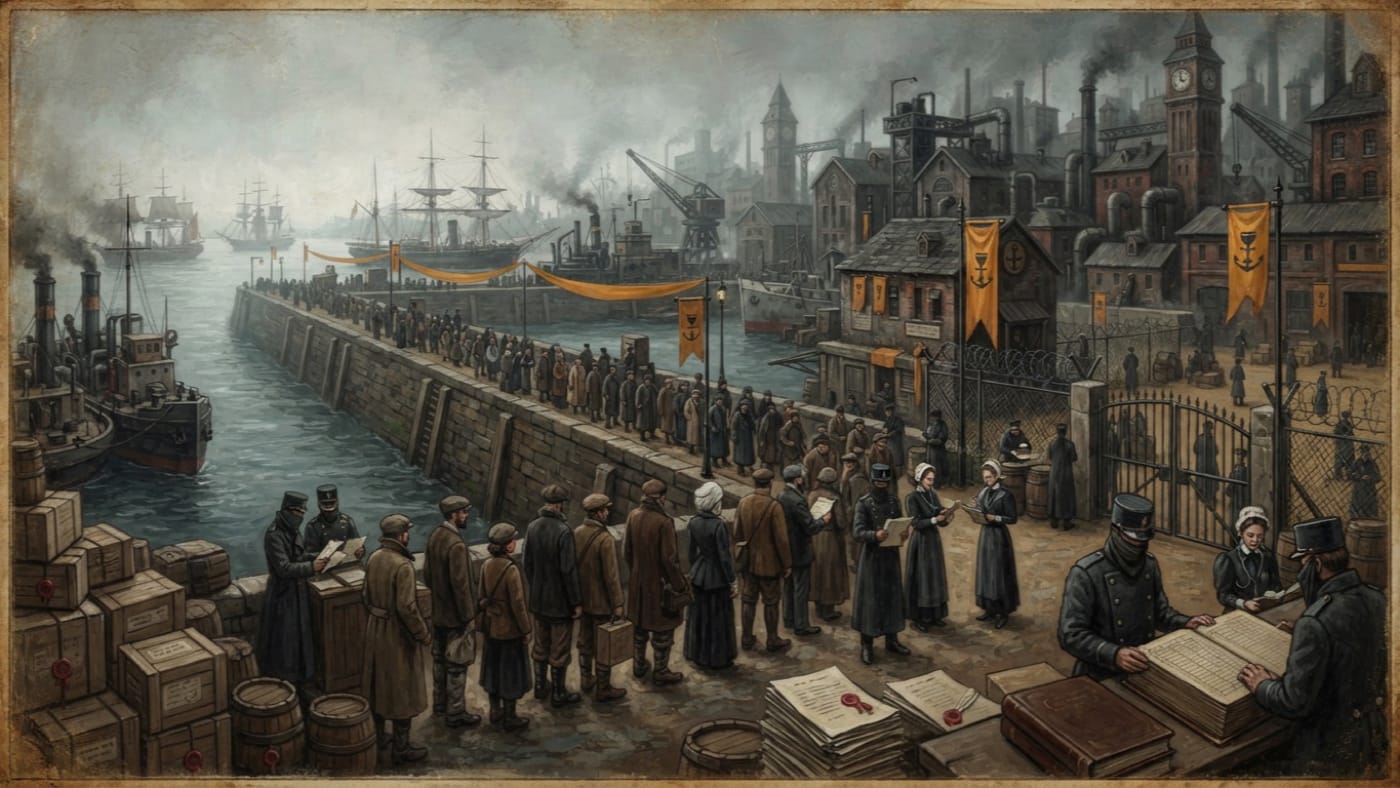
The office on the shore is documented, and I can describe it as Saffron practice in the present day. Vessels and suspect cargo still wait offshore under the old custom. Those cleared to berth have their crates, barrels and bales stamped with wax at the Third Quay Sealhouse, and their manifests are checked before anything moves inland. People are marched in single file under saffron cloth along the Quarantine Causeway (Unregistered), a stone-and-timber pier at the harbour mouth. Clerks give each arrival a salt rub on the tongue and then a confession question. Nurses listen to the lungs. Those who pass are given a dry-pass. Those who fail are saffroned and sent to the holding yards behind the Causeway.
A dry-pass does not release the bearer outright. It allows limited movement through a named district and can be recalled if the bearer's exposure category changes. A ship can be tied up at a Saffron berth while its crew, for legal purposes, has not yet arrived anywhere. Paper governs movement after the voyage is over, and it has more patience than the sea.
Two ordinary practices are often mistaken for fever measures. Every night at Saffron, curfew chains are dropped across the piers. Every day at Thessaloniki, ships pass the harbour chains in set windows. Both are routine harbour discipline and have nothing to do with fever. Fever restrictions are a separate jurisdiction and come with their own flags.
#On the Cost of Being Held
At Saffron, a quarantine hold suspends the held person's legal identity for as long as the hold lasts. A held person cannot trade, petition, testify or sell property. Their belongings pass into the Prefecture's trust custody. Their wages stop unless they are reassigned to sanitary labour, and that labour is real: piers have to be scraped, bedding burned and fever yards washed, and someone already exposed is cheaper to spend than someone clean. While the hold runs, berths stay full and cargo stays sealed. Depending on the season, pilgrims queue on the Causeway at a rate of four hundred to two thousand a day. Burn crews and sanitary militias carry out the parts of the work that are meant to be seen.
The medicine is also real, and I record it with no more reluctance than my rank requires. The Bureau of Mercy's nurses wash and feed the held. The current prefect, Halden Greaves, keeps good fever logs. His nurse rotations have reduced true brine-fever mortality along the Causeway, and his burn crews stop outbreaks that would otherwise travel inland in pilgrims' sleeves. The custody that saves lives also takes wages. The same signature covers both.
I once saw Greaves hold a pilgrim convoy for nine days because of a single cough. The cough was genuine. The nine days were administrative. That hold was one episode, and it does not establish a standard quarantine period. It also cannot be used to measure Nenos's closures, or anyone else's.
The Brine Fever Winter killed three thousand in six weeks.
Withdrawn. This sentence appeared in earlier published entries on Saffron Bastion and the Quarantine Prefecture. The current account of the winter records mortality only as one in five. It gives no absolute total and no opening or closing days. The figure of three thousand has no surviving source, and six weeks is not the length of the winter or of any closure in this survey. Do not work out a total from Saffron's population tables either. A proportion multiplied by a census is still not a count of the dead.
#On Nenos's Three Accounts
Nenos has one eye and three accounts of how he lost the other. In the first, the eye was lost when he collided with a quarantine boom during the Brine Fever closures. In the second, he lost it in a knife fight with a Seal-Mate from Varna. In the third, he gave it to the Drowned Row Syndic in payment of a debt. He swore each account on a different relic. Each oath is equally sincere, which means none of them settles anything.
Taken on its own terms, the boom account is still incomplete. It gives no port, no year and no length of closure. It does not say who worked the boom or why it was swung across the water that day. Nenos pilots at Thessaloniki, but that does not place the boom there. A harbour pilot's scars can come from any harbour he has had reason to dislike. His lost eye is a claim he makes. Nobody has verified it as an injury caused by any closure.
His refusal of passage during the Silence of Thessaloniki belongs to another folder. That was in A.S. 198. The cause he gave was the sea listening too hard, and no fever was involved. The refusal does not date the boom and the boom does not explain the refusal. Nenos would be the last man on the coast to treat them as one story, and he has already told three.
#On the Continuing Practice
The brine-fever has not been eradicated, and the Prefecture has never claimed that it was. Present-day Saffron still marks fever season with flags and sweeps and with the length of the queue at the Causeway. In Low Nets, "Wetmouth" is still an insult men will draw a knife over. Brine-breath still sends a household to the window to see whether the saffron cloth has gone up over their street. On calm nights the Brine Choir still sings under the Causeway for the dead and for those cleared of fever, and the Prefecture records none of it.
These are the limits of the record. No disease agent has been named. No absolute total for the winter has been recorded. No closure order from A.S. 112 has been found. Nenos's episode has no date, no port and no duration, and his injury has not been verified. No general closure of the coast is attested. The Bureau of Records may hold more. If it does, it has not told me, and I have asked in writing, which in Records counts as shouting.
What is attested comes to this: hulls at anchor beyond the breakwater, wax on cargo, salt on tongues, a yard behind a pier, a slip of paper that lets a person through, and a pilot who tells the story of his eye differently depending on who is paying.