
#On the Exemptions
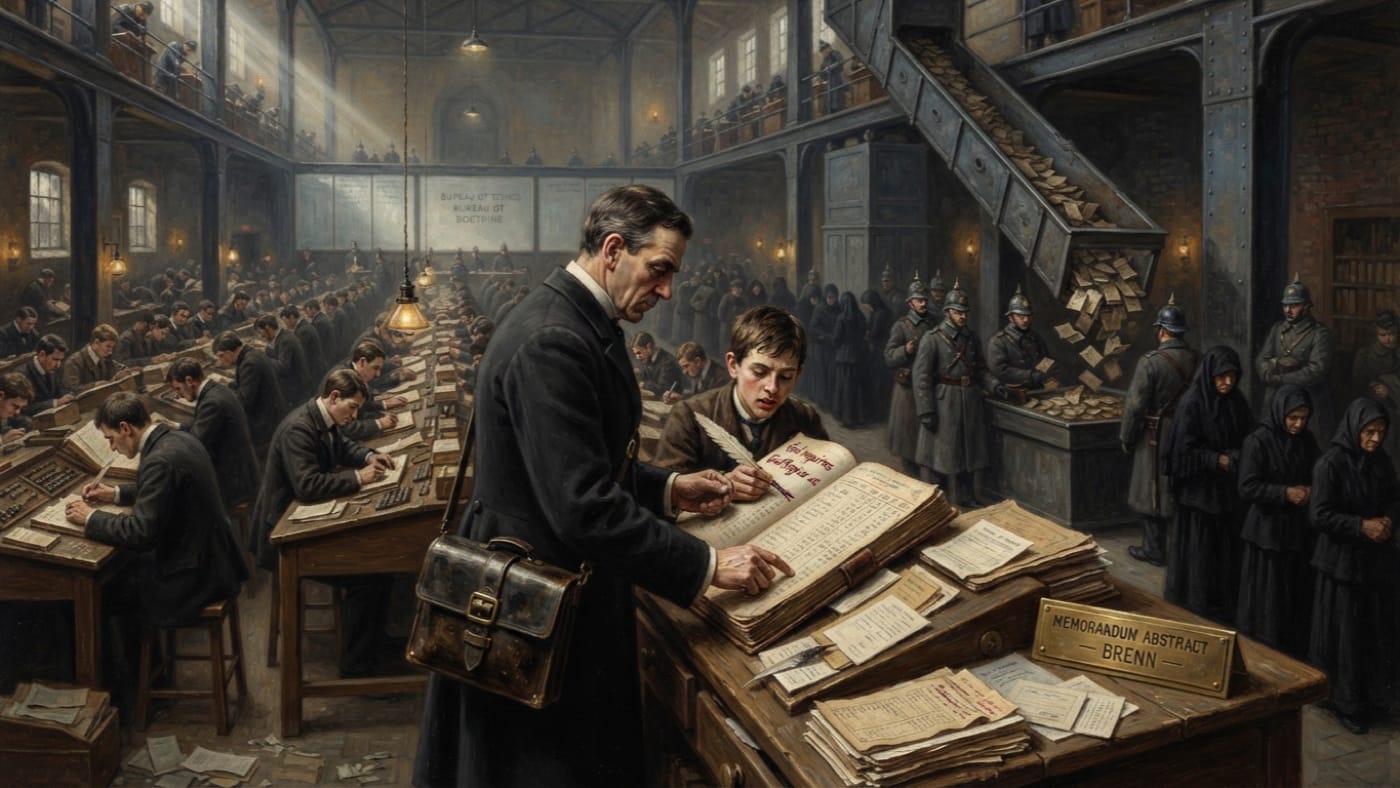
The Brenn Memorandum is a private fiscal paper of A.S. 138 (1848 CE). Assessor-General Kaethus Brenn of the Bureau of Tithes wrote it about two complaints that the Bureau treated as one: pity exemptions were multiplying, and arrears of the Widow's Pennies were growing. It is short, as dangerous papers usually are, and most of it is columns.
The exemptions began narrowly. A confirmed soldier's widow, registered and in good standing, might be excused her household dues while the Line digested her husband. Then war did to the word widow what it does to every category it touches, and stretched it. By Brenn's year the exemption covered women whose husbands were missing, deployed, imprisoned, conscripted, excommunicated or erased. It also covered women whose husbands had simply been gone too long for a parish clerk to keep asking. The published accounts say that on some northern routes a quarter of households paid nothing under pity. I give the figure as the sources give it, for some routes. Tithes has since tried to spread it across the whole corridor. That is the exemption problem again, committed this time by the auditors.
Brenn did not invent the charge he proposed to repair. Bereaved households had been bled before, in the famine extraction of A.S. 65. Afterward the instrument lay in Tithes memory like a retired weight in a drawer. Brenn opened the drawer. That is all a reformer ever does.
#On the Reduced Due
The memorandum's cleverness lies in its modesty. Anyone who survives to Assessor-General knows what full rates produce in a stairwell full of widows. So Brenn did not ask that the formerly exempt be taxed at the full rate at once. He proposed a compulsory bereavement due at a reduced general rate. Every bereaved household would pay something, and few would pay much. Under the old rule an exemption let a household leave the Ledger. Under Brenn's it became a discount inside it.
The argument survives in the passage most often quoted from the copies:
"Where payment cannot be substantial, payment must be instructional. The coin is less important than the act of surrender."
There the paper shows its real appetite. The penny was revenue, and revenue mattered to a Palatine Counting House watching its northern columns thin. The penny was also classification: a household that pays is a household entered, categorised and visited. Last and best, it was obedience on the route, the Assessor's knock answered on schedule. A coin too small to feed a garrison could still teach a household that bereavement had excused it from nothing.
Brenn's provisions varied by household, and here I must be precise. Later schedules have been stitched into his paper by people too lazy to check the folio. The memorandum allows symbolic reductions for confirmed soldiers' widows and holds that heretics' widows should pay more. It treats the administrative widow, whose husband appears in no current file, as an independent household until Records settles what became of him. The exact multipliers that now decorate route cards are not established as his clauses. I will not let them become his by repetition.
The memorandum was also only a recommendation. It bound no Assessor and changed no receipt form. Policy arrived a year later under another number.
#On the Folio
No sealed original is offered in evidence, and I will not conjure one. The memorandum is known through Brenn's private correspondence and through later copies that travelled with the minutes of the Second Fiscal Synod. The Codex entry on the Tithe Assessor explains how: a filing error at the Bureau of Records bound the minutes and the memorandum into the same folio. Records calls the matter "resolved by proximity." I mean to have that phrase embroidered on its next set of vestments.
Proximity did its usual work. Readers assumed that a paper bound beside a synod's minutes had been laid before that synod. The Widow's Pennies thereby acquired a respectable parent in "compassionate reform" under the Second Fiscal Synod. The same Codex entry answers that the assembly discussed salt futures and never discussed widows. Nothing in the binding shows that the Synod debated Brenn's arithmetic, approved it or even read it. A binder's thread joined the two papers, and Doctrine supplied the rest.
#On the Corrected Margin
The line the paper is chiefly remembered for stands beside the calculation of the mandatory reduced-rate dues, in a smaller hand than the columns: "God forgive us for the arithmetic." The Bureau of Doctrine reviewed the paper, struck out "God forgive us" and wrote "God requires" in its place. The margin now reads "God requires the arithmetic."
I have handled many corrections in my office. Few are so economical. Doctrine left the man his conscience and took his sentence. A plea to the Creator became a statement made on the Creator's behalf, and not one figure of the arithmetic below it moved. Readers who take the correction as proof of heavenly endorsement have mistaken a reviewer's ink for revelation. The margin proves what Doctrine wanted. It proves nothing about what the Creator requires.
Then there are the pious, who want Brenn for a secret dissenter. His prayer, they say, was a protest. It was a prayer. He wrote it, left the calculation standing, and the memorandum went forward. Remorse that never touched the figures is a matter between a clerk and his confessor. The figures went to Tithes.
Brenn's crossed-out prayer stands in his private notes on the Cradle Decree of A.S. 157.
That is how the Codex entry on the Tithe Assessor attributes it. The dossier on Kaethus Brenn, which deals with the man and this document directly, places the prayer beside the reduced-rate calculation in the A.S. 138 memorandum, and this entry follows the dossier. The competing attribution is a secondary account and an inconsistent one. It does not date the memorandum to A.S. 157, and it does not supply a second document bearing the prayer.
#On the Cessation and the Riot
The policy came in A.S. 139 (1849 CE) as Directive 91-B, "On the Cessation of Pity Exemptions." It ended the exemptions and made the Widow's Pennies compulsory at the reduced rate. A doctrinal formula went onto the route cards with it: shared obligation is shared grace; exemption from obligation is exemption from grace; the graceless are the Enemy's harvest. Brenn's paper came before the directive and argued for it. No record shows whether he drafted a word of the directive itself, and I decline to invent one.
The Widow Riot followed the revocation in the lower districts of Bastion-Königsberg. For three days the answer came in pot-metal and cobbles. Women beat kitchen pots in the stairwells and threw barricades across the lanes, and the escorts learned that widows do not advance in ranks. The Lower District Tithe Office burned. The published accounts report that four centuries of collection records burned with it. I record the span as reported. It tells us how old the sources believe those collection habits to be. It fixes no founding date for the office and certifies no four hundred years of Synodal administration, the Synod being considerably younger than its paperwork's ambitions.
Who set the fire, and how, remains unproved. The Bureau has suspected design. Lamps fall, coal spills and widows carry oil. The file stays open, which is where Tithes prefers to keep anything that might otherwise acquit someone.
Order came back by shield-line and punitive estimate, and the dues stayed. The riot left the directive standing and hardened the routes.
#On the Memorandum's Use
As of A.S. 201 the paper survives in instruction rather than law. Assessor manuals teach its logic without printing its author's name on every page. Assess the bereaved. Keep the rate small and the payment compulsory, and let the act of surrender do the teaching. Senior Assessors cite Brenn, with caution, as the source of the discipline on the Widow Route. Junior Assessors first meet the corrected margin in a training room, and they learn the lesson Doctrine intended. A clerk may regret what he enters. He enters it.
The Widow's Pennies are still collected at the reduced rate, still compulsory and still receipted, which is all a memorandum can hope for.