
#On the Works and Their Charge
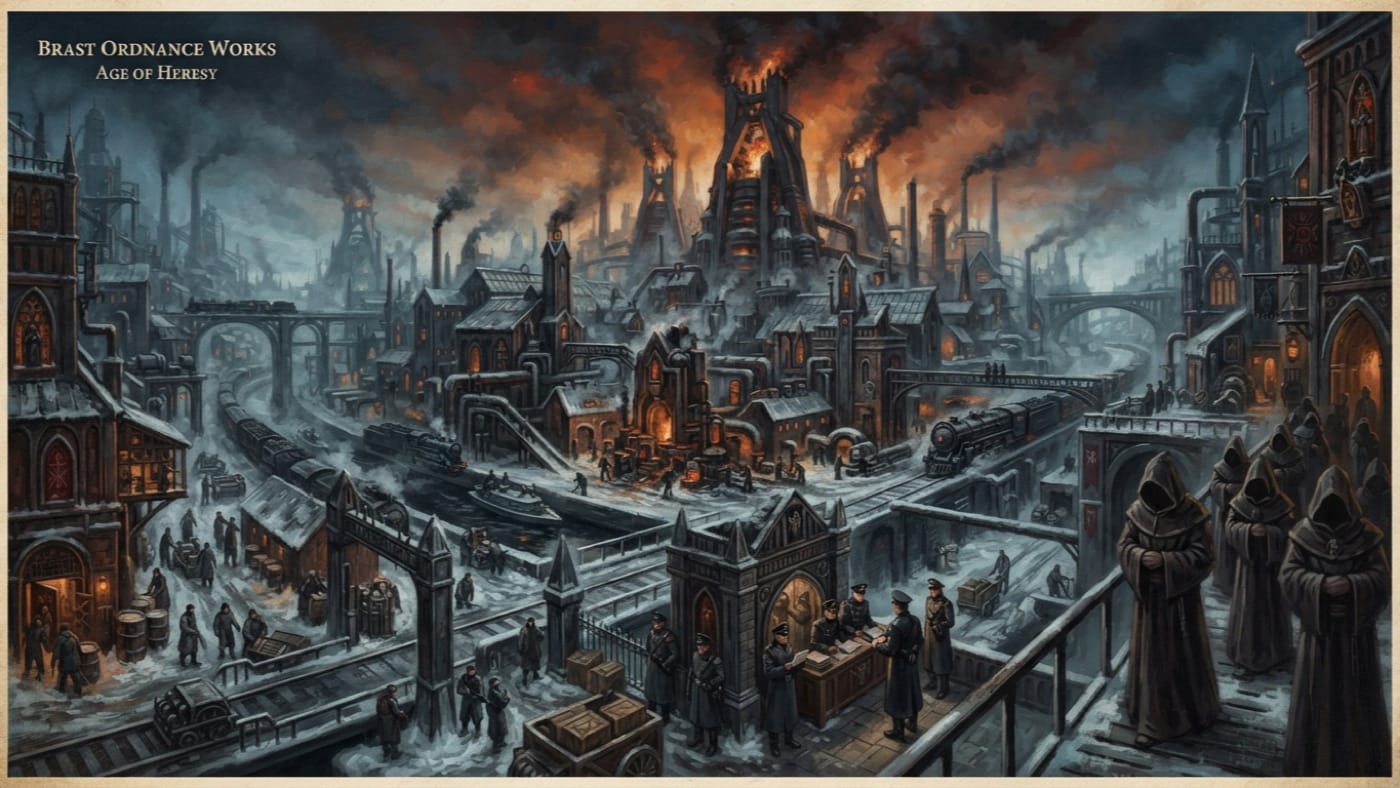
Brast Ordnance Works is the name the Synod writes on requisitions. The street calls it the Warm City. Line-soldiers call it the place that decides whether they freeze or move. Its less grateful residents call it the Soot-Shrine, a name I record only so that it may be fined. It is a foundry city of ninety-two thousand registered souls. Beyond that figure lies a swelling flux of drafted crews, refugee labour and rotating regiments that the registry has stopped pretending to count. It stands in the military rear of the Central Heartlands, in Zone 2, behind two defensive belts and well west of the Sagittal Line. Its site is an inland rail junction ringed by slag berms and cooling ponds, and it was built there to supply the first mass artillery pushes. The surviving papers do not record under a clean seal who chose the junction, or in which year, and I decline to forge that seal for them.
The city is laid out in rings around its furnace cathedrals. Rail lines and pipe-alleys run outward from that hot centre, and every road funnels through weigh-bridges and hymn-check gates. A visitor imagines he is entering a city. In fact he enters a sequence of permissions, each one warmer than the last.
#On the Passage from Furnace to Manifest
Feedstock comes in by rail: raw oil or peat, lime, brass, paper, grain, clean water, and the medicinal supplies that the import ledgers file beside the brass without visible embarrassment. All of it goes to the Chrismole Crown. The Crown is a complex of furnace cathedrals in kiln brick and iron cladding, and it smells of oil-incense, scorched metal and hot iron. Under the rites of the Furnace Chapterhouse of Saint-Combust, chrismole is distilled there and sanctified. Asking what else goes into the still is one of Brast's listed forbidden acts. A forbidden question keeps better than fuel, and I have kept this one in excellent condition.
The distillate runs out through the Still-Canals, a district of condenser channels and locks that smells of sweet solvent and algae, where canal skiffs pole between the valve towers. The Distillers' Compact rules this water. It controls the filters, and every filter is a slab of resin paste standing between sanctified fuel and something that kills its users. When filter stock runs short, output does not merely fall. It turns lethal.
From the canals, the work passes to the Gauge Ward, with its calibration halls, instrument shops, alcohol wipe and warm brass. There, under licensed choruses, pressure valves receive their serial seals and artillery sights are calibrated. Hymn-timing slates are copied there for the batteries that will need them. A gauge without serial papers is contraband. A sight calibrated to the wrong measure is a crime that the war collects later, at a distance.
Drums are sealed with wax prayers that can be traced by scent. If the wax melts wrong, workers call it seal-sweat and treat it as a confession of tampering. From the sealing floors the drums go by crane into the Rail-Manifest Quarter, through its yards and its tar, ozone and iron rain. Each one crosses a weigh-bridge and stands before a clerk of the Rail Manifest Court. No drum may leave unstamped. No hymn sheet may leave unlicensed. Pressure bells keep the whole day in order: the dawn bell, the distilling runs, the midday gauge checks, the evening dispatch, and then the night roar of the furnaces.
The calibration choruses and the filter stock are the narrow points. Every other part of the Works can be bought, beaten or drafted.
#On Those Who Authorise the Burn
Formal rule belongs to the Synod Ordnance Bureau, Brast Seat, sitting with the licensed Chapterhouse and the Rail Manifest Court. Command, rite and paper share one city, and each claims a different hour of the bell.
Commander-Auditor Sorn Vale holds the weigh-bridges, the Manifest Court and the power of execution. His boots are immaculate, a remarkable achievement in a city where the snow falls black. Vale does not regard a missing gallon as an accounting error. To him it is an absent man waiting to be found. In his ledgers every failure of procedure has a culprit, and every culprit is a sum that can be balanced.
Choirmaster-Calibration Ilyra Kest controls the only sanctioned choruses of the Calibration Choir. Her throat carries a scar and she never speaks above a murmur, yet that murmur can halt the Gauge Ward. If her singers are withheld, sights go uncalibrated, gauges stay unsealed and drums stay in their cradles. Kest's Measures license cadence the way the Compact licenses filters. Each body owns one of the city's two narrow points, and each knows it.
Guildmaster Pex Ruln keeps his hands oiled and his laughter timed to the roar of the furnaces, when nobody can quote it back to him. Through quotas and the slow strangling of supply, he controls throughput, filter stock and the still recipes. If the front accuses Brast of fuel heresy, Ruln will be standing beside the stills when the accusation arrives.
The Chapterhouse keeps ritual authority at the Crown, along with the steps it calls sacred and declines to call anything else. The Bureau of Engineering takes its readings, and the Bureau of Doctrine takes its jurisdiction. Neither has yet persuaded a furnace to sign a statement.
The calibration hymns of Brast are ancient and flawless.
It has always been the case that the hymns are exactly as ancient as the last correction the Choir approved, and as flawless as the gun that last fired them.
#On Warmth and Its Debtors
Workers live in the Boiler Commons, a district of barracks and ration kitchens. Its air smells of sweat, broth and coal dust, and its bread tastes of ash. Warmth is rationed in warm chits, which are heat credits that pass as currency and work as chains. A worker who exhausts their allotment falls into heat debt. That debt is repaid through overtime, through informant work, or through confession, which the Works treats as another kind of shift. Labour is kept in place by boiler-rite conscription and by debt bondage. Cold alleys are left unheated as punishment, and some people freeze in them.
The Works needs distillers, furnace feeders, valve runners on the catwalks, filter-makers, gauge scribes, choir technicians, boiler riggers and manifest clerks. Each trade has its own way of dying. Ash lung, chemical burns, rail crush, furnace flashback and fume fever are listed as hazards by people who have never stood near any of them.
Treatment is given in Ash-Hospice Row, among resin masks and bleach. The Ash-Hospice Sisters treat damaged lungs there and take Ash Confessions in booths beside the wards. The Sisters index each confession against the accident reports, so the Row keeps a second record of the Works, written in coughs. Ordnance's ledgers show perfect yields. The Sisters' records do not always agree.
The Slag Market lies on the outer ring, a place of vinegar, wet rope, scrap and provisions. It also does a trade in siphoned fuel, counterfeit seals and quiet hymn sheets. The Warmth Thieves of the Still-Alleys move their goods through pipe tunnels and along canal routes, and they buy officials with bribes. The law treats fuel theft as heresy. The Synod's broadsheets proclaim that Fuel is faith made useful. In the Commons, people say that Faith is what they burn when fuel runs low. I have cited both under seal, and only one of them was punished.
#On the Misfire and the Present Account
In A.S. 199 / 1909 CE, a battery at Bastion-Przemyśl supplied with Brast fuel fired four rounds into a friendly rail junction. Eleven people died and a supply train was crippled. Ordnance blamed sabotage. The Compact blamed the Choir, and the Choir blamed degraded feedstock. Engineering blamed harmonics, and the Chapterhouse blamed insufficient rite. The official cause remains pending, a word the Bureau uses when the dead are already buried and the suspects are still undecided.
After the misfire, Brast changed how it handles its machines. Watches were doubled. Gauges suspected of fault are now replaced under cursed-instrument procedure with stamped instruments. Oil anointing has spread to rails that were once thought too secular for prayer. Silence protocols now govern every change of shift. New crews must be introduced to their boilers, and every introduction requires witnesses and a Choir countersignature. Brast calls this behaviour of its machinery the Sulking Engines: delay, contradictory readings, hissed syllables, a remembered grudge. Whether any of this shows life, blessing or harmonic drift depends on which office is speaking, and each office is speaking for its own budget.
The Works was surveyed in A.S. 201 / 1911 CE. The disturbance remains a Category Two Localized Acoustic-Mechanical Disturbance, under Amber review. Seven sealed drums are missing. The number is so exact that the yards have stopped calling it a loss and started calling it a message. A night syllable recorded during the furnace roar sits in Vault Brast-4 under countermark. The rail engine at Siding Eleven stood still for forty-one days in A.S. 201. Nothing was found blocking it, broken in it or wrong with its fuel. The workers debated whether touching it would count as maintenance or as provocation.
Lux Thane Mire, Inquisitor-Mechanic and specialist in proof, has been sent from Strasbourg. He has not yet named a cause. The furnaces still burn, the drums still leave by the evening dispatch, and Vale is still auditing everyone. Above the Crown, the iron motto still reads Sing it true, or it fails, and the Choir still sings it.