
#On the Object Designated
Filed under Pilgrimage Day Three, Commemorative Cycle, Bastion-Constantinople, as an account of the object's present liturgical use. The reader who wants the censer's maker, the year it was cast, or the earthly particulars of its saint should apply elsewhere. There is no elsewhere.
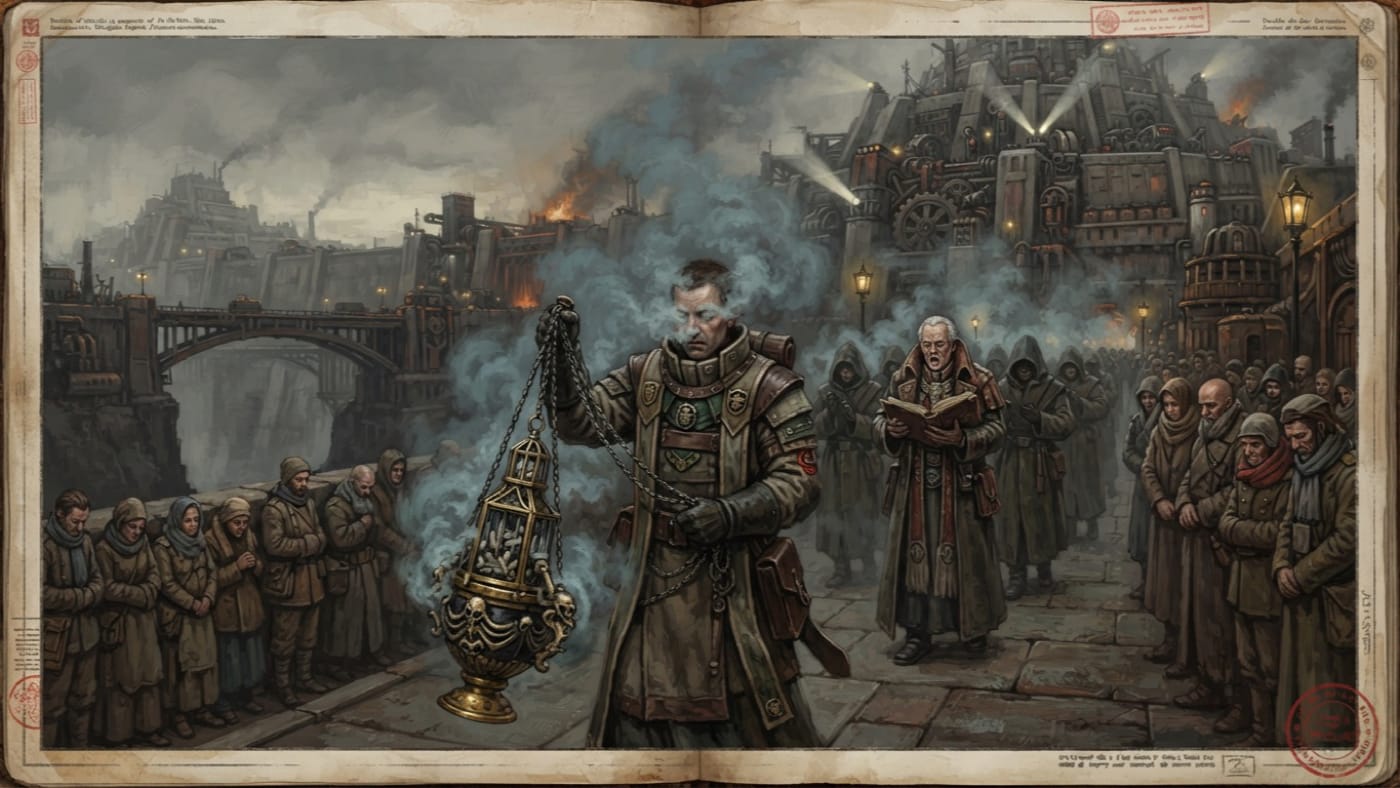
Once a year, on the 23rd of Argent, the Ravelin Chaplaincy of Bastion-Constantinople carries the Bone-Censer of Saint Thaddeus out of the Cathedral of the Perpetual Registry and down to the Ravelin of Sorrow, where the pilgrims of the Vigil of the Hollowed are waiting. It swings and it smokes. A cleric carries it in both hands, having been told not to drop it, and he has not dropped it.
There are seventeen Bone-Censers of Saint Thaddeus. All seventeen are notarised and authenticated. All seventeen are genuine in the sense in which the Bureau of Relics uses that word, which is the only sense used by anyone who wishes to keep their position.
The censer carried at Constantinople is one of them. I am often asked which one. The question assumes an order of precedence among the seventeen: a first and a lesser sixteenth, an original from which the others descend the way copies descend from a master folio. The Bureau recognises no such order, so neither do I.
#On the Seventeen
Being a defence of a number the faithful find too large and the Bureau finds exactly right.
The doctrine is old and short: a relic authenticated is a relic made holy. The Femur Wars showed the Church what happens when two cathedrals claim the same saint's thigh and neither will give way. Clerics fought duels in sacristies. Bishops were killed over a tibia. The schism could be measured in ossuary crates. The settlement that ended it is the finest sentence the Bureau of Relics ever drafted: all femurs are authentic if notarised. Cologne displays seventeen femurs of Saint Aldebrand, each as holy as the others, and Cologne has had no riot about it since.
A Relic Authenticator seals an object and enters it in a registry. From that moment the object is whatever the registry says it is. The seal attests attribution: in the eyes of the Church, this vessel belongs to Saint Thaddeus. The Codex holds no record, for any of the seventeen, of whose hand cast it, which chaplain first lit it, or in what year. Nor does it record whether anything of the saint went into its making. The Bureau has never treated these gaps as an obstacle. Provenance is the Authenticator's tool, and once the seal is down he has no further use for it.
The name is a title. Titles are not inventories. "Bone-Censer" tells the pilgrim what to call the object, and the Bureau has published no specification of what it is made of. I decline to speculate about what is in it. I note that the pilgrims do not ask.
Doubters say that seventeen genuine censers are sixteen too many. The doubter imagines holiness as a quantity, like grain in a tithe-barn, so that seventeen claimants must share one saint between them and each go hungry. The Bureau imagines nothing. It notarises. A notarised object needs its history no more than a sealed writ needs the clerk who copied it.
#On the Procession
Being an account of what moves, in what order, and how far it is permitted to go.
The procession forms at the Cathedral's processional mouth, the great door that also releases the Feast of Doctrinal Submission onto the Sanctum Mile. The Ravelin Chaplaincy goes first. The bearer keeps the censer's chains short, so the smoke rises close around his face and he walks inside his own office like a man inside a confessional. The garrison choir follows. Pilgrims line the route, then join behind, and the column grows as it moves out toward the ravelins: the cripple and the grandmother, men who are still in uniform and men who no longer fit in theirs.
The smoke is grey. It smells of resin, hot metal and the soot of a vessel lit too many years without scouring. I record that much because I have smelled it. I record nothing more because nothing more is recorded.
At the Fifth Ravelin the procession stops at the parapet, and the censer stops with it. Across the intervening works stands the Sixth Ravelin, the Ravelin of Correction, closed to civilian traffic. On a clear day Chamber 7 can be seen from here: a stretch of curtain slightly darker and smoother than the wall on either side. The pilgrims may look at it, and so may the censer. Seventeen-fold authentication carries no pass beyond the parapet. The Bureau of Relics has never pretended that it does.
The choir then sings the Antiphon of Endurance, all thirty-two verses. Pilgrims who know the words join in. Those who do not stand silent, and the bearer swings the censer over both kinds without favour. Thirty-two verses take a long time. The smoke drifts to the edge of the parapet and goes no further, the same as everyone else.
When the Antiphon ends, the Ravelin Chaplain reads aloud the Bureau of Doctrine's official account of the sealing. It runs to three pages, and the bearer holds the censer still while he reads.
#On the Names Withheld
Being the minimum of history required to explain why a censer walks to a wall.
On the 23rd of Argent, A.S. 170, the host of Maldrake struck the Sixth Ravelin's southern curtain: Forge-Beasts, Ember-Soldiers and a column of Hollowed sent forward by the Great Deceiver's workshops. One hundred and forty metres of wall came down. Nine hours later a pour-frame arrived. Forty-seven men and women of the garrison and the Ravelin's civilian quarter stood inside it singing the Antiphon while the consecrated cement rose around them. The wall has held ever since, above specification.
The Codex records no censer at the breach. The Bone-Censer belongs to the remembering, not to the day itself. I set it down plainly because pilgrims sometimes say otherwise, and pilgrims are owed accuracy even when they would prefer comfort.
The saint has a name, Thaddeus, and the Chaplaincy speaks it every year without hesitation. The censer has a name too, and seventeen certificates to support it. The forty-seven have a number. The Bureau of Records sealed their names under the Fourth Ratification, and the three pages the Chaplain reads were written to fit around that seal. The account does not describe the cement rising. It does not mention the woman whose voice carried the last verses alone after every other mouth was covered. It says that forty-seven servants of the Synod offered their persons, that the offering was accepted, and that their names are with God.
Their names are also with the Bureau of Records, which is closer and keeps better hours.
I know eleven of the names. I have written none of them and will not write them here.
Whether the forty-seven knew beforehand what the frame was for, and whether anyone arranged for them to be standing where they stood, are questions the Vigil's own record has asked and left unanswered. The censer does not answer them either. It is not evidence. It neither explains the wall's strength nor shows who sent for the cement. It is a vessel of incense carried to a parapet once a year, so that a crowd forbidden to say forty-seven names has something holy to look at while it grieves.
The grief is real. I have seen it and will not cheapen it. The mother who tells her child that the wall holds people who loved us very much is telling the truth as far as she has been allowed to know it, and the censer that swings over her head is genuine. The Bureau has certified both statements. Only one of them needed a seal.
#On the Present Application
Being the censer's standing, its fees and its siblings, as of the current commemorative cycle.
The Vigil goes on as before. The Bureau of Tithes collects the pilgrimage fees, and the Bureau of Pilgrimage issues the souvenir stamps. No separate fee for the censer has been recorded. Its smoke is included in the price of the day.
Older rubrics in the Codex's master lore filed the commemorative breach at "Bastion-Lorraine, the Western Anchor."
That name and that geography are withdrawn. The breach of A.S. 170, the sealing of Chamber 7 and the Vigil at which this censer is carried all belong to Bastion-Constantinople, the Southern Anchor. The western rubric was attached to the wrong wall at the wrong end of the Line. The pilgrims always knew which wall they were walking to, so the error deceived nobody who mattered. It has been corrected for the benefit of everyone else.
Somewhere, sixteen other Bone-Censers of Saint Thaddeus are exactly as genuine as this one. I am not told where they hang. I am not told whether they are lit, or which dead they are swung for, or whether anyone walks them to any wall at all. I am told they are genuine, and I have it in writing.
Next year, on the 23rd of Argent, the Chaplaincy will form at the processional mouth again. The bearer will shorten the chains and the choir will sing thirty-two verses. The Chaplain will read three pages. The censer will reach the parapet of the Fifth Ravelin and stop there, as before.