
#On the Category
The List of Laughters contains a rule that every Fog Clerk memorises in his first week and spends the rest of his career failing to explain to publicans. A table-slap is counted separately. If the slapper is drunk enough to have mistaken the table for his own thigh, the act is entered under Bodily Percussion, Non-Musical.
Read it twice. The hand strikes the table. The wood takes the blow, the cups jump, and the noise is the noise of a table. Yet the category is decided by what the drunk believed he was striking. The Censorium of Taverns has here achieved what confessors have pursued since the first screen was nailed into the first booth: it classifies the deed by the interior state of the sinner, recorded by a stranger, in ink, before the beer has finished spilling.
I find it beautiful. A man in his cups loses the boundary between his furniture and his leg. The state keeps that boundary for him, in a column, under seal.
The usual objection, raised chiefly by publicans and by men who have been entered, holds that a slap is a slap. This is peasant metaphysics. A slap on the table is commentary. The table belongs to the house, the house holds a licence, and a blow upon licensed timber addresses the room. A slap on the thigh, intended, addresses only the slapper. The drunk who confuses the two has addressed himself in public by accident, which is the condition of most drunks and nearly all poets.
#On the Entry
The entry follows the house form laid down for every sound in the List: ward, street, licence number, keeper's seal, fog-grade, bell-hour, inspector present. Then the category. Then the beads.
Here the curious reader wants the price. A chuckle is one bead and a guffaw three, figures so public that every child in Strasbourg can recite them before its catechism. The bead value of Bodily Percussion, Non-Musical appears in no abstract I am permitted to quote, and I am permitted to quote a great deal. The allocation itself is sealed. A publican who wants to know where the boundary lies may learn it the way his trade learns everything, through punishment. The drunk who wants to know whether a mistaken thigh costs less than an honest table-slap may go on wanting.
I will say this much. The category gives the clerk somewhere to put the noise, and that is both its first mercy and its last. A sound must be named before it can be fined, and a name that does not fit is a defence. The Censorium dislikes defences. It has therefore provided names for everything, including the error of a hand that forgot which wood belonged to it.
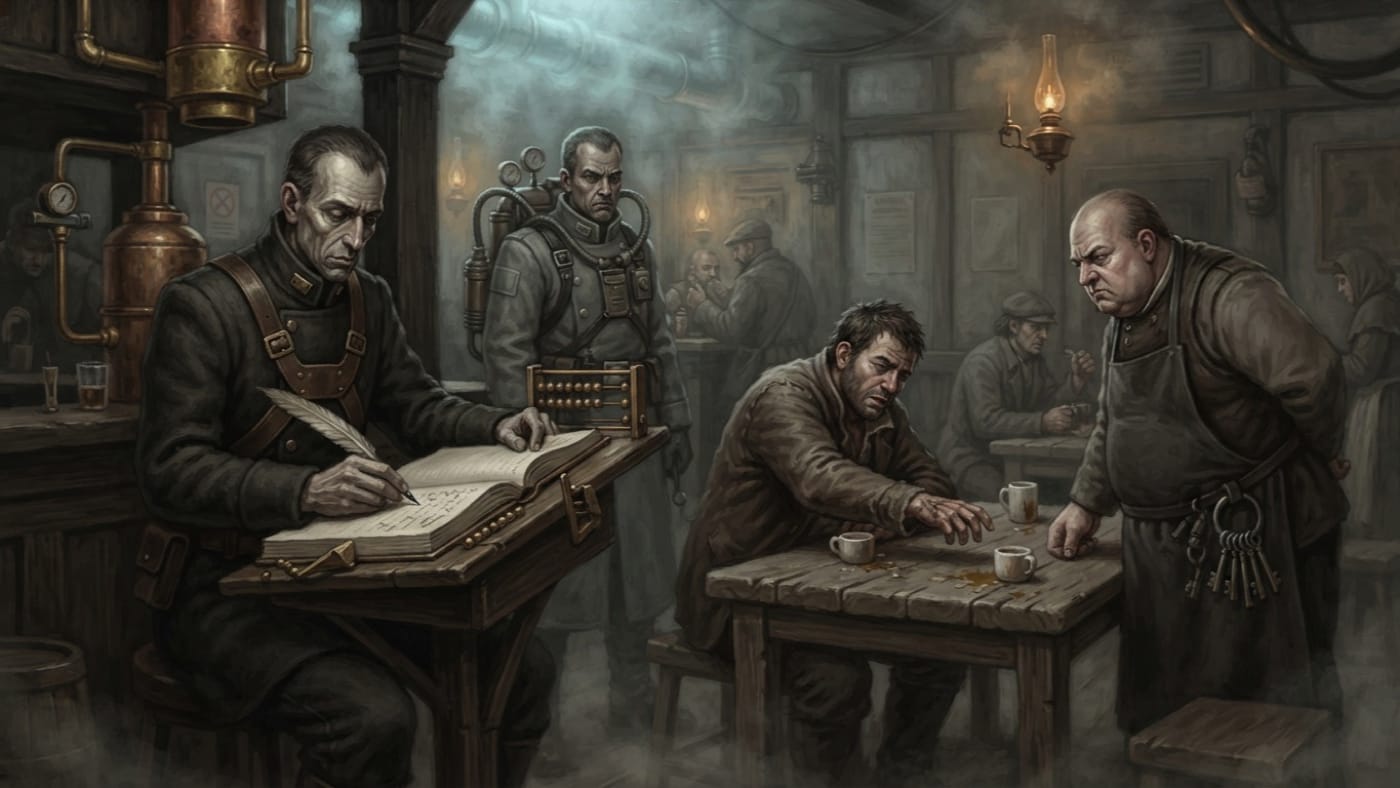
The Fog Clerk makes the entry at his slanted desk near the rear wall, far from the fog pipes so the page stays dry. He turns the bead chain. The beads click, and the room hears them. He signs. Then the Licensed Housewarden comes to the desk and countersigns, because a sound made under his roof becomes his sound once the ink has it. The patron signs nothing. For administrative purposes the patron is weather.
Keep the offices straight. The Housewarden runs the room. The clerk keeps the List. A Purity Fume-Inspector, if one is present, is sniffing the lamp-smoke at the next table for whatever the lamp-smoke conceals. The clerk hears, the Housewarden pays, the Inspector smells, and each keeps his own book.
#On Rhythm
"Non-Musical" names the category. It passes no judgement on the sound.
A completed entry is pricked with a pin if the sound contained rhythm. The category stays as written. The pin is a separate mark with a separate meaning. The same clerk makes it, and it attaches to Bodily Percussion, Non-Musical as readily as to a chuckle delivered in measured breaths. One slap is rarely rhythm. Two slaps are an argument. Three at an even interval, with a neighbour's cup landing on the fourth, are a congregation forming without a licence.
Three pinpricks in one column summon a Festival Chorus-Master. Five summon Purity. Seven summon the Lictors. The pins are counted down the column, independent of the beads and of the number of hands involved. A lone drunk may strike the table forty times without earning a pin if he strikes it like a man falling down stairs. Six hands may earn three pins in a minute if they agree on a beat.
The Chorus-Master comes because agreement is his trade. The Bureau of Festivals schedules rejoicing, cues the applause, and stops the chant before the chant decides what it means. Its officers have a saying, if they clap off-beat, run, which I consider good advice for every occasion, weddings included. A rhythm the Chorus-Master did not start is a rhythm someone else started. Doctrine holds, and I record it as Doctrine's position, that the Great Deceiver prefers a crowd that keeps time, because a crowd that keeps time can be led. Doctrine has never ruled that a drunk's mistaken thigh led anyone anywhere. Doctrine is waiting for him to try.
#On the House That Bears the Sound
The patron goes home. The house stays.
Every bead and every pin falls on the licence above the bar: red wax, ward mark, and a number the clerk has already copied. The Housewarden knows this the way a cellar knows damp. His trade is seating plans and stopped songs. He puts the loud men near the door so their noise leaves first, resets a rising laugh with a staged coughing fit, and has cups set down hard so that a snicker drowns in crockery. Into this careful room comes a man who cannot find his own leg.
The Housewarden cannot unslap a table. He can water the next cup, lower the lamp, and let the fog rise a hand's breadth over the boards until shins are wet and spirits follow. He can lean down and say to the patron the one word every keeper uses on such nights. I will not print it, because the clerk would have to enter it.
The room smells of sour ale, lamp oil, damp wood, and bread gone grey at the crust. The shutters are shut, and the curfew bell is coming. The Housewarden wants the night to end as a dull night, because a dull night is the only kind the List forgives without comment.
He is right to want it. The Laughing Swan Inn of Strasbourg burned in A.S. 102 after three unauthorised chuckles in a week. In A.S. 153 the Laugh Riots of Seville taught the Dominion that a population able to read its own paperwork can laugh in sequence like a regiment firing by rank. Seville ended in braziers. Neither case turned on a slapped table. Both turned on a column filling up.
#On Present Application
As of A.S. 201 the List is kept nightly in the licensed premises of the Dominion. Master copies go to Strasbourg, district abstracts to Festivals, enforcement marks to Purity annexes, and fee columns to the Bureau of Tithes. All of it ends up on the shelves of the Bureau of Records, where nothing is forgotten and very little is read. Bodily Percussion, Non-Musical travels with the rest of the Censorium's categories. Its entries are few, and its clerks are proud of them, because a man who can spot a confused thigh at twenty paces in low fog is a man with a future.
The public term under which these entries are reckoned was revised in A.S. 199.
An earlier fair copy of this article stated that a confused thigh "counts against the ward's mirth quota."
Corrected. Since A.S. 199 public copies say devotional levity allocation. The Warden regrets the lapse into internal vocabulary, which reached the copyist through an open door and a clerk who talks.
The allocation is called the Creator's gift, measured out. The drunk who spends part of it striking a table he took for his leg has spent it badly. The clerk sees everything, forgives nothing, keeps the rate unpublished, and writes it down.