
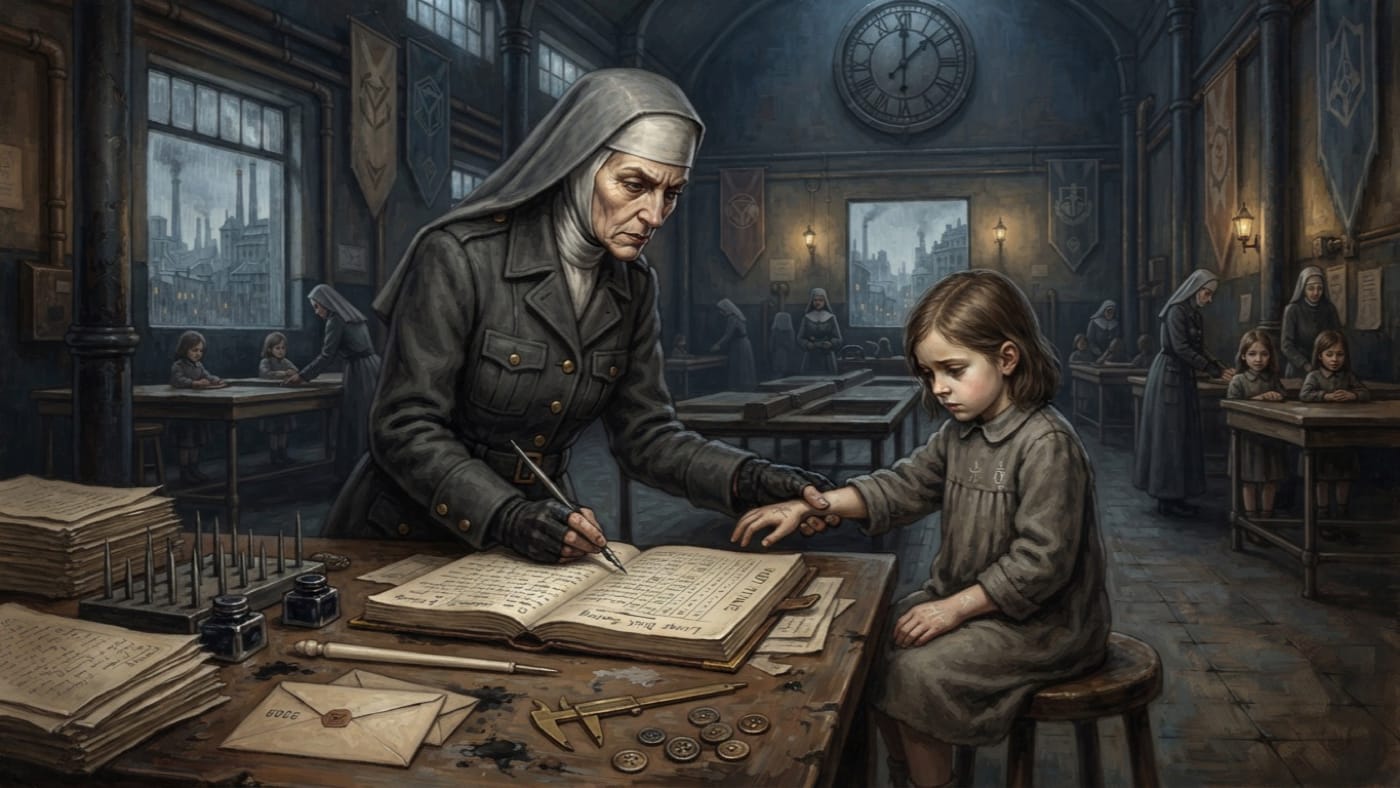
#On Their Station
"Lineage is a knife." — Registrar idiom, chalked inside more than one intake door
Among the grey-coated clerks of the Orphanarii there is a party that distrusts the ink it writes. The Bloodline Hawks hold that a child's provisional name, however neatly lettered, is written over an older hand, and that the older hand keeps showing through the vellum like a palimpsest that refuses its scraping. They are Registrars of a certain temper, and Root assessors of the same temper, and the fact that these two descriptions meet over the same intake file has never troubled anyone enough to produce a ruling.
They hold no charter that I have been able to locate. They keep no chapter house, they publish no roll of members, and they have no master to receive a complaint. They are a position rather than a body: a habit of reading, shared between the profession that names children and the Order of the Root, whose doctrine is short enough to embroider on a cuff. Heresy is hereditary. Families may be condemned together and uprooted together. The Hawks took that doctrine down to the washing bench and gave it a column in the minor ledger.
What separates a Hawk from an ordinary intake clerk is the question asked. The clerk wants to know what the child is: age by teeth, health by skin, hunger by the speed of the spoon, origin by whatever wagon delivered it. The Hawk wants to know whom the child comes from, and treats every answer as a liability that has not yet been priced. The Purity Reclassification made lineage liability and bloodline risk scoring standard practice across the Bureau of Mercy. Most Registrars fill in the score because the form requires it. The Hawks believe in it.
#On the Evidence of Kinship
The Hawks read bodies the way Records reads disputed deeds: for whatever survived the forger.
Their published subjects of attention are cheekbones, dialect remnants, lullaby fragments, hand dominance, allergy patterns, and sleeping posture. Root's examiners add repeated gestures, attachment to the former household, and prayers spoken at night for parents who no longer appear in any current roll. A child who sleeps curled toward the east wall, who flinches at oats, who hums four bars of something under the soup queue and stops when watched, has supplied three entries before breakfast.
A sensible clerk would sort these. A cheekbone is born. A lullaby is taught. A night terror is inflicted, usually by the very soldiers who delivered the child to the gate. The Hawks file all three in the same column and call the column blood. A mother's song and a mother's jaw become, under their pen, a single inheritance, and the soldier's boot that produced the nightmare is quietly credited to the grandmother.
The implements are the Registrar's own, borrowed and sharpened. The tooth chart estimates age and, in Hawk hands, hereditary irregularity. The measuring rod records height, then posture. Hair goes into sealed envelopes. Root's examiners trace descent across parchment with narrow ivory pointers that never touch the ink, a delicacy they deny to the children. Belongings are catalogued as the profession always catalogues them: the button, the parish scrap, the saint card, the coin sewn under a cuff. A Hawk reads the button for its maker's district.
Then come the code words. Salt-blood, unsung kin and black root are Registrar slang for suspect heretical lineage. They are not diagnoses, and no lancet has ever drawn salt from a vein. They are words a clerk can write in a margin without writing heretic beside a five-year-old's name, which the Bureau considers indelicate. A flag entered at intake travels with the child through every later ledger, every ration draw, every placement petition. It costs the Hawk one stroke of cheap ink.
#On the Root Intake
The Root stream is the Hawks' natural habitat. These children come from condemned households: families convicted outright, dissolved by Administrative Dissolution, or flagged for review by an Index Damnatus amendment strip carried to the gate before the porridge. They arrive with wrists tied in witness ribbon and surnames already struck from the Great Ledger of Souls.
The functions are divided with the usual Synodal tidiness. The Ward-Sisters wash, delouse and observe. The Registrar assigns the provisional name, the origin code, the three disks and the lineage flags. The Bureau of Records keeps or revises the identity thereafter. Root conducts hereditary review. The Bureau of Purity stands nearby with the patience of an enforcement arm that has never once been told no. No single desk owns the child, and so no single desk can be blamed for what happens to it.
The Hawks' contribution is the second reading. Once the child is clean and tagged, the file is opened again in the low-bell wing of the Strasbourg Central Orphanarium, beside the Mercy district's endless Records traffic, and someone asks whether the old house has truly been left behind. A gesture is noted. A word of dialect is underlined. A prayer overheard through a dormitory wall becomes a supplementary entry, initialled and dated, and the child's risk score rises by a figure no one outside the room can check.
Root teaches the Wintering of Ghent as an instructional precedent. Under Ordinary Carmina, before her elevation, a quarter of that canal city was sealed for a season. Suspect family continuities were destroyed, and the surviving children came out of the thaw with rearranged surnames and revised baptismal kin. I record no Hawk at Ghent, because I have found none. I mention it because it shows a Hawk's argument at the scale of a quarter rather than a cot. Root rewrote a whole district's kinship in one winter. The Hawks suspect any rewriting that took less effort.
#On the Name-Givers
There are two kinds of Name-Giver, and confusing them is a mark of the provincial. In the street, Name-Giver is a nickname for any Registrar, spat at the grey coat in the same breath as Paper-Mother. Inside the profession, the Name-Givers are a faction, and they are the Hawks' chief opponents.
The Name-Givers hold that identity can be remade. Give the child a name without hooks, Ward-Seven rather than Rose, feed it on schedule, drill it in catechism, keep it hungry enough to listen, and the old household fades into a dream-error by the age of ten. Their creed is the profession's own idiom: a clean name is a leash. The Hawks reply that a leash on a bad dog is still a bad dog. One faction believes the ledger can overwrite the blood. The other believes the blood will eventually overwrite the ledger, and that an honest clerk should enter the fact in advance.
Do not mistake the Name-Givers for the gentle party. They do not dispute that the child's family must be erased. They dispute only whether the erasure works. Their hunger drills and naming masses are as coercive as anything a Hawk recommends. The difference is that a Name-Giver's failed child is a disciplinary problem, while a Hawk's failed child was a prediction come true.
This quarrel is a separate matter from the one between Shelterists, who hide siblings and misspell dangerous surnames to keep children alive, and Pipeline Purists, who see children as resources owed to guild, militia and annex. A Hawk may be either. So may a Name-Giver. The Hawks reserve a particular loathing for the shadow placement brokers who sell clean origin codes and launder lineages through borrowed dead names. A Name-Giver at least launders by the book.
#On the Children Who Fail
An adverse Hawk reading closes doors quietly. The child's reeducation is extended. Adoption grows unlikely, because respectable families ask for clean lineage, no remembered dialect, and no tendency to answer to a previous name. Guild masters skip the flagged disk at the midday viewing. Transfer becomes likelier: to stricter instruction, to Purity examination, to the side corridor where the floor is always too clean.
And beyond the corridor is the cabinet. Beneath the Strasbourg Central Orphanarium, in a cabinet Mercy holds does not exist, the records report a culling rate of approximately four per cent among Root intakes. The figure applies to Root intakes, not to the Orphanarii at large. It is a documented outcome, not a tariff levied on each wagon. Nor does the cabinet say whose initials stood at the foot of each recommendation. A Hawk's flag is one entry among the Ward-Sister's log, the Registrar's code, Root's review and Purity's countersignature, and the cabinet records the sum without crediting any single hand. I hold the key. I have read the columns. They contain the words too attached more often than anything resembling blood.
"Reeducation is universal." — Public doctrine of the Orphanarii, as recited at every Root intake
Clarified. Reeducation is universally begun. Its completion is recorded in a separate cabinet under a separate key, and the two documents have never been asked to agree.
As of A.S. 201 the Hawks have never been busier. Displacement along the Sagittal Line sends westward wagons of children whose papers burned with their parishes, and every child without paper is a lineage without a ceiling. The Pale Kin conceal births and manufacture false identities, so the Hawks distrust any foundling with a suspiciously plain face. The Pale Kin's own Blood-Kin Purists, a different faction with a stubborn preference for relatives, leave kinship trails that the Hawks follow with real gratitude. The new Index strips arrive monthly, and each one makes some dormitory memory newly illegal.
The children who remember are their great subject. A girl insists the Registrar has misspelled her real name. A boy hums a banned nursery tune because his mother sang it under shelling. Three separated siblings tap one pattern on three dormitory walls. To the Name-Givers these are failures of method. To the Hawks they are evidence, entered in ink and initialled at dusk.