
#On the Feast in the Mercy House
The Blessing of the Ladles is the feast of Saint Marrow-of-the-Ladle as the Bureau of Mercy keeps it. It happens in kitchens and over pots, with the doors shut and the queue outside listening. It needs no cathedral. A ward with one fire, one pot and one senior Sister has everything the rite requires.
This account surveys the observance as the Mercy houses practise it in A.S. 201. No file I have been permitted to open dates its first celebration. If it was ever ratified, the ratification came the way Marrow came, by repetition. I record what is done now. The past may apply for a separate folio.
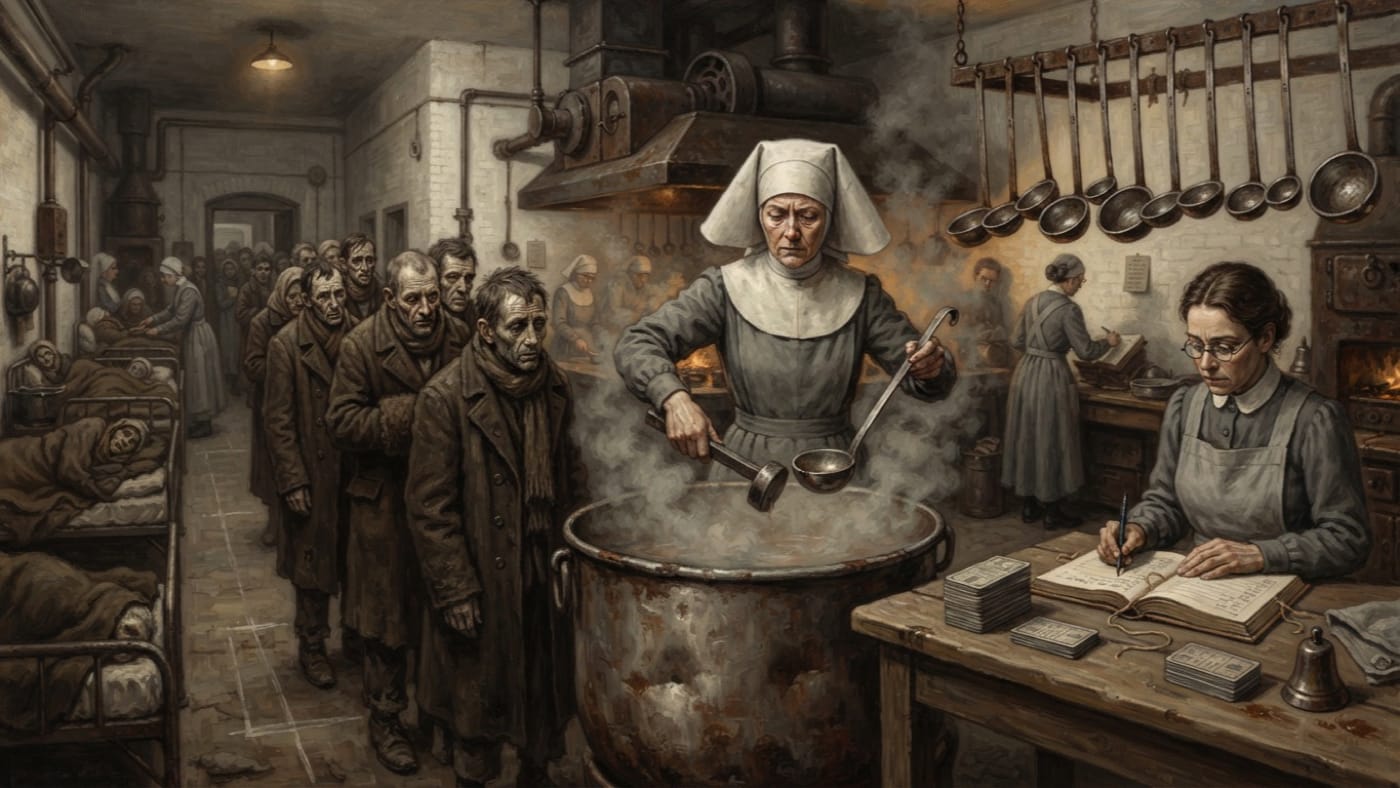
The ward smells of steam, bleach and boiled grain. A man in the far cot coughs on the same note he has held since Lauds. The ladles hang on their hooks. Each has a measure line and each has a serial. Each belongs to the Synod, and each is the tool by which the Synod decides how much of a patient may be kept alive today. Once a year the Church kisses them.
#On the Saint Behind the Measure
The Church's legend belongs to the years after the Broth Riots of A.S. 112, once the Ledger Laws had taught Mercy to count its bowls. It tells of a bastion famine, and the Bureau has wisely declined to name the bastion. The stores were empty and the roads were closed. A ward-hand of uncertain rank cracked the last marrow bones, boiled them in a dented soldier's helmet and served two hundred patients from a single ladle. The pot lasted until dawn.
Pulpit editions still teach that the helmet "gave without growing less."
Corrected per the Bureau of Relics: the broth ran out more slowly than inventory predicted. The miracle is entered as a favourable variance.
The Bureau of Doctrine approves Marrow canonically and leaves the history disputed. The woodcuts disagree on whether the saint was a field monk, a ward-matron, a skeleton in an apron, a stain on a pot or several cooks folded into one name. Doctrine has kept all of these readings unresolved, because a saint left unresolved cannot be disproved.
Marrow also has a division of labour to respect. Saint Sabina of Ghent keeps the wound, the cloth and the bandage. Marrow keeps the bowl. Popular piety calls them mother and cook. They are no relation. The feast belongs to the bowl alone, and Sabina's strip of painted cloth stays above the bandage shelf for the day without complaint.
#On Washing, Counting, and the Tone
Every ordinary shift opens with a small rite of its own. The Ward-Sister washes to the wrist, counts the ladles, taps the ward bell once and murmurs the Mercy Line. Nobody calls this a feast. It is hygiene with a prayer attached.
On Marrow's day the bell is left alone and the pot does the speaking.
Every ladle in the ward is taken down. Every one is washed. The washing is thorough, because the Sisters know which eyes will be on it. Then the ladles are counted against the ward register, serial by serial. The figure is said aloud, since a number the room has heard is harder to dispute later than one written down by a frightened hand. Next a senior Sister kisses each ladle. The kiss falls on cold iron that still smells of lye, and a kiss given forty times before breakfast loses its tenderness by the eleventh and keeps going anyway. Last, each ladle is struck once against the rim of the pot.
The order is fixed: wash, count, kiss, strike. Change the order and you have not blessed anything, you have only made a noise in a kitchen.
The tone is recorded. A clerk or witness writes it beside the serial in the broth book, which is string-tied at the end of the rite like any other ledger of the Laws. Three outcomes are possible, and the register treats each one differently.
A cracked tone means the ladle is replaced. A flaw that can be heard is a flaw that can leak, and a ladle that leaks gives out unmeasured mercy, which the Laws regard as theft running in the opposite direction.
A dull tone means confession. The register does not say who must confess. The Sisters understand this ambiguity well enough. A dull ladle confesses no one by itself, so the ward chooses.
A missing ladle means lockdown. Doors are barred, the count is taken again and the Sister in charge is questioned. The Bureau's stated reason is that a stolen Mercy ladle can feed an unregistered household for a week. Doctrine finds that sentence alarming. The Ward-Sisters find it believable, because they know what an unregistered household eats in an ordinary week, which is mostly nothing.
Every ladle sanctified that morning goes back to work at noon. Blessing changes nothing about the measure line on the bowl. The kiss does not widen it.
#On the Helmet in Marrowgate
The kitchen rite is held in every Mercy house. Marrowgate adds a procession on top of it, because Marrowgate has the relic, the crowds and the drainage for both.
The Helmet-Chalice comes out under glass. It crosses the casualty square, past whitewashed brick, rusted gutters, the chalk lines that separate clean streets from the rest, stretchers that have not stopped for the feast and the grey aprons of staff who have stopped only briefly. Steam rises from the ward kitchens on every side. The Mercy Chapel steps, where the pain-relief line queues the rest of the year, fill early.
Patients reach out to it. Some touch the helmet itself when the bearers let them. Others touch the reliquary glass and then press the same hand to whatever part of them has failed: a stump, a ribcage, an eye under a bandage, a belly that has already been told which ration class it belongs to. No form is prescribed, and the Church promises no cure. The crowd draws its own conclusions and is not invoiced for them.
The Bureau of Records still does not know whose helmet it was. Three death rolls claim the initials on the rim. Mercy does not care, the patients care less, and the glass gets cleaned of fingerprints at sundown.
#On the Full Bowl and Its Conditions
That day the children of the Orphanarii receive one full bowl. It is not thinned with ash-flour. For one meal the broth is what the word promises: fat on the surface and marrow in the taste. The children are told to thank Saint Marrow first and the Bureau second. They do it in that order, and the Bureau is content to let a saint with no body or birthplace take public credit for an item already in the budget.
The refectory prayer is said as usual: Saint Marrow, count the ladle. On the feast the ladle is counted with unusual care, so the prayer is at least answered.
The bowl is one bowl. It does not open the gates, waive registration, suspend the clean-grey-black allotments or extend to a child's mother waiting beyond the whitewash. It is a good meal served once, and those who serve it know exactly how good it is.
Mercy catechisms call the Feast of Saint Marrow "the day when no one leaves hungry."
Clarified for authorised teaching: no registered ward recipient leaves hungry within the feast perimeter during the authorised serving window, subject to ration availability, conduct certification and ladle reconciliation. The hymn keeps the shorter line, because clauses don't scan.
Every condition in that sentence is a door with a clerk behind it. A recipient must be registered, and must be inside the perimeter. They must arrive within the serving window, while rations last. Their conduct must have been certified. The ladles must reconcile, so if one ladle went missing at dawn, the whole ward's generosity waits on a lockdown. Hunger that falls outside the perimeter is filed under ordinary hunger and gets no feast.
The Ward-Sisters keep the warmth credible anyway. They serve slowly, scrape the pot to the bottom and tilt the ladle at the most generous angle the mark allows. A good Sister knows how to fill a ladle to the very edge of its line.
I have recorded elsewhere watching a boy at the Marrowgate feast hide half his bowl under his coat for a sister too sick to queue. The Ward-Sister saw him. She stamped his ration card as fully consumed and looked away.
#On Present Observance
As of A.S. 201, Marrow is approved for ward invocation, kitchen oaths, calming broth lines and absolving ration variance up to minor degree. In emergencies Marrow may also bless helmets pressed into service as pots. None of these permissions is a required part of the feast. A Sister may invoke as many as her ward has reason for. On the day itself, most invoke the one for variance.
The feast is still held in every house that keeps a pot. Its origin remains undated, Marrow remains in dispute and the ladles remain numbered. The tone register for the year is string-tied and filed. It shows a quantity of cracked tones, dull tones, absences and lockdowns that Records considers within tolerance and Mercy declines to publish.