
#On the Black Assignment
“Black-zone makes saints or monsters.” — Ward saying
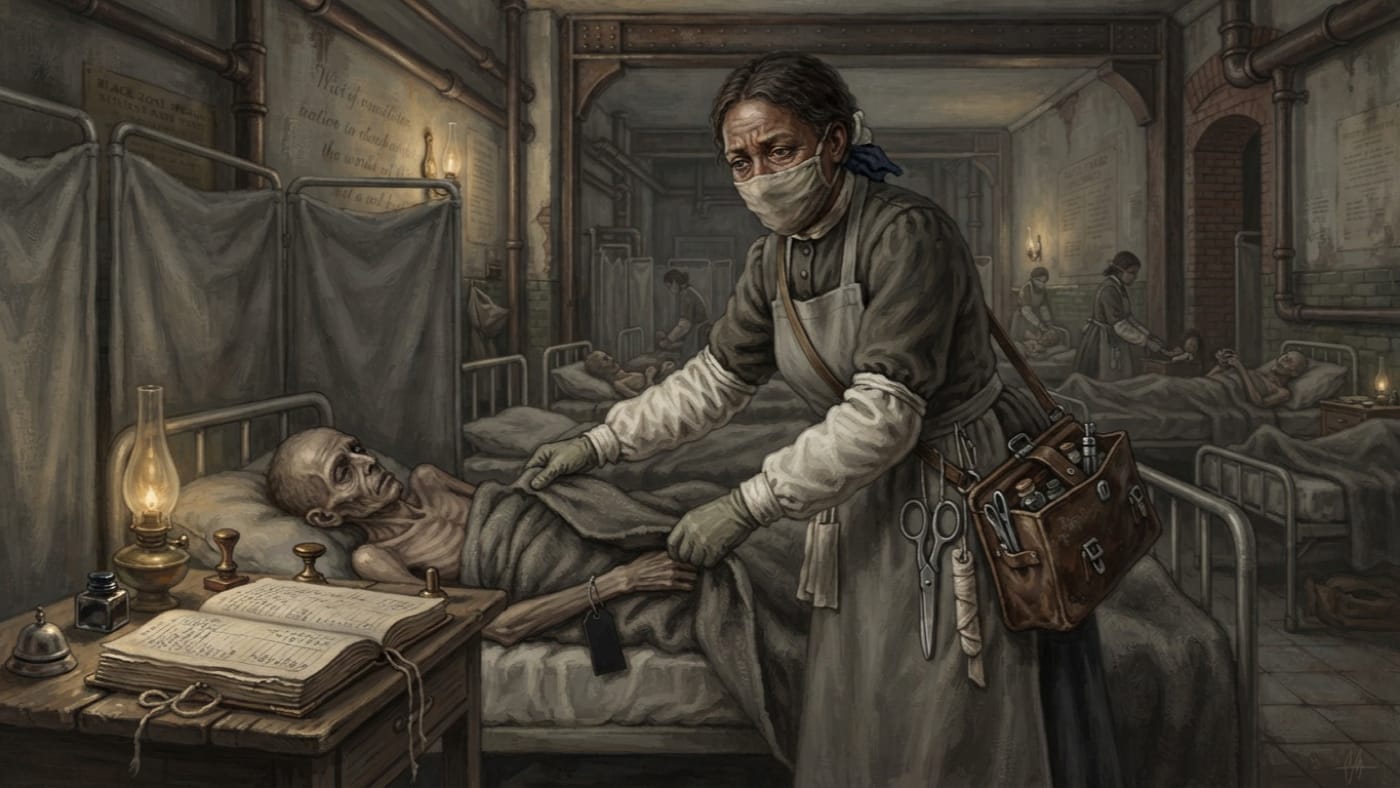
The Black-Zone Specialist ties the screen before touching the patient. The cord goes to the hook and the cloth to the frame, with a folded towel weighting the gap at the floor, because the clean corridor complains of draughts and the clean corridor has the auditors’ ear. Only then does the specialist turn to the cot.
Within the Mercy Ward, the title ranks above full stamp authority. It stands beside the Quarantine Master and the Confession Liaison among the advanced stations of the Bureau of Mercy. Its holder works where the ward sends whatever it cannot cure, release, explain or afford. Black admission is granted on five grounds, singly or in combination: terminal, contagious, anomalous, politically inconvenient, beyond allotment. A man may lie behind the screen with a clean wound and a bad surname. A girl may lie there with a fever that will break by Thursday and a dream that Doctrine dislikes. The zone is a classification. Prognosis is kept in a separate column.
Three populations staff the corridor. There are the specialists. There are penitents serving out a sentence of ladle and bucket. And there are ward-hands whose compassion offended a supervisor, sent down by demotion so the clean zone could keep its manners. All three wear the same grey apron and the same white sleeve wraps. The patients cannot tell them apart. The ledger can.
Clean-zone gossip, and more than one intake clerk, calls every hand behind the black screen a “Black-Zone Specialist.”
Corrected: a black-zone assignment is a posting, and frequently a punishment. Specialist standing is an advanced rank, earned above the full stamp. A demoted Ward-Sister carrying slops behind the screen has acquired a smell, not a title.
#On Admission and Allotment
The patient arrives with a tag, and the tag arrives with a colour. The specialist reads the paper first, then the face, then the paper again. Records will read only the paper.
Intake classifies by symptoms, papers and a behaviour rating. Clean receives full broth, measured draughts and decent linen. Grey receives enough to remain quiet. Under the Ledger Laws, which Mercy enacted after the Broth Riots of A.S. 112, black receives “sufficient,” and every ladle, bandage and dose leaving the cabinet is signed against a cot number. Sufficient has never been defined. This is its genius. A word without a quantity can be audited in any direction.
In practice, the black allotment is a measured ladle. It grows smaller in the hand of a frightened attendant than in the hand of a specialist who knows exactly how much broth the sheet will bear. Linen is counted out by the length and must come back, soiled, by the same length. Pain relief is released by countersignature, and a countersignature needs a second officer willing to set a name beside a dying stranger’s. The Bureau of Medicine issues memoranda on the matter. They arrive damp.
The black tag is no warrant of departure. Those belong to the Hospices of Departure, and the specialist dispenses no black elixir on a ward tag’s authority. Much of the specialist’s expertise lies in reading the tag against the body. A patient admitted as beyond allotment may prove recoverable, and recoverable patients belong in grey, where the allowance is larger. A petition for transfer out of black costs ink, a supervisor’s patience and the specialist’s credit with the intake desk. Some specialists petition weekly. Some have stopped.
#On the Round Behind the Screen
The round is the ward’s ordinary cycle of broth, washing, treatment, observation and log, performed with fewer hands, less light and higher stakes.
The specialist washes to the wrist, counts ladles and taps the ward bell once. The mask goes on first, then the sleeve wraps. A diesel-scent rag is folded beneath the mask. The ward-hands swear it keeps something out, and the specialist wears it without comment. Bandage shears hang from the apron string. The disinfectant stands on the floor beside the bucket, never on the desk and never near the ledger.
At each cot the specialist checks the forehead, gums, breath, the smell of the wound and the eyes. A competent specialist knows at a glance whether a patient will take broth or choke on it, and whether a dressing can wait until the second bell. The same glance tells whether the muttering in cot nine is fever or something for the Inquisitor liaison. That is the skill: attention. The specialist notices the hand that has stopped picking at the sheet, the cough that has changed register, the pulse that has grown polite.
The better specialists speak the patient’s name during washing, low enough that the patient hears it and the hall does not. No regulation requires this. The auditor cannot find it in the columns, so it costs nothing.
Then comes the ledger. Every act is entered: the bowl and its quantity, linen issued, dressings changed, each drop released with its countersignature, and observations in ward shorthand. The string-tied ledger lies on a desk at the screen’s edge. The ink on the specialist’s hands stopped washing out years ago. Before shift-end comes reconciliation. Bowls are matched to bodies, drops to signatures and linen to laundry returns. Where the round has ended in the usual way, death-transfer tags are matched to cots.
#On Witnesses and Death Entries
Black-zone patients talk. Fever loosens the tongue, and terminal fear loosens it further. The Bureau of Records values such speech accordingly.
The Deathbed Confession Harvester comes for that speech, carrying a terminal seal and the narrow white cuff that signifies it. The senior Harvesters call themselves Black-Zone Harvesters, and their own career ladder uses the phrase “black-zone specialist” in lower case. This confuses intake clerks and pleases nobody. The two offices share a corridor and a dying patient, but they do not share authority. The ward specialist holds no terminal seal, grants no absolution and conducts no examination. The Harvester holds no ladle and signs for no linen.
What passes between them is access. The Harvester needs the patient conscious, propped up and audible. The specialist knows whether the patient can bear it, and when. The specialist may grant the quarter-hour, delay it until after broth, or refuse it on the grounds that the patient is unconscious, which is sometimes true. Ward-hands also witness confession packets, and a specialist’s mark on the witness line carries weight with Records. That weight is a liability.
When a patient dies, the specialist stamps the death against the cot number and fills out the transfer tag. The body goes to the corpse-transfer men with the docket that lets it move. A death entered at the wrong hour, under the wrong name, or not entered at all keeps something alive: a ration line, a pension, an inheritance dispute. Deaths can be misfiled profitably. When an audit finds one, the black-zone attendant is the convenient signature to blame.
#On Salt, Silence and the Audit
Every specialist of long service carries salt in an apron seam. The ward-hands say it keeps the zone from speaking. The auditors say it is bribe currency. Both are reporting what they see.
Concealed relief is ordinary behind the screen. A clean length of linen is diverted from the grey cabinet. A ladle is registered to a cot whose occupant left before dawn. A morphine drop goes out on a split signature because the second officer was asleep and the patient was not. The Bureau calls this mercy fraud and punishes it with public penance. Falsifying an audit-critical ledger brings immurement. The specialist commits it anyway, cleanly, one lie at a time.
Worse hands use the same cabinet. A death misfiled for profit uses the same split signature and the same diverted tag. The auditor arrives under the code word “white sleeves” and cannot tell the two apart from the columns alone. Often the auditor does not try. Supervisors know which specialists keep a second ledger in memory, and they hold that knowledge as leverage. The kind ones are the easiest to threaten.
Folklore gathers behind the screen. Ward-hands speak of the black-zone lullabies, songs patients sing before they die. Some staff will not discuss them, and Orison has since claimed them as unregistered melody. Ward testimony also keeps the story of a night outage when the broth pot went silent and every patient woke at once from the same dream. No specialist I have questioned admits to having been present. All of them tap the bell.
Clean-zone colleagues keep their distance and their pens ready. Black-zone service was once a punishment, and the clean zone remembers it that way. When the auditors come, a clean-zone signature is rarely the one sacrificed.
#On the Present Service
In Marrowgate, the black-zone wards lie nearest the dead boundary, a short carry from the Quiet Stacks. The death docket that moves a body past the cordon is the specialist’s last document of a shift, and moving a corpse without one gets a man shot. Bed allocations go up at midday. The black cots are never posted, because they are never vacant for long.
Along the Sagittal Line, the bastion infirmaries at Brest and Przemyśl send their black-zone overflow inland when the wagons run and keep it when they do not. Demand for experienced specialists exceeds supply. The supply of demoted ward-hands does not run short.
Penitent, demoted or advanced, everyone behind the screen signs the same ledger.