
#On the Name
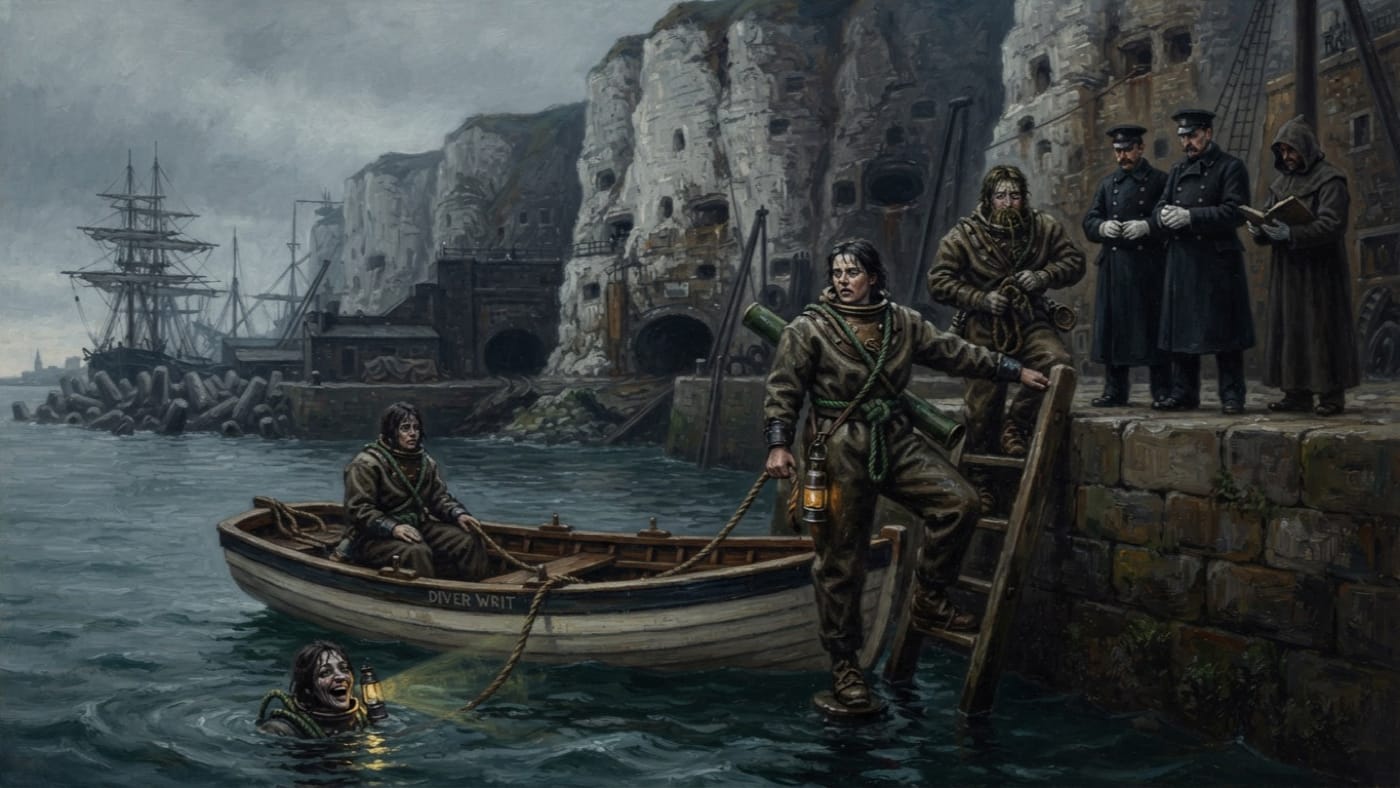
The Black Lungs are the Undertide Divers of the Chalk Redoubt of Calais. Nobody on the Net Quays has used the longer name since the Diver Writ was first printed. They are human, and I say so at the outset because the file on the Undertide holds so many draggers, bellies and processional masses that a careless archivist might shelve the people who go down after them in the same cabinet. The Black Lungs belong in a different drawer. They are militia and specialists: rescue crews, recovery crews and cave scouts. The Chapterhouse sends them under the chalk when a name has sunk on the Wall and the water below the harbour goes still.
Locals explain the nickname four different ways over spiced salt-wine. The Bureau has adopted none of the four, and I decline to add a fifth. A corps that climbs the quay ladders spitting brine and chalk grit takes its name from the people watching it climb, and those people do not file etymologies.
The Chapterhouse needs them. It is also wary of them, the way a cathedral chapter is wary of the one canon who keeps the crypt keys. The record holds both facts. Only the second was written down with any warmth.
#On the Work Beneath the Chalk
From above, Calais is defended by guns, mine-chains, the bell-grid of the Gunline Choir, the bone-reinforced Teeth, and the quarantine gate, which in practice defends against everything. Each of these points at water that nobody on the cliff can see into. The Black Lungs can see into it. They launch from the Net Quays through the under-cliff boat tunnels and into the sea caves that run back under the redoubt. Down there are drowned shrines older than the garrison, and passages the quarry families walked long before anyone had the authority to forbid it.
Their public warrant is rescue and hunting. In practice the work falls into three parts. They bring up the living when a skiff founders or a tunnel floods. They bring up the dead, along with whatever the dead were holding, and this is the more common duty. They also scout the caves: which have shifted, which approaches have grown louder, which channels the things below used last and may use again.
The trade was learned in the wreckage of the Great Breach of A.S. 71. That year the sea caves broke, hundreds drowned, and survivors went back into the black water with rope and lamps to look for whoever the water had kept. Grief and necessity drove those first descents in roughly equal measure. Formal arrangements came later, and in Calais formal arrangements are made of paper. The offices that answered the breach carry Synodal titles in the record now. In A.S. 71 they were coastal engineers, a frightened garrison and whatever bells were to hand. The formal Synod was still nineteen years away from ratifying anyone's letterhead.
#On the Descent and Its Warnings
The kit is plain. A diver has a suit, a lamp, a rope, a cave map and the kelp-green cord that marks a Black Lung on the quay as plainly as ink-black cuffs mark a Tribunal clerk. The parent file also records brass throat plates keyed to emergency bell-lines. The Gunline Choir wears brass at the throat too, and neither office has conceded that the idea was the other's. I have not seen a diver's suit opened on a table. I will not describe one by guessing.
What the divers do describe, readily and with tedious precision, is the approach. The first sign is pressure in the teeth, a dull ache in the jaw that has nothing to do with depth. The second is the lamp flame flattening sideways in still air. The third is the rope getting heavier while nothing visible pulls on it. A diver who feels all three is expected to signal and turn back. The record does not say how often a diver feels all three too late to do so.
Each carries a knife, silvered and salted, which is good for cutting a fouled line and for very little else. Calais tells newcomers otherwise and lets the sea correct them. A blade cannot open a tide. A correct map can bring a diver back, and so can the right bell sequence struck on time from the cliff. Calais reckons its jurisdiction by how far its fog-bells can be heard, and under the chalk they carry badly. In the deep tunnels a diver is nearly outside the city's law, which is one reason the city distrusts the divers and one reason they keep going down.
Nobody has given me an honest account of the things themselves as a diver meets them, and I refuse to write a dishonest one. The divers report shapes, pressure and noise. Their findings sit in the bestiary drawer, still awaiting classification.
#On the Captain and Her Second
Diver-Captain Sain has gone into the cave systems more times than any living officer on record. Her reports give depth, current, visibility, rope length, how long the lamps lasted, and casualties. She does not describe faces. Asked why, she answered: "Because some were ours." The Bureau filed the answer without comment. I add none, which for me is a considerable act of restraint.
Her second is Ila "Kelp", who laughs underwater. Seven divers, two signal riggers and one quarantine warden attest to it. The warden heard the laughter rise through a sealed pump. Physicians cannot say how a person laughs at depth, and the divers will not say why she does. The Bureau of Purity has declined to investigate. Inquisitors dislike water and call the dislike jurisdiction.
The two go into the same water. Sain comes back with numbers. Kelp comes back amused. The garrison finds the numbers more frightening, and the garrison is wrong.
#On What Returns
A diver surfaces with kelp in their teeth and someone else's ring, as the quay saying goes. The ring passes to the Tribunal clerks. The body, if there is one, goes to the Undertide Pens. The Pens are a quarantine facility in law and a cupboard in practice, where the wardens keep problems in white gloves until the problems stop making noise. Returning divers are inspected at the same gate as returning corpses, and the wardens do not always say which category they have in mind.
A diver who does not come back is written down twice. One entry goes in the casualty ledger. The other goes in the watch book of the Script Wall, since the names of lost divers have often appeared on the chalk within seven nights, low down by the surf line, where a reader has to kneel in seawater to speak them. Often is not always. The watch book keeps the vigil all the same, and the ledger clerks have stopped asking why.
Then there is the testimony, and here the Black Lungs become a political problem. Below the harbour they see what nobody on the cliff can see, and the Bureau of Doctrine has never decided what such sight is worth. A diver who says the caves tapped back on a heavy reading night has made an observation, a heresy, or both, depending on which seal receives it. The Unread argue that the reading feeds the tide. Their pamphlets cite diver talk without asking the divers' permission, and the divers have not sued for plagiarism. That silence is now under review.
The Coastal Annex describes the Undertide Divers as the only living witnesses of the things below.
Corrected. Breach survivors live in the Chalk Warrens. Net crews have watched bellies rise under their keels. Gunners on the Teeth have seen processional masses press against the pilings. The divers alone go down to the entities, repeatedly and on purpose, and come back up to report. The Annex mistook a professional monopoly for an ontological one. The divers have not corrected it.
The Chapterhouse complains, in correspondence I am permitted to summarize, that diver reports arrive measured, signed and incomplete. Salvage rumours mention caches in the boat tunnels. Tribunal clerks mention sea-gates that jam on the days a dive is scheduled. Proof of a conspiracy would require someone to go into the caves and find it, and the only people qualified to do so are the suspects.
#On the Present Watch
In A.S. 199 chalkscript appeared on doorframes three hundred yards inland. Names bled through plaster in the Chalk Warrens, and a child's name showed on seven lintels in seven different spellings. The divers were not sent inland. Their work stayed in the caves, where the trouble presumably began, and the caves have grown worse.
The lamp oil shortage of A.S. 201 has slowed the readings. Slower readings mean more names sinking, and sunk names bring the west-hush back into the harbour. Cave System Bravo has been active. A diver's lamp now burns rationed oil on the same ledger as a reader's lamp, and the two allocations are fought over in Salt Row with a ferocity the Bureau reserves for budget lines. Commander-Prior Sabelle Morn has requested oil, powder, bell riggers, quarantine surgeons and reinforcements. The Bureau of War sent back a circular praising vigilance. Cantor-Major Pell keeps the fire-chart and counts the beats. The Bureau of Bells confirms that the sequences remain sacred.
The Black Lungs go down at dawn under Amber discipline, with rope, lamp, map and green cord. They come back up at the quay ladders, or they come back as names in the watch book, written low on the chalk.