

Reverse Index
Referencing “Black Ledger Cutpurse / Assassin”
Every codex entry that links to Black Ledger Cutpurse / Assassin. 21 entries.
Return to Black Ledger Cutpurse / Assassin

Black Ledger of Ghent
One hundred thirty-seven dead, four columns, and a stain called water
Seized in A.S. 159, Ghent's blood-stiffened weigh-station ledger records 137 executions and the arithmetic that became a criminal banner. The Church keeps it under glass and calls the stain water.
Codex Ref. XIII.1.17-002

Cache Runner
The clerk hides the absence; the runner carries the weight
The Cache Runner is the Grain Keeper's route specialist, moving diverted grain through curfew to hidden stores and hungry households. One interception gives the Bureau a cellar, a ledger, and a ward.
Codex Ref. XII.13.07-001
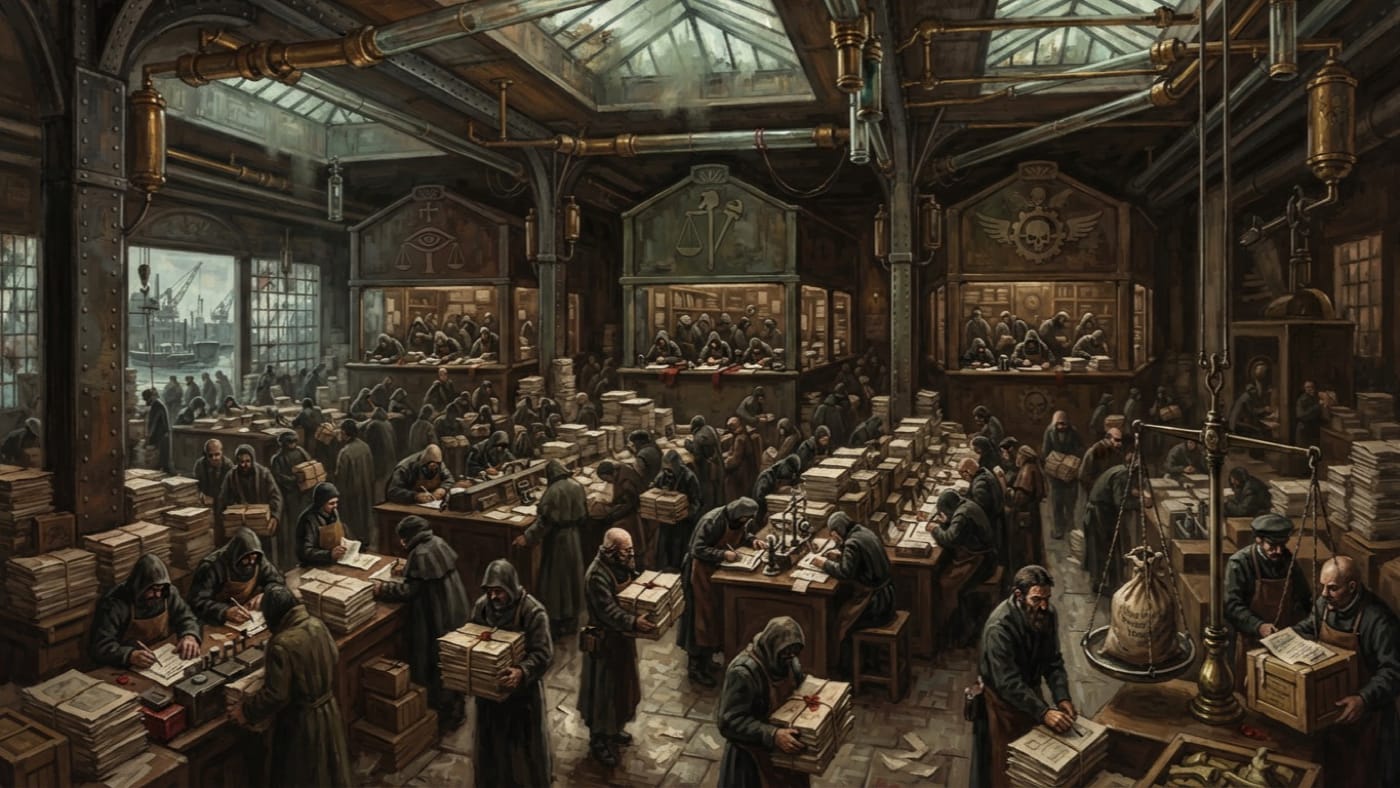
Canebière
Where cargo becomes paper, and paper waits for permission
Marseille's commercial quarter, where merchant houses turn cargo into paper under three competing Bureau offices. Goods may leave once their description has acquired every necessary seal.
Codex Ref. II.4.09-019

Caravan Factor
The Synod's confession that geography is ungovernable, licensed and taxed accordingly
The Caravan Factor occupies the gap between the Bureau's filed route-plan and the road's actual condition — part cartographer, part accountant, part diplomat, and part criminal, though the Synod prefers not to use the last term in official correspondence.
Codex Ref. XII.6.01-001

Checkpoint Queue-Marshal
The man who holds the rope holds the war
The Synod's most hated indispensable servant — 1,140 Queue-Marshals holding the ropes that hold the lanes that hold the war together, constituted A.S.
Codex Ref. XII.7.01-001
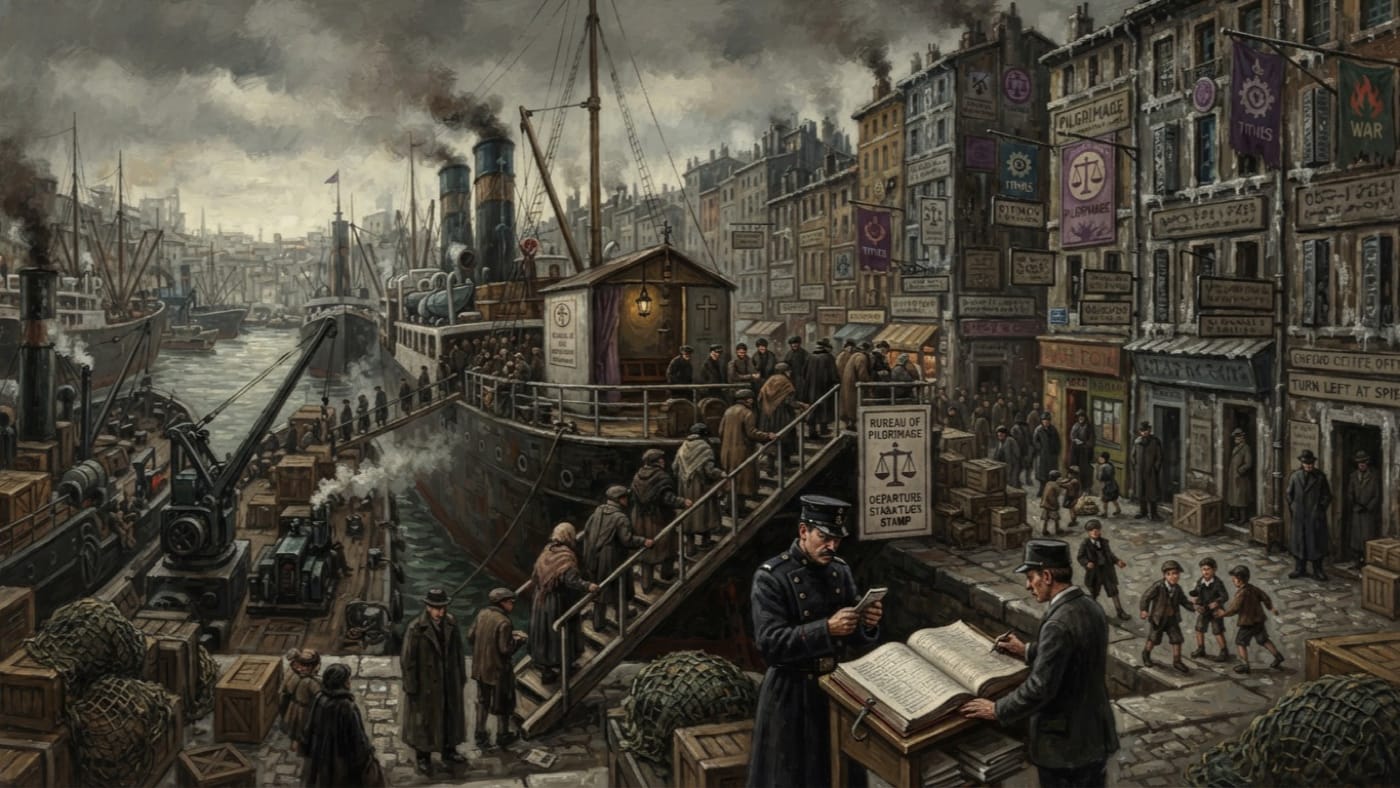
Eastern Basin
Pilgrims sail under seal; the spies serve as landmarks
A.S. 201 survey of Marseille's enlarged harbour and quayside quarter: pilgrims sail under seal, relics arrive under suspicion, three Bureaus dispute the water, and the officially nonexistent spies serve as landmarks.
Codex Ref. II.4.09-013
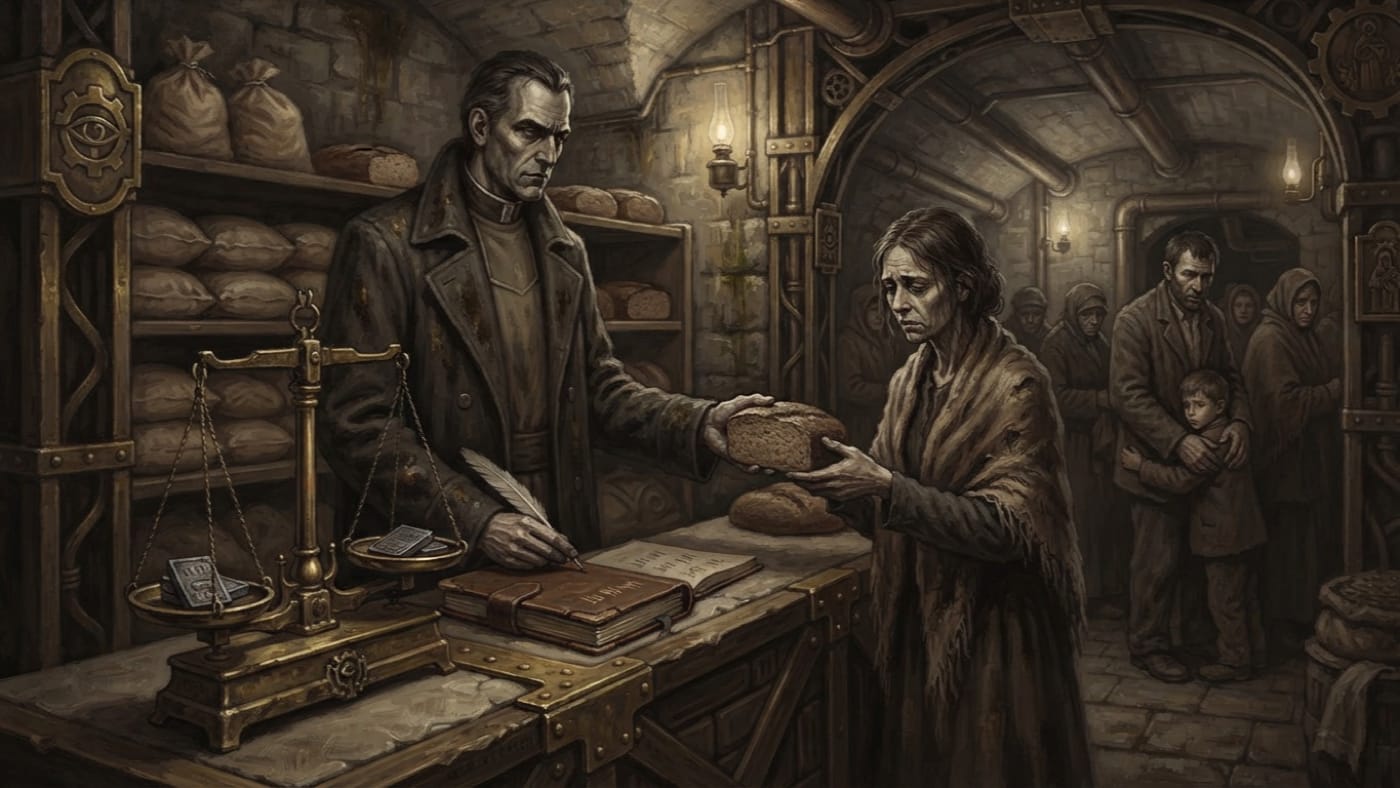
Famine Interest
The loaf is eaten; the obligation survives
Famine interest advances bread against property, silence, service, and persons. The Hunger Broker's ledger compounds because the debtor keeps eating.
Codex Ref. XIII.1.13-001
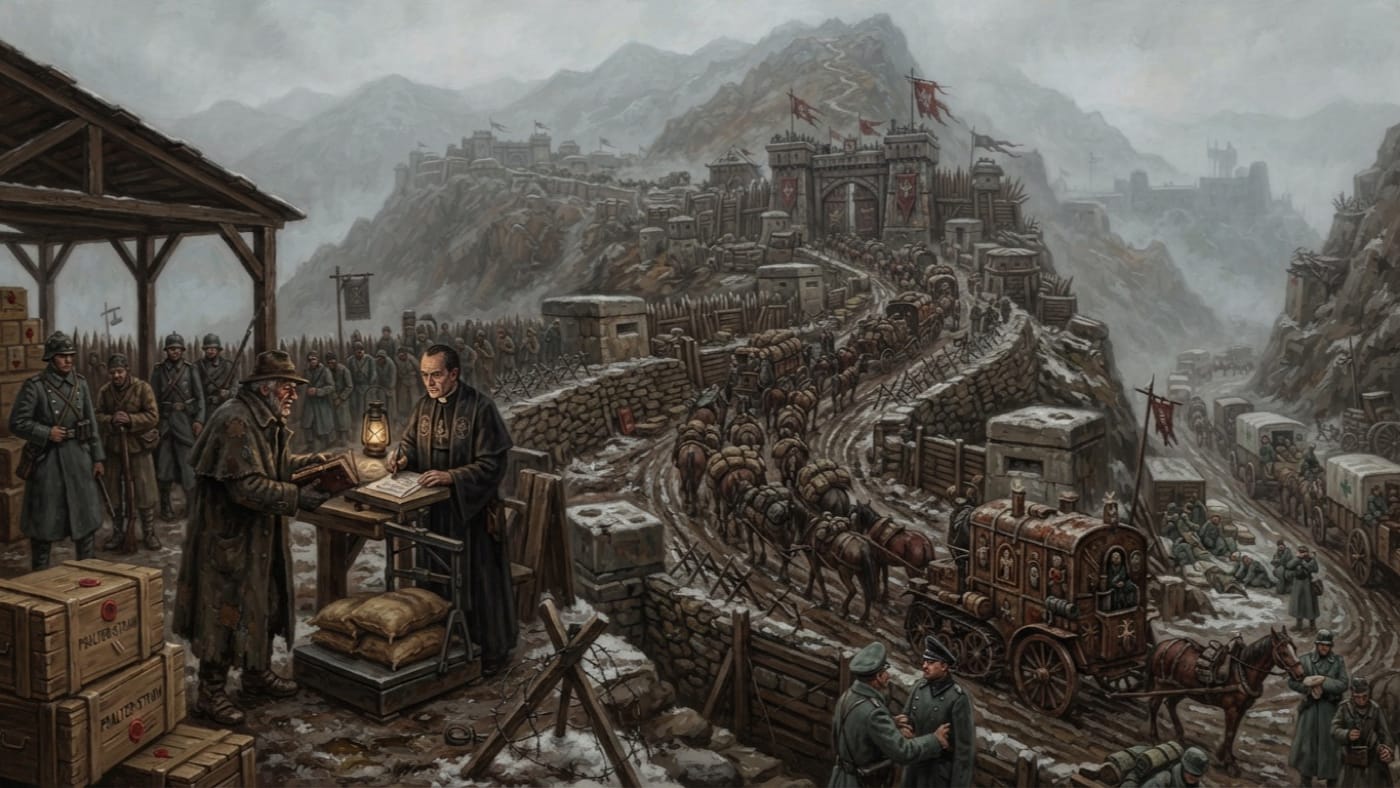
Forward Supply Zone
Where freight becomes evidence and every sack requires a confessor
The Bureau of War defines the Forward Supply Zone as Zones 4–7: bastions, contested ground, Charnel Lands and southern sea lanes. Freight crosses by permit; every loss and every bribe must find a name to answer for it.
Codex Ref. II.4.07-201

Gatewarden-Notary of Passage
The sole functionary who may halt a column of four thousand by raising one ink-stained hand and asking for documentation.
The Gatewarden-Notary of Passage stands at the point where all five great commodities of the war — disease, heresy, desertion, contraband, and ambition — must be sorted, weighed, stamped, and either admitted or refused. The Gate does not care about the man.
Codex Ref. XII.7.04-001

Grain Keeper
The fifth proscribed heresy, which is also why most of the civilian population west of the Sagittal Line survived the last four winters
The fifth proscribed heresy: farmers and millers who hide grain from the Bureau's ration ledger and thereby keep the population alive. The Bureau calls them spiritual saboteurs. The population calls them their only recourse.
Codex Ref. XI.2.01-001

Ledger Duellist / Citation Advocate
Where the sword would be excessive and the firing squad irreversible, the Synod reaches for its ink
Fourteen hundred licensed advocates fight citation duels in the Synod's precedent pits — establishing standing, constructing precedent chains, striking opponents from the Ledger of Souls. Three hundred more operate in the shadows.
Codex Ref. XII.26.01-001

Ledger Hand
Legible, and therefore unread
Ledger Hand is the Grain Keeper art of making fraudulent ration pages look too dull to read. Attributed to Old Klem, it conceals grain misapplication beneath competent penmanship.
Codex Ref. XIII.1.100-201

Ledgerwrights
The hand that gives the bread and enters the debt
Ledgerwrights allocate the Black Ledger's bread, assign its targets and keep the second book. The hungry receive aid; the desk records what their gratitude may purchase.
Codex Ref. XII.4.04-001

Mara Vell
Seven hundred pages in search of a woman
Mara Vell, the Blank Notary, is the seal-forgers' patron and the subject of seven hundred pages. I can attest to the file. The woman remains unresolved.
Codex Ref. II.1.41-001

Marseille
Salt, pilgrims, and a territorial dispute the [[bureau-of-records|Bureau of Records]] has declined to arbitrate
The Synod's southern mouth — 650,000 souls between limestone and salt water, two competing Bureaus sharing a harbour they cannot agree on.
Codex Ref. II.4.09-012

Old Klem the Ledgerman
He did not hide the sack; he hid the absence
Old Klem the Ledgerman is the condemned founder-figure of Grain Keeper ledger fraud, the clerk who taught spoiled grain to become bread again.
Codex Ref. III.2.01-122

Quai Saint-Lazare
Where holiness queues, fraud pays duty, and Marseille sells the answer twice
Quai Saint-Lazare is Marseille's salt-crusted relic throat, where the Bureau of Relics weighs bones, doubts miracles, prices fraud, and forwards danger under seal.
Codex Ref. II.4.09-017

Shadow Advocates
No licence, no bell, no mercy; still the ruling holds
Unlicensed ledger-duellists who settle filthy disputes in cellars, warrens, docks, and black-market rooms where official law cannot appear without confessing failure.
Codex Ref. XII.28.04-001
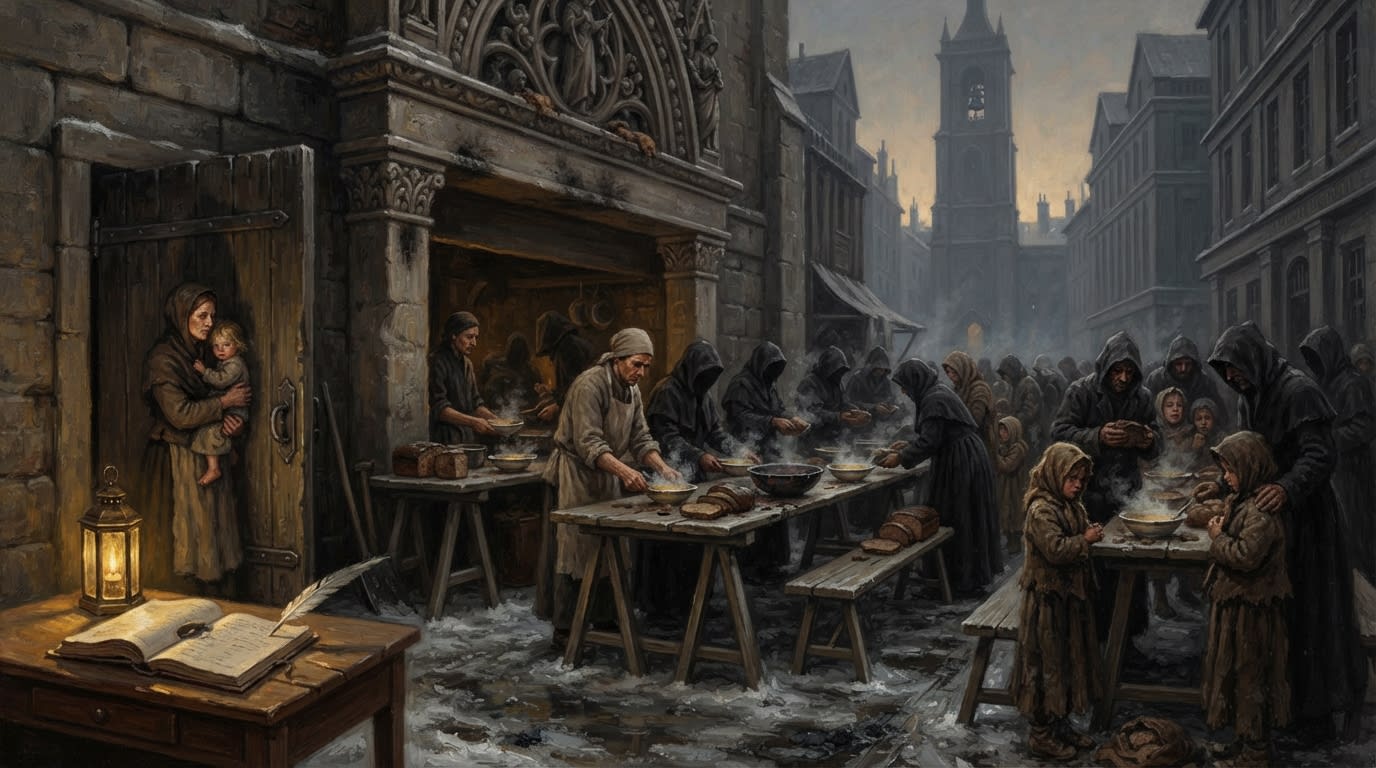
The Ashen Ascension
Mercy with a bowl, a ledger, and an appetite it will not name
The Ashen Ascension feeds before it prays, shelters before it asks, and names the dead before it claims the living — which is why the Bureau cannot burn it without admitting what the Bureau has failed to feed.
Codex Ref. XII.9.04-001

The Codices Obscurae
The books that do not exist have excellent indexing
The Codices Obscurae are denied by every Bureau that matters, which is precisely how a careful reader knows where the bodies are indexed.
Codex Ref. XIII.1.06-001

The Salt Dues of Marseille
Temporary measures have the finest survival instincts
The Salt Dues of Marseille began as an A.S. 92 emergency surcharge on coastal salt and learned immortality, feeding war, pilgrimage, and every clerk hungry enough to call permanence temporary.
Codex Ref. XIII.1.39-001