
#On the Familiar Face
"The enemy who comes with a rifle has the courtesy to look like an enemy."
Field scholars attribute six kinds of identity-demon to Morwen, the Weeping Host. The Beloved are the only ones that need no introduction, and that is their whole method. A sentry at Bastion-Irongate is trained to challenge strangers, deserters, an officer in the wrong boots and the corporal who reports for duty twice. He is not trained to challenge his mother. No army under the Creator has worked out how to train him to do it.
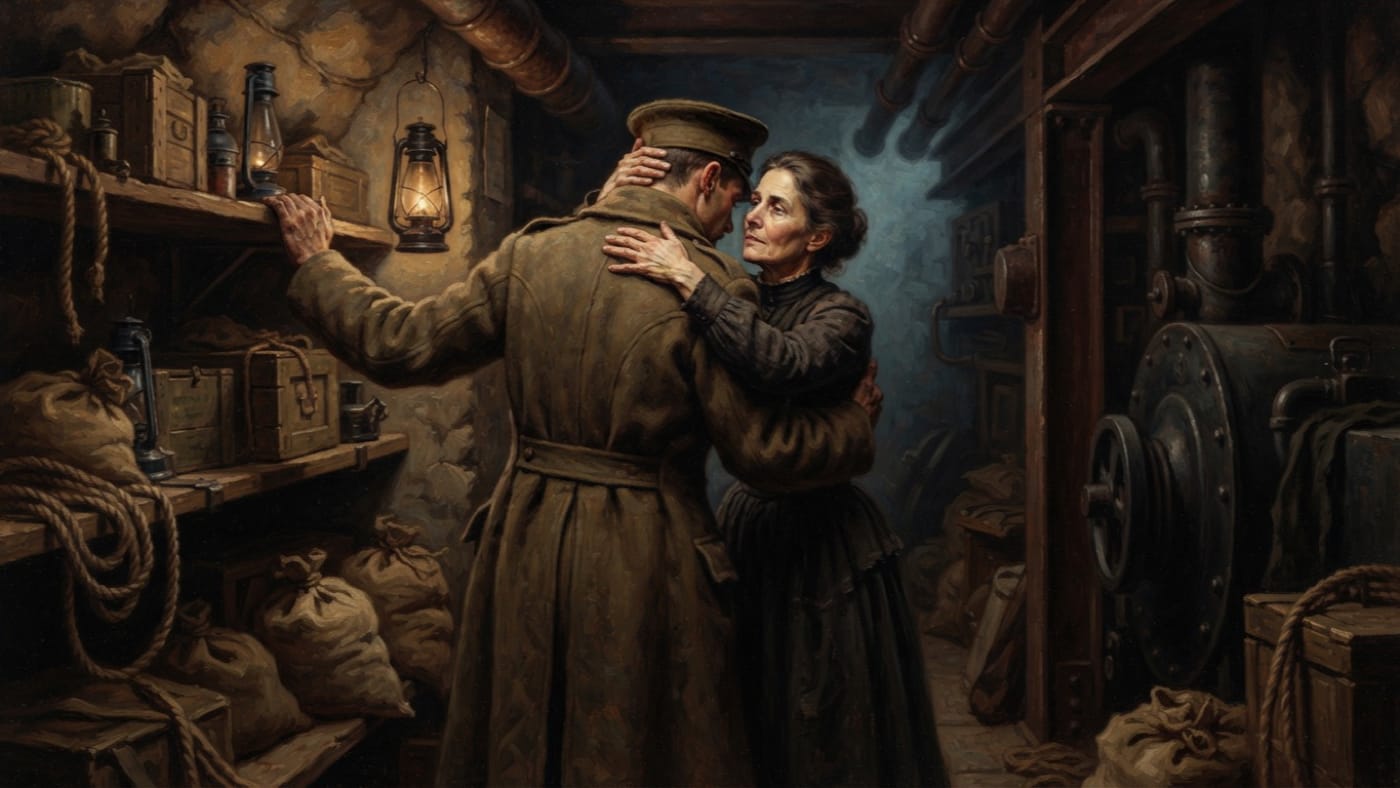
She comes into the supply recess at the second watch with her hands folded the way she always folded them, left over right and thumbs crossed, as she held them in the back pew while the priest overran his hour. She has been dead three winters. Or she is alive and asleep in a village two hundred miles west, which is worse, because the sentry has no grief ready to make him suspicious. Sometimes it is a childhood friend, unchanged, who mentions the quarry and the stolen pears. Sometimes it is a wife whose original is twelve yards down the same trench ladling broth. The husband looks from one to the other and finds that he loves both of them.
The dead make the work easier for the Beloved, but they are not required. Bereavement is just the cheapest way in. Any love will serve.
#On Their Embrace
"They do not attack. They embrace. They comfort. They forgive."
Every other enemy on the Line can be described by what it does to a man. The Beloved can be described only by what a man does for them. They do not shell the parapet or creep under wire. A Face-Thief spends months studying a captain so it can take his place. A Hollow One sits near a sapper until his phrases start to leak into it. The Beloved simply ask to be held.
What happens next is up to the soldier. The Bureau of Doctrine holds that no demonic power overrides the will, and the Beloved do not try to. They offer comfort, and the soldier decides. If he returns the love, leans into the shoulder, says Mother and lets himself believe it for one breath, he pays. Something essential to his particular self passes across to the thing he is holding.
The field accounts agree that there is a payment. They disagree about what it is. Some describe a memory that has gone pale: a kitchen remembered without its smell, a father's departure kept as a fact but no longer felt. Some describe a lost habit of the hand, or a phrase that no longer feels like his own. The account from the Palace of Echoes has the plainest wording: a mother's face becomes familiar rather than beloved. The man can still recite her name. He has stopped flinching at it.
Nobody knows whether touch is needed or whether returned affection is enough. The surviving depositions include both, which settles nothing. Nobody knows what exactly passes across, either. The Bureau has given the substance no name. Since the Bureau names everything, including the damp, I take this as an admission of ignorance.
The loss builds up. A man embraced once is a little less himself. The published Morwen dossier traces the longer road of surrender to its end in the Hollow One, a person-shaped vacancy waiting for the next better life. I will not turn that road into a schedule. No file I have read shows a single embrace producing a Hollow One. The Bureau of Rites has sealed its dissolution cases, and I am not going to unseal them by guesswork.
A preference for embracing over bayonets is a method, not a promise of harmlessness. General field doctrine holds that Morwen's corporeal demons bleed and die like the rest of the Great Deceiver's infantry. The Synod has recorded no weakness peculiar to the Beloved. Killing one has never been the hard part. The hard part is getting a man to fire at the woman who taught him his prayers.
#On the Fitting of Faces
"A Beloved is fitted behind them."
The Palace survey describes Morwen's military doors in one sentence: a Mirror-Stalker studies through them, a Beloved is fitted behind them, and a Worn is taught which sorrow to speak in which voice. The same fragments describe the Archive of Unworn Lives, a store of gestures, griefs, laughs and command-voices separated from their owners and kept as stock. Records can say that a Beloved is fitted. It cannot say from which shelves, by what hand, or how long the fitting takes.
The categories blur at the edges, as all of Morwen's categories do, but the Beloved hold their own ground. A Mirror-Stalker shows you yourself improved. A Face-Thief replaces a particular person so it can occupy his life, his bunk and his pension. A Beloved wears the person you love and aims that face at you. The mother is the bait, and the son is the target.
#On the Mother and the Soul
"A Beloved wearing a mother's face does not become the mother."
The sentence comes from the second clause of the Singleton Doctrine, the clause on non-transfer. Doctrine wrote it with an actuary's calm. The likeness can be perfect: the folded hands, the habit of saying the son's name with a rising note, his childhood fevers remembered night by night. None of that makes the thing the woman. Copying her appearance does not multiply her person, and the soul, Doctrine holds, cannot be passed from hand to hand.
The doctrine has a consequence the soldiers dislike. A Beloved often comes with forgiveness: for the letter never sent, the funeral missed, the harsh word on the platform at Sofia. Doctrine says that forgiveness carries none of the mother's authority. She is the only one who can forgive what was done to her, and she is either in the grave or at home. It is not absolution either. Confession cannot be handed to a better speaker, and no sacrament passes through a borrowed mouth. The soldier who accepts that pardon has received nothing, and has paid for it with something of his own.
Doctrine also holds that whatever passes to the Beloved cannot be the soul, because the soul does not transfer. Doctrine has not said what it is instead.
Meanwhile the clerk has a body in the recess and two women's names on his form, and he cannot tell from the corpse which one he is filing. Heaven knows. The fourth clause lets the clerk act without knowing as Heaven knows. He writes conditional identity and moves on.
The Bureau of Doctrine's A.S. 180 guidance held that the Singleton Doctrine afforded "absolute theological protection" against identity corruption.
Revised A.S. 199: "significant theological comfort." The Doctrine and the Beloved now deal in the same commodity. Doctrine's is genuine. The Beloved's is warmer, and comes with arms.
#On the Refusal of Comfort
"We can hold the walls. We cannot hold ourselves."
The Synod's tests were built for impostors. They do badly against intimates.
Challenge phrases fail first. A Beloved wearing the friend from the quarry knows about the pears, and knows which boy fell in. Personal histories fail next, because the history is the bait. A recognition test assumes the claimant is trying to get into the son's life. The Beloved is trying to get the son to come out of it.
The Ledgers of Self do somewhat better because they work from the other direction. A Ledger records the soldier, not his mother. A man who comes out of a recess and can no longer give the smell of his father's kitchen, or the exact words he muttered when his first rifle jammed, has a gap that a clerk can measure even when the man himself cannot feel it. The bone-lines are copy-resistant, and a gap in them can be read. The Ledger cannot tell whether the woman in the recess was real. Sometimes it can tell what she took.
Chaplains are told to quote the non-transfer clause aloud, slowly, to any soldier reporting a visit. Purity watches his eyes during the recitation and writes down nothing tender. Neither office claims this is a cure. The chaplain gives the man a sentence to hold onto. Purity notes whether he can still hold it.
Mirror Discipline does not help here, and soldiers should stop believing that it does. The three-count rule guards against reflections: recognise, assess, avert. A Beloved standing in a supply recess is not a reflection, and turning one's eyes from a woman's face has never once stopped her arms.
Sometimes the Beloved wears a person who is present in the garrison, like the wife at the broth kettle. The matter is then a matter of two claimants, and the Twinning protocol may apply. That procedure is narrow. It requires an emergency identity hazard, the concurrence of Purity and the Bureau of War, and Rites observation, and since A.S. 199 it pauses three times for Ledger comparison, controlled mirror exposure and Rites protest. Twinning is permitted policy. The Singleton Doctrine does not demand it, and a Beloved sighting does not trigger it automatically. Mercy, the Bureau and the widows have all filed objections. The weather has not changed.
What actually works, when it works, is refusal: a man saying you are not her to her face, in her voice, while she forgives him. I have heard that it is the hardest sentence spoken on the Line. I have never had to say it.
#On Their Present Employment
"The Kindest Enemy keeps the second watch."
In A.S. 201 the Beloved are active along the Danube approaches, in the recesses and listening-saps of Irongate. They come across the Mirror Waste from the Hollow Vale, and they come at the hours when letters are read. This survey records their present employment and does not claim to date their first appearance, their first classification or their numbers. Morwen has not sent them against the walls. She sends them to the men behind the walls, one at a time, with their hands folded.