
#On the Protected Road
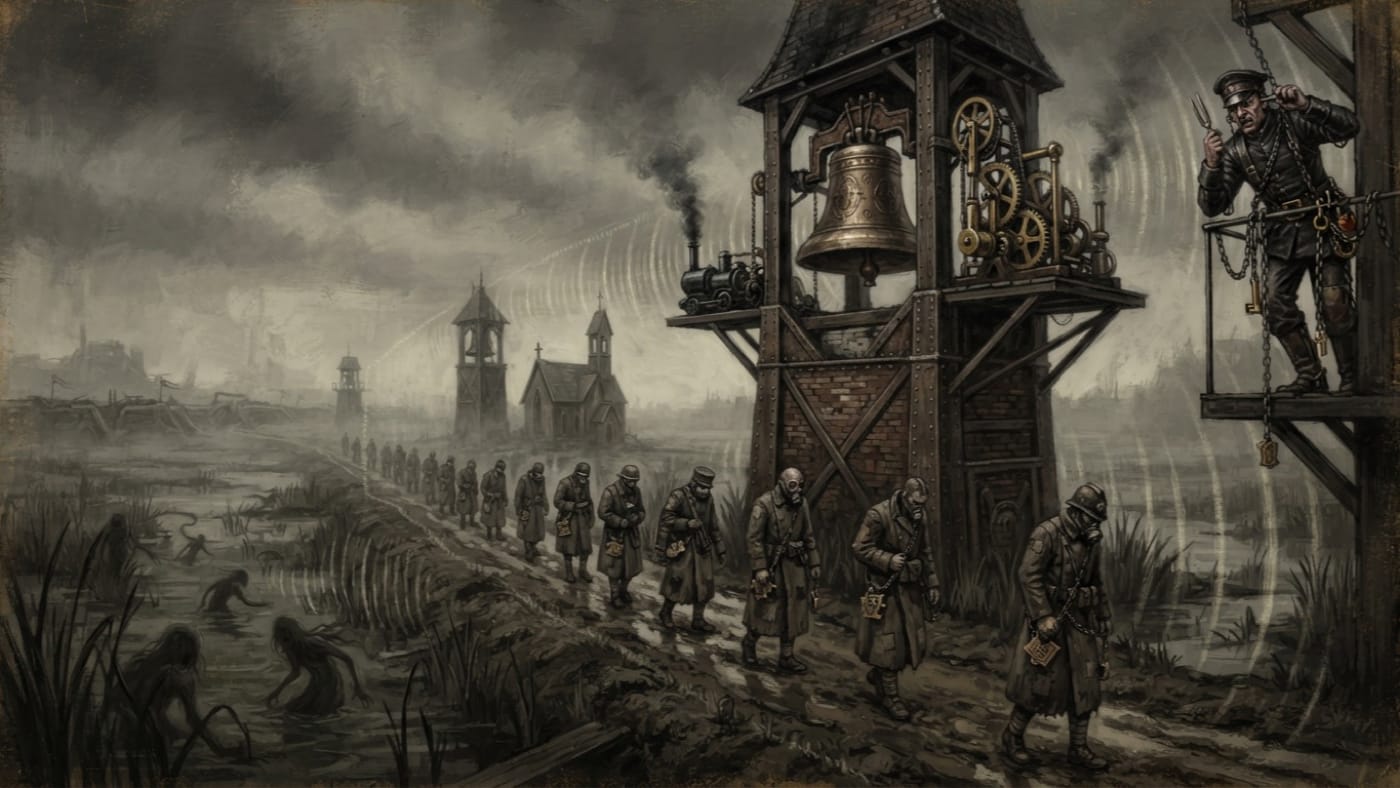
A pilgrim on a licensed road walks inside a sound and seldom notices it. Bells in the road chapels, waystations and relay towers ring in overlapping peals, each one caught before the last has died. A traveller who keeps to their cadence moves through a corridor that the Bureau of Bells has tuned and the Bureau of Pilgrimage has licensed, and that the Creator, as far as any careful clerk can tell, has declined to contest. This is Bellway protection as the road knows it. It has no walls. It has intervals.
The intervals are specific, and so is what they do. The craft-lore of the Route-Stampers records that certain Bellway intervals repel minor river-wights and the whisper-things that gather in roadside ditches. The Bellwardens add three more services: warning peals, the masking of certain sounds that come before an incursion, and the gating of passage itself. That list ends where the evidence ends. Doctrine teaches that pure tone drowns the whispers. Why a correctly struck interval should offend a river-wight, Doctrine has not filed.
The same instrument serves larger masters. Along the Sagittal Line, from Bastion-Königsberg to Bastion-Constantinople, military peal-nets carry command, and a sector is bounded by what its bells may order. Above the trenches the Vigil Arks and the towers of Orison measure their sky-sermons against the same tempo. The pilgrim hears only the humble end of it: a chapel bell ringing on schedule and keeping small things in the reeds.
#On the Tone and Its Keepers
A protected road is a maintained road, and the maintenance is done by hand. The Bellwarden climbs to the sector bell with a toll-key chained to the harness, a set of tuning forks, an oil kit, chalk for pitch marks and wax for the log. At the top the warden checks pitch, decay, the spread of the tone and the interval between strikes, then listens for anything rung without authority. That might be a tinker's handbell, a smuggler's wedge, or a hum in the stone that matches no chart. Small drift goes into the log. Larger drift brings a hush order or a tone quarantine, and the road closes.
The key is chained because keys were once stolen. Bellwarden lore keeps the memory of a year when rebels took the bells and the streets fell silent, and the chains followed soon after. The wardens say "the key is the vow." They mean it more literally than the men who wrote the vow.
The Church has divided this work among its offices with the care of heirs dividing a dead man's coats. Pilgrimage licenses the road and issues the token. Bells licenses the tone, ordains the bell-masters, and keeps the standard set by the Bell Codex, ratified in A.S. 115, which judges every lawful peal, silence and alarm. The Bureau of Tithes collects wherever a pilgrim may be stopped, which is everywhere. Commerce charters the smiths who make the tokens, and Records may veto them. No single Bureau owns the protection of a pilgrim. Each owns a share of the invoice.
The cost falls on the keepers' bodies. Tower work takes the hearing first, then the sleep. After that come phantom peals, compulsive counting, and the inability to rest without something humming in the room. The Bureau calls this bell-sickness. It treats it with rotation and reassignment. When a warden begins to hear names inside the brass, it treats it with a quiet change to the roster. The road keeps ringing, and it does not record who rang it.
#On the Token and the Licensed Step
The pilgrim token is where the road's sound meets the pilgrim's body. Since A.S. 140 the token has carried a bell-hour core, and a Route-Stamper fits it in a fixed order. The smith verifies the bearer's identity and eligibility for the route, then stamps the crest and serial and binds them to a ledger entry. Next the core is seated and tuned to the cadence of that particular road's Bellway. Finally the token is sealed in red wax and walked in the shop's pacing-lane, over chalk hour-marks, while the smith counts against the tick. The good shops also keep a quiet box for listening tests and run a sample at midnight, because the trade holds that a core sounds different after the hour turns.
The tuning is the whole point. A token tuned to its road keeps the bearer's pace in the road's time. A pilgrim who keeps that time is on the licensed stretch, within the licensed window, at an hour when the bells are rung and kept. The protection belongs to the road. The token keeps its bearer in step with it, and at every inspection it tells the gate whether he has stayed in step.
The Church found this convenient in three directions at once. The chime that marks a safe pace also marks a lawful one. It feeds the indulgence ledger. It tells the checkpoint clerk, the chain-handler reconciling the day's counts, and the Tithes officer working out a deviation levy exactly where a body has been. Since the Bellway Harmonisation aligned pilgrim routes to bell schedules so that movement could be traced by toll pattern, a late pilgrim announces himself to everyone with a ledger.
Bronze, Silver and Gold each authorise different roads. The Bureau of Bells publishes no table showing that Gold is guarded more tenderly than Bronze. The metals license journeys. Nobody has shown that the river-wight can read them.
Early sermons claimed the token "forgives as it rings."
Corrected. The token forgives nothing. It records eligible motion for later application against approved categories of remissible fault. Whatever keeps the bearer alive on the road is kept by the road, its bells, and the people paid to tune them.
#On Drift and the Counterfeit Winter
The Great Counterfeit Winter of A.S. 160 is the Church's best-documented case of tokens that passed every inspection and failed the road. Forgers in Lyon, Marseille and two frontier towns that the public audit does not name made bell-hour cores that drifted fractionally from the authorised Bellway frequency. The metal was good. The stamps were good. The tokens rang true to every ear at the gate. A trained Tuner holding one close could hear a faint wetness in the chime, but Tuners were not posted at every ford.
Pilgrimage's own account says that after a week's march the accumulated error had placed bearers three hundred yards outside Bellway protection. The dead were logged as route-adjacent fatalities, environmental. Three hundred yards is the distance reported that winter, under those forgeries, on those roads. It is no standard of coverage. The audit does not explain how a slight error in a sealed core moved a walker from the protected road to its margin. I decline to invent a mechanism for readers who want one.
The ledger answered in two columns. The first held bodies by the roadside, already classified. The second held spiritual debt, which accrues from the first false chime and descends on the forger's family whether or not anyone is convicted. The two consequences are distinct: drift exposed the walker, and debt pursued the household. The Bureau has never confused them and has never failed to collect on either.
The trade has argued about it ever since. Cadence Purists hold that a core tuned only to Synod-approved harmonics is the only honest core, and that every field adjustment is a forgery waiting to happen. Route Pragmatists answer that a road in mountain fog, at a river ford or across a marsh does not sound the way it sounds on the chart, and they tune for the road in front of them. Neither faction keeps a register of the dead that the other accepts. Below both of them the Silent-Core Crew sells muted mechanisms to smugglers and deserters. A silent core tells the gate nothing, and no Tuner will vouch for what it tells the road.
#On the Limits of Protection
The road is safe while its bells are true, and bells can be made false. A captured tower rings in an enemy's hand. A false peal moves crowds toward an ambush. A mimic tone, which Bells attributes to the Great Deceiver's agents, can copy the official cadence closely enough to fool the people sworn to detect it. Honest incompetence has its own record, since mistuned bells have caused panic and visions. Neglect is slower and duller. It looks like a slack rope, an unoiled mechanism, a timing wheel nobody has checked, or a Litany-Engineer's machinery left without power. A token tuned faithfully to such a bell keeps faithful time with a lie.
The Church's answer is the Counter-Toll Corps. When a foreign tone enters a corridor, its operators answer with sanctioned overwrite patterns until the road's cadence returns. "Louder is cleaner," they say. Their own lore keeps the exceptions: ears that bleed, crowds that panic at the overwrite as readily as at the intrusion, and hush corridors that fail and open breaches. When volume works, it restores the cadence. When it fails, the pilgrims hear two bells contending and have to choose which to follow. At the waystation markets of Peregrine Row, escort-sellers and dealers in quiet passes make their living from that choice. Their halls echo, and the echoes are unreliable guides.
What the survey can certify is limited. The bells keep certain small threats from the road when the bells are maintained, tuned and obeyed. The token keeps its bearer in time with those bells when it was honestly made and honestly carried. Beyond those conditions the protection is not a matter for this office. The deaths are Pilgrimage's to classify.