
#On the Low Ground
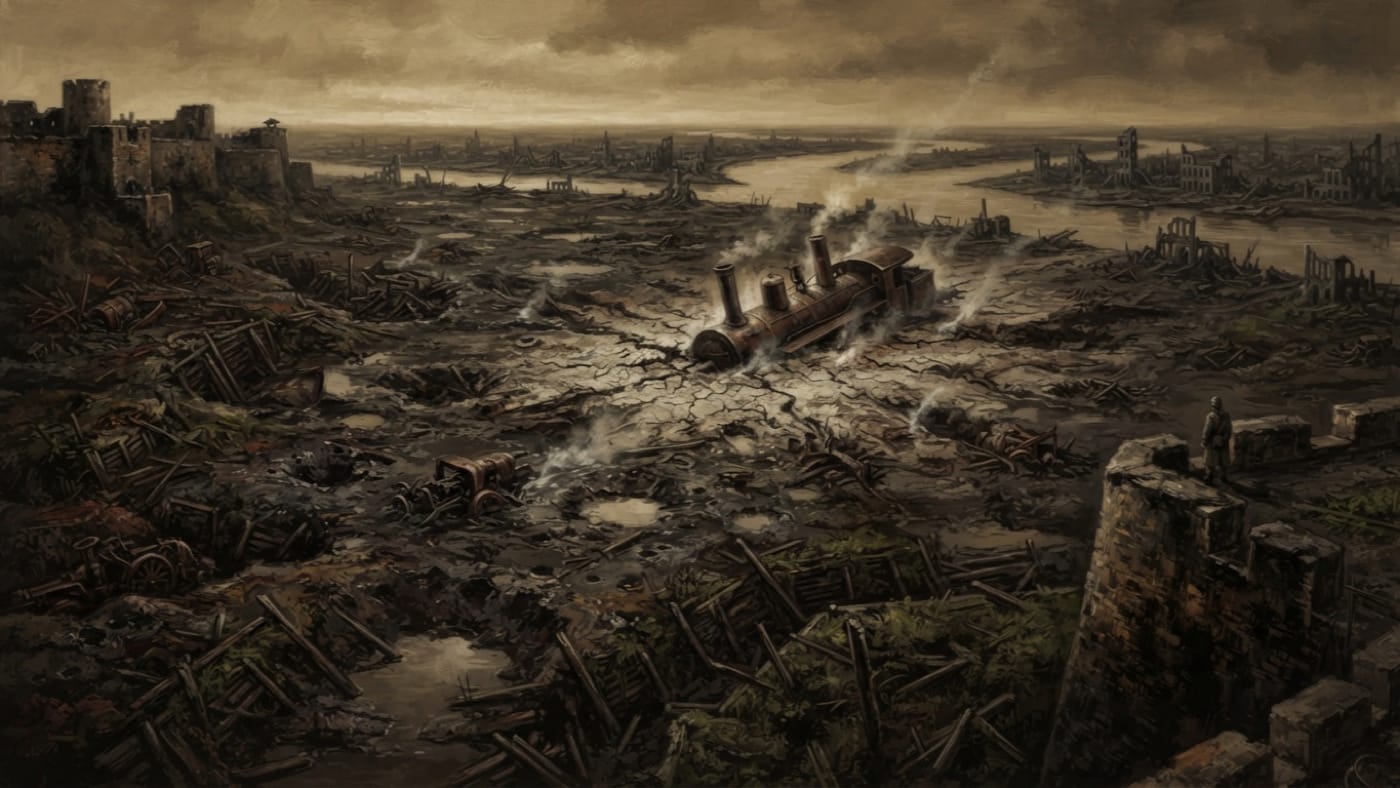
The Belgrade flats are the part of Belgrade the Synod prefers to see from above. They lie beneath the old citadel along the lower river approaches, where the Sava gives itself up to the Danube. The ground there holds the old fords, the ruined suburbs and the battery sweeps. It is pocked with shell-holes and hoof-pits and cut by collapsed trenches, and the long ford scars mark where columns crossed and did not come back. The upper city is stone. The flats are what the stone looks down on, and it has looked down on them without comfort since A.S. 120.
No surveyor has fixed their perimeter. The Bureau of Records carries them as a description rather than a boundary: the low ground below the fortress, down to the water, wherever the mud happens to be this season. A ledger can live with such wording. A patrol cannot.
In the battle the flats did the work low ground always does. They carried the fords the Enemy wanted and the lower sweep where Battery Veyl laid its guns, and they gave the Wrath-host a road into the river. They are also where the dead were left, because the dead were too heavy and the living too few.
Pilgrims today reach the approved rise above all this under armed escort. They kneel at the basalt sighting posts, look down, and are turned around. The flats are prohibited. Nobody has been forbidden to look.
#On the Mud Beneath the Surface
What lies in the flats is Flesh-Mud. The field classification is Category Two Hostile Terrain, Variable Sentience, and the classification belongs to the material. Belgrade's theatre remains Zone 5/6, ruined and contested, on or near the Sagittal Line. The mud is a Zone Five phenomenon that happens to have settled into a Zone 5/6 city. Clerks who confuse the two get reassigned to places where the distinction is taught with a spade.
At rest it looks like ordinary trench mire: black, glossy, swollen with rain. It gives a little underfoot and then holds, and that holding is where men start to trust it. Then it tightens. Soldiers who have survived it describe ligaments rather than suction. Something wraps the ankle, finds the joint and folds the limb downward, as if the ground were putting away a tool.
Its composition is the battlefield's inventory without the paperwork: river sediment, powder, rust, bone, grave-water, horse, man, the grease of rations and the wax of devotional candles carried into the line by boys who expected to need them. Nobody sorted any of it. The mud has.
The mud does not take sides. Wrath's infantry drowned in the same mire as the levy, and demons have gone under it as surely as the boys who were sent to kill them. A firm crust means only that the mud has not yet moved. War's planners judged these flats passable after nine days without rain. The Danube had fallen, and the low ground looked good enough for batteries. By the second hour of the battle the first gun-teams were axle-deep.
#On the Engine Taken in A.S. 120
The battle that the Church now calls the Miracle of the Danube's Turning had many parts. Maldrake's Wrath-host came west through heat-haze with its iron burning red. Relic artillery and river batteries answered it from the rise and the lower sweep. Campaign testimony records three apparitions above the guns and the river, and the Bureau of War, Doctrine and Records later ratified them on sight-line convergence. The Danube turned against the ford. The mud was one part of this, and a small one. It was simply the part that ate something.
At the seventh hour, as the Wrath-forged centre pushed into mortar range, one of its engines went into the flats and stopped. It sank to the waist. The record gives no name, crew or pattern for it, and I will not invent any. It was a Wrath-forged engine, and that is all the ledger holds.
It did what Wrath does when it is held. It burned hotter. Witnesses on the lower sweep describe the grates brightening from red to a colour they could not name and the air above it bending like water poured over a stove. The mud nearest the hull dried. Then it baked. A crust formed around the engine's waist, pale and cracked like a potter's failure, and for a short while the engine sat in a collar of fired clay that looked, to anyone watching from the batteries, exactly like ground.
Then the crust cracked.
What lay beneath it was not the black mire of the surface. The accounts all agree that it came up red. It rose through the fractures, over the baked collar and over the engine's burning flanks, and it took the machine whole. It did not topple the engine or drag it sideways. It folded the engine down into the flats the way it folds a horse, one joint at a time.
A chimney of steam stood where the engine had been. It screamed for nine minutes. Soldiers at Battery Veyl said the scream had words in it. The translators attached to the confessor detachments were asked afterwards which language those words were in. Each of them said he did not know, and each of them was lying in the manner of men who wished to go on sleeping.
Maldrake's centre broke at the eighth hour. It is tempting, and several regimental chaplains have given in to the temptation, to say that the mud broke it. The mud took one engine. The rout took guns, a river, three ratified apparitions and something close to forty thousand Synod dead in the casualty annexes. The engine is part of that battle, and the mud is no explanation for its outcome.
#On Favourable Terrain and Its Price
Three Bureaus filed the engine, and each filed it where it would do that Bureau the most good.
Doctrine filed it under miracle. The Enemy's machine was swallowed by the Creator's ground at the hour of the apparitions, and Doctrine saw no further question.
War filed it under favourable terrain. In War's usage that phrase covers anything that kills the Enemy without costing a battery.
The Bureau of Engineering filed it under pending investigation, and it has kept the file pending the only way Engineering knows: by sending junior surveyors down to look. The parent record says plainly that those attempts have been lethal. It does not say how many surveyors have died or how often they are sent, so I will not either. Engineering has never produced the engine. The flats have never returned it.
Men who must cross Flesh-Mud have the usual Zone Five measures. Salt bombardment freezes an active patch, generally for seven to twelve minutes, depending on rain, shelling and how many dead lie under it. Plank roads over fascines spread a man's weight. Censer smoke stiffens the upper layer long enough for a stretcher. Rope teams tie every man to two others, so that the mud must take three at once. None of these has been laid across the Belgrade flats as a permanent crossing, and no such crossing exists. They are field measures. They buy minutes and cost men.
The engine settled one point beyond argument: heat does not save you. The baked crust looked like ground and held like ground until the moment it failed. Anyone who reads the A.S. 120 account and thinks of fire as a crossing method has missed the whole of it.
Early War circulars advised personnel to cut trapped comrades free at the boot and pull upward.
Corrected. Upward extraction makes the ligament response worse. Brace the man, salt the perimeter, cut the visible tendrils, then pull. The engine was not pulled upward by anyone, and it went down all the same. Men pulled upward by their friends have gone down faster.
#On the Closed Lower Flats
As of A.S. 201, a canonised victory has not made the flats safe.
The Bureau of War keeps an observation post in the Upper Fortress and rotates its garrison every thirty days. The men there watch the flats for Wrath residue, illegal crossings and scavengers taking black mud to sell as relic-soil. They watch for the breathing after rain.
When it rains, water gathers in the shell-holes, the hoof-pits, the fallen trenches and the ford scars. The mud swells. Bubbles rise, warm, and break with a smell of iron, candle wax, rosewater and river weed. Sometimes they come in sequence, and the men on the rise have stopped counting them because the counts would go into a report.
The Wardens say the breathing is gas released from saturated battlefield soil. Engineering calls it residual thermal cavitation, which is Engineering's way of saying that something down there is still warm. Doctrine has ruled that the question lies outside devotional necessity, which means pilgrims may wonder but may not ask a priest. I record all three explanations. I endorse none of them. The flats have not endorsed any of them either.
The Belgrade Courts stand in the upper yards, between the approved rise and the low ground, and their troubles are their own. Nobody should mistake the tribunal yards for the flats or the flats for the yards. The yards have judges. The flats have appetite.
The Bureau of Pilgrimage, constituted in A.S. 123 when the roads to Belgrade filled beyond counting, sends its companies no lower than the basalt posts. Escorts carry staves for pilgrims who try to climb down, and they use them. Civilian resettlement of Belgrade is unauthorised. The flats are the part of it where no illegal hut has ever been found, because nobody has ever been able to build one there.
The Danube still runs past below. The engine is still down there, or it has gone somewhere else. The ledger cannot distinguish between the two, and the mud will not help.