
#On the Transfer
The Baptism of Mud is the moment the Synod stops asking a household for its son and begins issuing him. It is performed on levy recruits after the mustering field has counted, confessed, stamped and provisionally sorted them, and before the catechism-barracks teaches their feet the drum. It recurs wherever War trains the Continental Levy. In practice that means wherever there is a trench, a chaplain, and a clerk whose paper stays dry for at least the first ten names.
The Levy belongs to A.S. 110, to the Feast of Saint Aldebrand, and to the Brașov terror that taught Strasbourg to count sons by the tenth. The Bureau of Conscription was constituted in A.S. 112 to impose forms on the resulting chaos. Neither date says when the first boy was put into the first flooded ditch, and the archive has declined to volunteer the information. The rite has no recorded inventor. Useful things seldom do. Their fathers prefer to remain on the payroll.
Two Bureaus describe the same wet boy in two dialects. The Bureau of War calls the rite a sacrament. Conscription calls it completion of transfer. Both are correct, and the Synod has never required them to choose. Census confirmation, quota declaration, confession receipt, the wrist mark and provisional assignment have already carried the recruit most of the distance from his mother's table to War's custody. The trench closes the distance in public. It makes the handover visible, cold and liturgically finished, so that nobody present can later claim the matter was unclear. That includes the father at the fence, the boy in the water and the clerk at the board.
#On the Flooded Trench
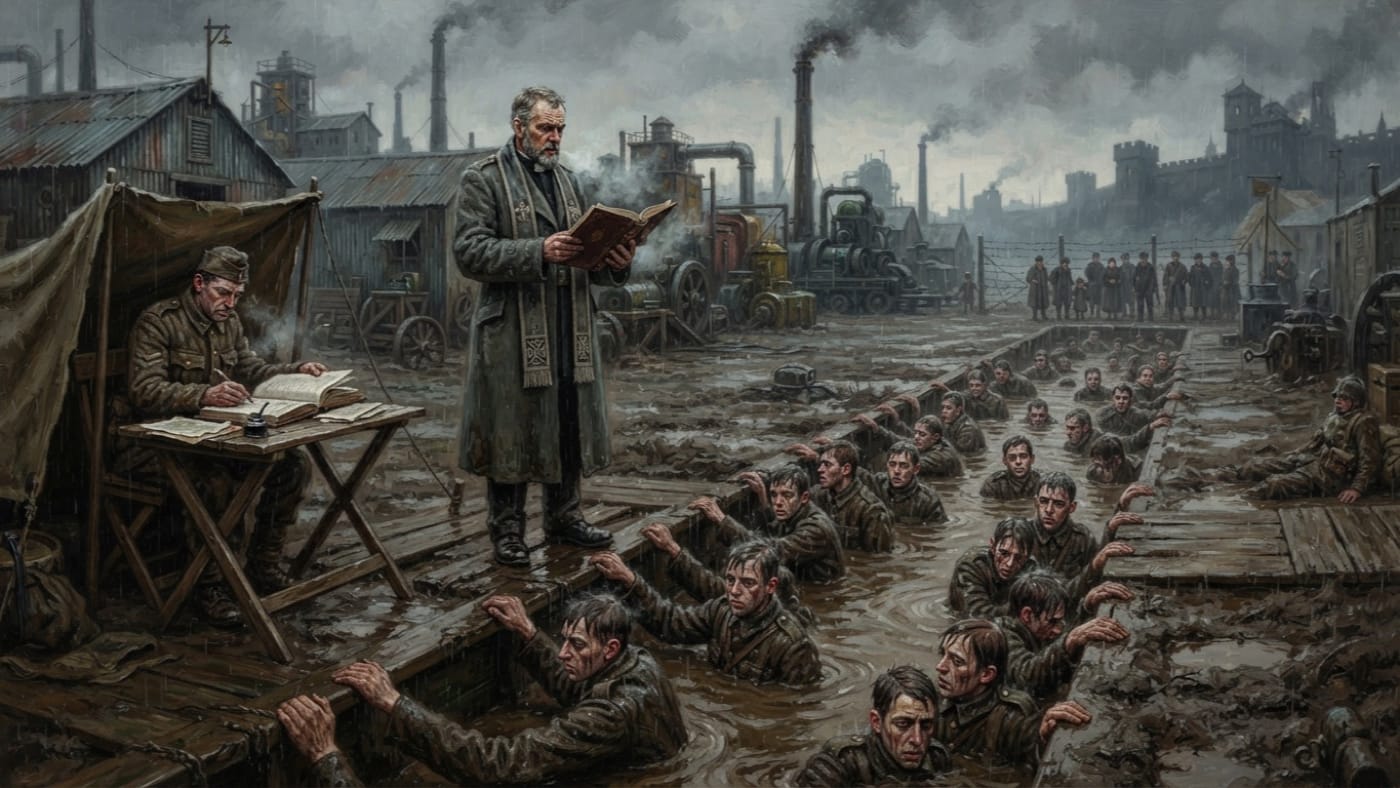
The trench is dug for the purpose or borrowed from drill. Rain fills it. Where rain proves idle, buckets and pumps correct the Creator's schedule. The water is opaque, brown going to grey, and cold in the particular manner of standing water that has touched nothing but earth and the previous company.
The recruits are marched in by file. They enter in whatever wool they arrived in or the issue they have just been handed, and wool drinks. By the time the water reaches the belt, each boy is heavier than the muster scales recorded. At chest depth he is held. Hands grip the trench boards, sergeants stand on the lip, and the chaplain takes the firmest planking the site affords. Nobody forces a head under. The rite requires him to hear.
A Tribune-Chaplain then reads the Litany of First Earth from his field missal. He reads over the rain, over the chattering teeth, over the clerk calling names that the wind hands back to him misspelled. The full text is reserved to War, and I have no licence to reproduce what I have not been shown. The field abbreviation, however, was printed for chaplains in haste, and haste makes excellent theology:
On the final line the recruits are brought up. They come out shivering and caked from collarbone to boot. They gasp in a way the chaplain is trained to hear as devotion and the orderly is trained to hear as the first stage of something inconvenient. Each is pronounced a soldier of the Faith. The clerk records the pronouncement against the name if the ink holds. When the ink fails, the pronouncement stands, and the ledger is corrected at the barracks by a man who was never wet. Records has always preferred that arrangement.
War's chronicles say the Bureau baptizes its levies in mud and blood. Provincial enthusiasts have occasionally read this as a recipe. It is a schedule. The trench supplies the first element, and the Line supplies the second without any need of ceremony.
#On the Chaplain's Inspection
The public believes the Tribune-Chaplain stands at the edge to bless. He does bless. He also watches, and the watching is what War pays for.
His first task is the voice. He must keep the prayer's authority while one boy retches, another faints against his neighbour, a third tries to climb the boards before the last line, and the clerk interrupts to ask whether a surname ends in -er or -ert. If he falters, the recruits learn that the trench can be outlasted. If he shouts, the rite becomes punishment in front of the fathers, too early to be useful. A chaplain who can hold the pitch through all of it has passed an examination more honest than anything set at seminary.
His second task is to read the recruits while he reads to them. He notes which hand grips the trench board and whether the boy turns toward the road home. He notes whether the boy spits, prays, sings, bites his lip bloody, laughs, or falls into the wrong kind of quiet. None of this goes into a sealed table of scores. No such table has reached my desk, and I have asked. It travels instead as informal notes of tendency, passed from chaplain to drill sergeant in the vocabulary of men too cold to be formal. The notes adjust drill, and drill adjusts assignment. A laugh in the trench may be remembered at the rifle company, the mortar pit or the baggage train, according to the judgment of whoever read it.
The boy leaves the water with a blessing and a note. Only one of them is addressed to him.
#On the Three Days
The mud stays on for three days. It is the only duration the rite imposes on the body afterward, and it is observed.
For the first hours the mud is wet, and the recruit is colder in the barracks than he was in the trench, because the trench at least was consistent. By night it stiffens at the joints. By the second morning it has dried into a grey crust that cracks at elbow and knee and sheds onto the bunk, the bowl and the neighbour. Catechism, drill, the ration queue and latrine order proceed around it. An instructor at Stuttgart or Metz can tell at a glance which companies came up from the trench this week. So can everyone else. That is the intention.
Two marks must never be confused in a report. The Triune Knot stamped on the wrist at the mustering field is Conscription's mark. It is ink, it lasts nine days, and it carries its accusation on the skin should the boy run. The mud is War's mark. It lasts three days, covers the whole body, and is a condition he wears in public. The first says he was counted. The second says he was received.
Levy broadsheets in the western provinces describe the Baptism of Mud as the recruit's free dedication of himself to the Faith.
Retained for households; withdrawn from instruction. Chaplains and drill staff are to understand the rite as the ceremonial close of transfer into martial custody. The broadsheet wording may still be read aloud at the fence, where it comforts those who have nothing left to sign.
On the fourth day he washes. Under the crust is the same boy with fewer options. It surprises him.
#On the Present Use
As of A.S. 201 the rite is performed across War's training network. It is held at Metz beside the depot ledgers and at Stuttgart, where the catechism-barracks have made mud-baptism assessment a local speciality. It is held at Lyon, and at Essen-of-Hymnsteel and Brast, where boys pass from the trench into the discipline of foundry heat. It is held at whatever temporary camp War has lately honoured with a chaplain. The Tribune-Chaplains themselves train at Metz, Stuttgart, Lyon and the forward schools, and their examination includes a flooded trench of its own. The same rite that receives recruits also trains its officiants. The Litany-Engineers share the chaplains' chain of classification but none of this duty. They tend engines, and the trench is left to men who tend boys.
The purpose is the standing army. Feudal levies reached the front still belonging to their lords and parishes, and they died that way, in local order. The Synod requires a soldier with no earlier owner visible on him. For three days the only thing he wears is mud, and it belongs to nobody else. When it comes off, Records has his name, Doctrine has his answer, and War has the rest of him, bound east by rail.
Doctrine has not certified whether the trench works any change in the flesh beyond cold, and War has not asked it to. The rite needs no miracle. It has attendance.