
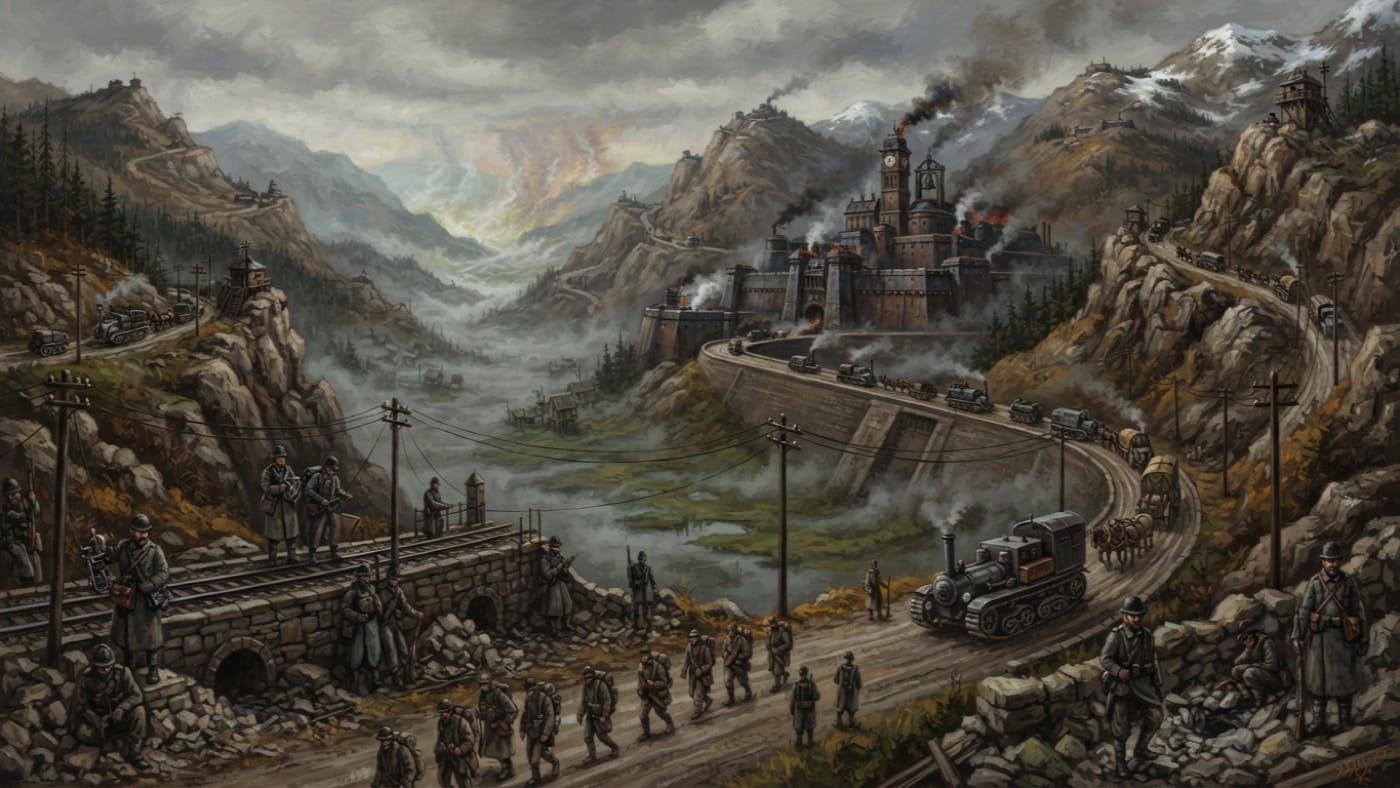
#On the Range and the Passage
Filed on the Southern Theatre assessments current in A.S. 201: Shipka's standing returns and the Contact Zone's quarterly review. The mountains are older than both documents and have not been asked to countersign.
The Balkan Mountains cross Bulgaria from west to east, between the Danube lowlands and the plains that slope down into Thrace. Before the Sundering they were known mainly to drovers, monks and tax assessors who found them tiresome. After A.S. 45 they became the second-to-last wall of the Church's southern defence. The Sagittal Line uses three barriers in the south. The first is the Iron Gates gorge at Irongate. The second is this range. The third is the Bosphorus under Constantinople. The range has one door the registry is willing to call viable, and Bastion-Shipka stands in it.
The registry calls the Shipka Pass the single viable route from the Danube lowlands through the mountains toward Thrace. Goatherds will describe other saddles to anyone who buys them a drink. The registry does not count routes a goat can survive. It counts routes a munitions column can survive in winter with an escort, a timetable and a telegraph wire running beside it. By that measure the goatherds lose.
Shipka is the sixth of seven bastions from north to south. Its designation dates to about A.S. 68, when the Line was defensible but unfinished and the offices that would later seal as the Synod still issued orders under provisional names. It was ratified in A.S. 72. Sofia lies behind it to the west, the southern staging city between the Irongate and Shipka sectors. Sofia receives the traffic going east and the damaged men coming back.
The held sector around the pass belongs to Zone 4. Its forward approaches open toward the contested ground of Zone 5 and toward Zone 6, which belongs to Syrion. The Bureau of War assigns the Languid Dreamer a theatre that includes the Bulgarian highlands, the Balkan range and the Aegean approaches. On any given morning, control of a particular ridge depends on who can see it and whose bells still reach it.
#On What Must Cross
The Church does not hold these mountains for the view. It holds them because powder, shell-fuses, grain, lamp-oil and coal must get over them, and because hospital carriages must come back the other way. Constantinople burns fuel faster than Thrace can be made to stop burning. Every ton of it that reaches the Bosphorus by the southern road has first been hauled up to Shipka and let down again.
The work is done by escorted convoys and by the rail gangs who keep the road passable for them. Linemen walk the telegraph route in pairs and test each span against the bastion clock. Where the wire has gone slack, they splice it. Where the wire is tight but the signal comes in slow, they splice it anyway and write the delay in the log. Litany-Engineers inspect culverts, retaining walls and bridge footings. When they find a crack they cannot explain, they file it as if it were a heresy. Bell signals pass along the road between stations under the schedules of the Bureau of Bells. A convoy that cannot hear the next station stops and waits until it can.
The mountain road connects to the marsh spur. East of the bastion, the Reed Road embankment carries rail across the Shipka Marsh. Two kilometres out along the causeway is Station Two, where instruments measure how badly the minutes have been bent. The sector is Timing Relay 7A of the Bureau of the Hourglass, which has compared Shipka's clocks against the rest of the Line since that Bureau was constituted in A.S. 134. Before A.S. 134, the Shipka garrison compared its clocks by shouting.
The garrison itself rotates every four months, the heaviest rotation on the Line. Relief columns climb the same road as the shells. The men they replace come down it counting the days aloud, and quartermasters are instructed to correct them when the count is wrong.
#On the Valleys That Lose Time
The range is not the Vales. The distinction is important, because a quartermaster who mistakes one for the other will either refuse to send convoys at all or send them without bells. The high ground mostly keeps its own hours. The trouble is in the low places. Syrion's fog settles into the valleys that cut into the range from the east and south. It lies in hollows, follows streams, and crawls up the old approach roads until someone rings it back down.
Where it reaches, the reports are consistent in type and inconsistent in every detail. Sound arrives late. A shout from the next bend turns up after the man who shouted it. Clocks at neighbouring posts disagree, and a patrol's return time depends on which one it trusts. Routes change. A path that took an hour in spring takes three in autumn, or twenty minutes, and the twenty-minute version is the one to fear. Whole households have been found asleep together. Some settlements hold inhabitants who breathe steadily, stand where they last stood, and cannot be reached by anyone.
The Hourglass classifies the worst of it into two kinds. Stillness Fields cover areas. Inside one, a traveller may lose a week in an afternoon or spend days in a minute. Drag Corridors are long and narrow. They tend to follow roads and riverbeds, which in a mountain range are the only places anyone wants to walk. Neither kind behaves reliably. A valley that was clean last season may not be clean this one. A corridor may close, move or wait.
In A.S. 181 a sergeant walked into a Drag Corridor near Shipka. He walked out in A.S. 196, clean-shaven, with fresh rations and a pristine kit, and told the post that he had set out that morning. His wife had remarried. His daughter had enlisted, been wounded and been discharged. He now works in the Sofia filing annex, where no one notices his confusion about the date.
The Bureau once tried to chart this ground properly. The Cartographic Expedition of A.S. 73 sent three hundred men into the deeper fog and got fourteen back, each carrying a map that contradicted all the others. What exists of the Balkan range's fogbound valleys today is a set of pencil notes, a list of wake-bells that rang irregularly, and orders to redraw both every quarter.
Earlier Bureau assessments classified the Shipka corridor as of negligible Sloth influence, manageable through standard stimulant and bell-density protocols.
Revised after the loss of Outpost Eleven-West in A.S. 194. The corridor is now classified as persistent low-grade seepage under active monitoring. This revision applies to the corridor only. The Bureau makes no assessment of ridges it has not seen, and it has not seen most of them.
#On the People Along the Approaches
The range is not empty. Official circulars say otherwise, and the officials who write them have not walked the road.
Convoy crews live on it in shifts. They know which switchbacks punish a tired team and which culverts flood after rain. Engineers keep bridges and cuttings standing. They treat every entry in a maintenance log as sworn testimony, because a softened reading on a Balkan retaining wall means a column in the ravine next winter. Observers on the high shelves record fog movement, bell delays and personnel who have begun describing sleep as reasonable. In the marsh below, the stilt-hamlets pay their tithes in peat and fish. In the folded valleys to the south, remnant hill families refuse evacuation orders with a persistence that would earn a regiment a citation.
All of them are tired. That is the weakness Syrion exploits. He does not target the idle. He finds the man who has held the same road for nine days without relief and offers him rest that appears to have no cost. Rest itself remains necessary. The garrison sleeps, the crews sleep, and the Bureau of Medicine enforces it. The danger is rest that nobody scheduled, offered by the fog at the moment when stopping looks like mercy.
#On the Southern Contact
South of the pass, the mountains break down through the foothills toward Thrace. There the fog meets a second enemy. Maldrake's furnace pressure comes north-west out of the burned country. Where it meets Syrion's fog, the weather does things no instrument was built to record. Rain rises and burns. Frost forms on stones still too hot to touch. A watch that begins in winter can end in forge-heat. Signals arriving from Shipka come in doubled, shortened, or answered before they were sent. Some slopes have been glassed, and the patrols cross them in smoked lenses.
The rivalry between Wrath and Sloth is old and still active. The Contact Zone adds a complication. As of A.S. 201 its review records a localised accommodation, a stable hostile interface along which neither power advances in force. The Bureau of War uses that fact where it can. The Bureau of Doctrine forbids calling the line a border, and the Bureau of Doctrine is correct to forbid it. Two enemies who hate each other in a fixed position have not promised Shipka anything. A forge column held at the fog edge is not hammering Constantinople this season. The Synod has no guarantee about next season.
#On the Present Condition
As of A.S. 201 the passage is open. Convoys climb under escort and descend on schedule, or on a schedule the Hourglass accepts. The telegraph works along most of its length. The bells reach most of the stations they are meant to reach. Relief comes every four months. The eastern valleys lose hours unpredictably, the marsh spur loses sleepers to the mud, and the southern foothills lose their weather to two powers who both want the road. The range carries all of this without comment, because it is stone and stone does not file returns.
The Church does not hold the Balkan Mountains. It holds a road through them, the ground on either side of that road as far as a sentry can see it, and the schedule that keeps both of those things in use. Everything beyond the reach of its bells is a matter for pencil.