
Sources are checked; I'm writing the prose now.
#On the Hall's Authority
"Record: silence, observed." — Bureau of Relics examination manual, intake instruction
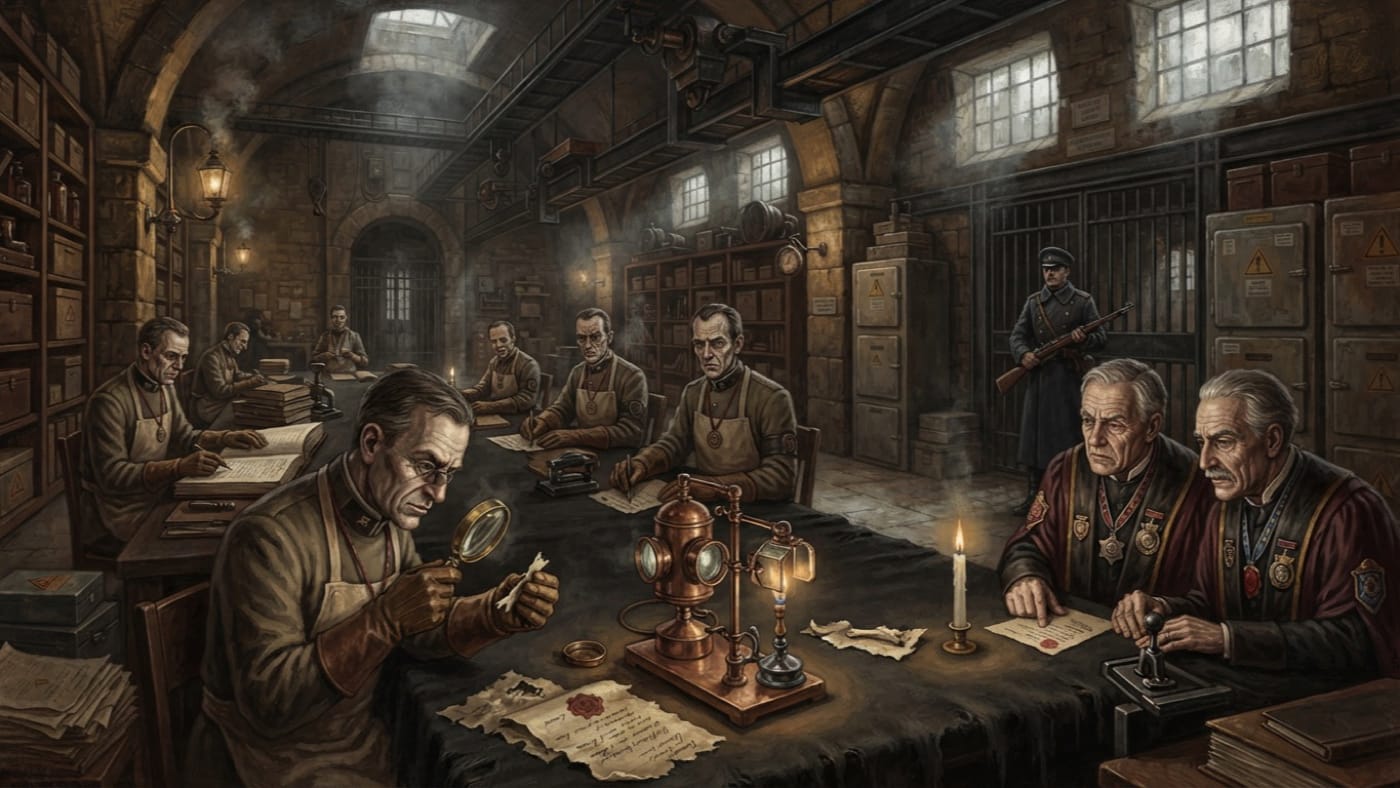
The Authentication Hall is where a relic stops being a rumour in a box and becomes an entry in a ledger. By charter the Bureau of Relics holds four powers: custody, authentication, classification and distribution. Elsewhere those powers are exercised in ink. Here they are exercised in gloves.
The Bureau established its Authentication Hall in A.S. 92 (1802 CE), under the First Ratification, two years after the Concordat of Strasbourg created the formal Synod. The ratification established the Hall as an office with a seal. It records no architect, no cornerstone and no dimensions. I will not supply any from imagination, since imagination is how forgers make their living. In Strasbourg, the Hall's work answers to the Bureau's seat in the Cathedral Close. Provincial halls do the same work under the same manual, and the provincial hall the record names with most confidence stands at Bastion-Sibiu. The reason it is on record is given below. It is not a happy one.
The consequences leave by the door. A seal pressed in the Hall decides which shrine collects pilgrims and which parish receives a receipt. It decides whether a finger-bone guards a trench niche on the Sagittal Line or ends up in a wall as lime.
#On the Rooms and Instruments
A relic arrives in a lead-lined box, sealed with quarantine wax and carrying an Authenticity Writ. The Writ holds the custody chain, a physical description, a theological justification and proof that the fee was paid. It is the petition. The verdict comes later and belongs to the Bureau.
The box is opened in the intake chamber, which is ventilated for reasons the manual leaves unstated and every Lamp Hand can guess. The lead stays there. It is recorded, tagged and left on its shelf. The Candle Proof formulary forbids lead within the immediate testing radius unless contamination is already suspected, so the box goes no further than the intake chamber.
Beyond intake are the examination tables, covered in black felt or left as bare stone, with brass scales, ground lenses and tincture ampules sealed in wax. The rooms are kept cold, because warmth makes bone sweat and makes clerks talk. Response testing needs a sealed room with still air and its own door. The registry needs light, dry shelving and a seal press heavy enough that nobody can operate it absent-mindedly. The quarantine cabinets are closed, lined and locked. They hold Contaminants until transfer. Some objects stay longer.
The smells, in the order a visitor meets them: camphor from intake, antiseptic incense, old bone, the metal polish on the scales, heat from the Blessing Lamp's shutter, paper dust, and red wax going soft on the registry desk. The vaulting overhead is stone wherever I have seen it. The layout varies from hall to hall. The separation of the work does not.
This establishment should be kept distinct from its neighbours. The Relics Archive admits licensed visitors to look at objects already graded. The Reception Hall of the Vault of Sacred Custody is as far as the public may go. The Vault itself holds what the Hall has already judged. The Archive does post an Authentication Hall notice on its wall. That notice shows the reach of the Hall's procedure. It does not mean the two share a floor.
#On Passage Through Examination
Consider a representative submission. A parish sends a finger-length fragment of bone wrapped in blackened wire, with a Writ three pages long and a donor's letter four pages long. The object has no name here. The procedure has seven.
Intake and Quarantine. The seal is broken and the fragment is weighed. Its smell, colour and sound are recorded. Most relics make no sound, and the manual prescribes the entry silence, observed. Relics that hum or click get a different entry and a clerk standing closer to the door.
Provenance Reconstruction. The custody chain is read one link at a time. A Records clerk sits at the same table and checks every seal against the reference impressions. Every unwitnessed transfer and every "record lost in the Retreat" is marked. A perfect chain gets a second reader, because perfect chains are what forgers produce.
Physical Examination. The fragment is examined with scales, lens, tincture and the Lamp at its first and second degrees. Porosity, grain and fracture are recorded. The Bureau of Engineering calibrates the scales every month and resents it.
Doctrine Fit. The Bureau of Doctrine rules on whether the claimed saint, the claimed miracle and the object's continued existence can be tolerated. Doctrine's reader rarely speaks during the other stages and never skips this one.
Response Testing. The fragment goes into the sealed room. A clean white taper is lit one palm-width from its edge, and two witnesses of superior rank watch. If the flame leans toward the object, that is assent. If it withdraws, that is refusal. If it flickers, the test is repeated and the dossier grows. The Candle Proof was standardised in A.S. 98. Earlier candles were observed, but they were not yet governed by the formulary. The Lamp is opened further only as far as its protocol allows.
Verdict Drafting. The Examiner assigns one of four grades: Ward-safe, Votive, Contaminant or Fraud. A grade is a separate matter from class. First, Second and Third Class describe what an object is. A grade describes what the Hall has found it fit for. A luminous response does not earn Ward-safe on its own. Plenty of things glow, and some of them glow with hostility.
Notarization. The press comes down, the wax takes the mark, and a second hand countersigns the registry entry. The Writ goes into the file. The entry is now the object's legal identity, and the Writ is only the history of how it got one.
Disposition comes next. The manual treats it as the result of the examination rather than an extra stage. Ward-safe objects go to the Vault or into bastion rotation. Votive objects go to shrines for display. Contaminants go into the quarantine cabinets and later the Vault's own. Frauds are confiscated and rendered into lime. Seven stages do not need seven rooms. A small provincial hall can manage four of them with one table, one corridor and a clerk who has stopped complaining.
The procedure is older than its polish. In A.S. 94 a disputed object reached the Hall with its provenance broken in three places, and Notary-Saint Caldre carried the argument down into the Vault for a night. The Bureau has never published what the object was, and I will not publish it for them.
#On the Filing Hands
The Hall runs on Lamp Hands and registry scribes, with Examiners above them, notaries beside them and senior custodians over all of them. Rank shows on the body. Lamp Hands have crescent burns at the wrist. Scribes have ink on their cuffs. Everyone above the scribes wears a clearance cord, because every door past intake asks to see one. Masks are issued for ash and for anything that arrived damp.
The Hall's work also depends on other Bureaus. Engineering maintains the Lamp housings and swears at the bulbs. Relics controls bulb issue and has final authority over examinations. Records checks the provenance chain. Doctrine checks the saint. Tithes sends the invoice. The Relic Authenticator manages all of them and still has to hold the taper steady.
Applicants do not enter the testing rooms. Their influence arrives on paper: patronage letters, cathedral seals, diocesan memoranda on the urgency of the feast. It sits in the file, where the witnesses can read it and are trained to feel nothing about it.
#On the Revisions and the Broken Wall
The Reliquary Schisms of A.S. 140–160 taught the Hall that its verdicts could multiply. The cathedrals of Cologne gathered seventeen authenticated femurs attributed to one saint. Every one had a clean chain and a separate Examiner. The Fourteenth Doctrinal Congress resolved the theology in A.S. 147 with the Femur Principle: all femurs are authentic if notarized. The administrative crisis took longer to resolve. Records was granted co-custody of provenance chains, which is why its clerks now sit at every provenance table. Reduction notices issued by A.S. 160 fixed the practice of eleven new First-Class authentications a year.
The Hall has not been idle since. The limit of eleven applies to new First-Class authentications, and to nothing else. Rechecks, Second- and Third-Class work, quarantine handling and every returned object still pass across the tables. The revised four-grade taxonomy of A.S. 165 gave all of that work its present vocabulary.
In A.S. 174, at the Authentication Hall of Bastion-Sibiu, an Examiner working alone tested a glass shard of disputed provenance. His report called the result "overwhelming." The clean-up crew called it "structural." The Blessing Lamp register notes the fourth degree, used without authorisation. The shard was reclassified. The Examiner was reclassified. The wall was rebuilt. The Bureau has not explained what either reclassification meant, and I will not guess on its behalf.
Response Testing may be conducted by a single Authenticator where witnesses cannot be assembled without delay.
Permission withdrawn after the Bastion-Sibiu incident of A.S. 174. Response Testing now requires two witnesses of superior rank. Delay is to be endured.
Sibiu also houses an Assay Chamber, which tests coin and metal for the Bureau of Tithes. The two rooms share a fortress and a fear of counterfeits. Beyond that they have nothing in common, and their ledgers must not be mixed.
#On the Present Work
Velmora the Covetous Serpent has been sending counterfeit relics across the Line since at least A.S. 180. The Bureau constituted the Counter-Relic Examiners in A.S. 182 and ordered weekly re-authentication of every frontline relic. Objects that flicker in a trench chapel come back under lead, and the Hall examines them again from intake onward, without regard to their earlier grade or whoever signed it.
The Serpent works through trade. She cannot command a clerk's hand. She can only buy it, if the clerk has decided to sell. The Hall defends against that sale with witnesses, cords, countersignatures and a registry that remembers every name. Those defences have held often enough to justify them, and failed often enough to explain the weekly re-authentications.
As of A.S. 201 the lamps are burning, the cabinets are recorded as silent, and the transport boxes wait on their intake shelves.