
#On the Nail That Failed to Become Proof
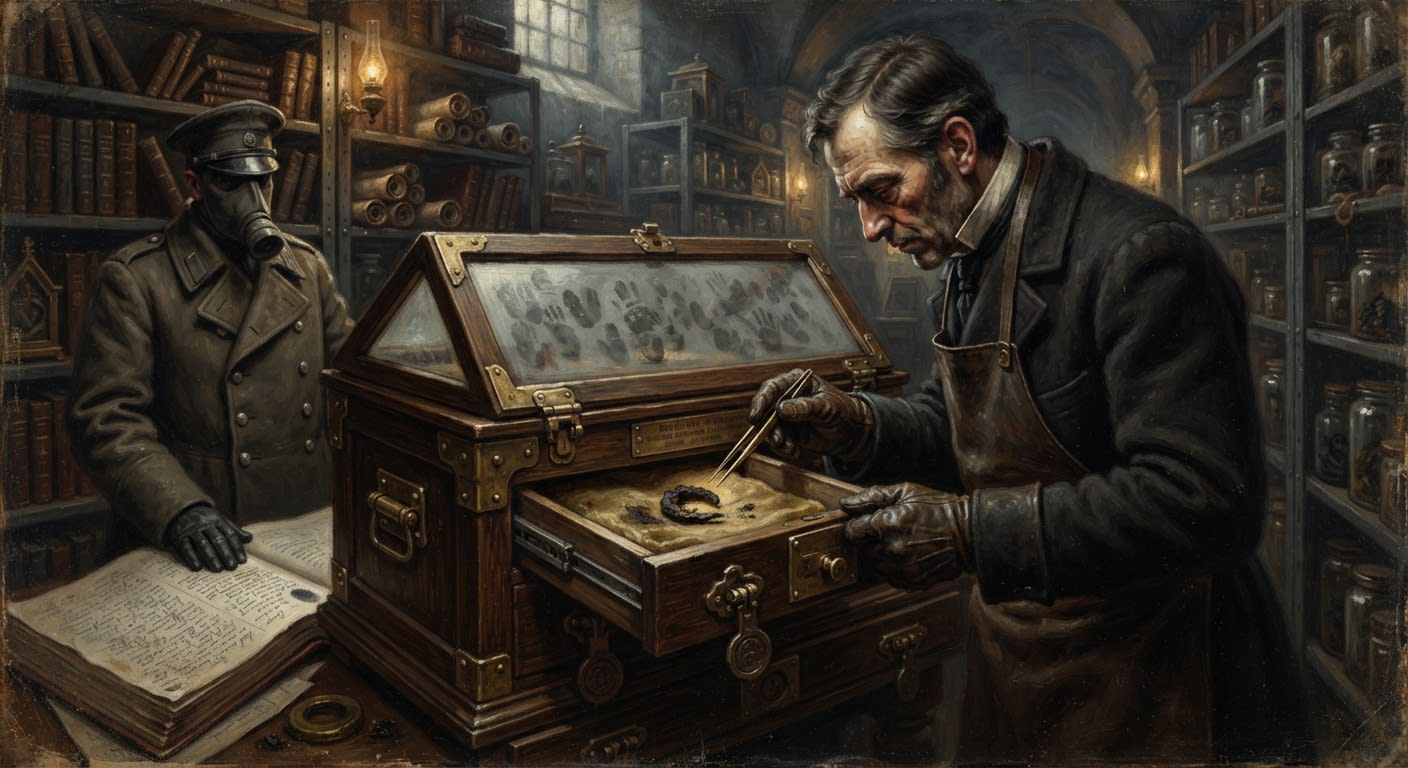
The Ashen Thumbnail of Cologne is a curved fragment of nail, or of something that has agreed to look like nail. It is blackened along its whole length, as if someone drew it through a candle and then left it alone to think about what it had done. It is narrower than a wax wafer and weighs less than the ink used to catalogue it. The Night Notaries of Cologne attribute it to Saint Vellum-of-the-Quiet-Hand. The Bureau of Rites has never confirmed her canonisation, and the Bureau of Relics has never authenticated any relic of hers. The Thumbnail changes neither fact. It lies between the two in a drawer.
It belongs to the six. The Quiet Wafer of Ulm, the Brest Palm-Cloth, the Mainz Stamp-Head, the Strasbourg Apron Strip and the Little Finger Bone of No Parish complete the company. Each appeared, drew veneration, was tested and doubted, and went back into custody. The Thumbnail is the smallest and the darkest of them, and it is the only one that makes an examiner feel absurd for picking up tweezers.
A femur can be denounced with dignity. A skull can be put on trial, and a rib can be measured, weighed, argued over and thrown out by a tribunal wearing proper robes. A thumbnail has to be squinted at. No Bureau has ever fully recovered its authority after squinting.
#On Cologne, Where Bones Learn Arithmetic
Only Cologne could have kept this object. Anywhere else it would have been swept up with the marrow-dust and forgotten by Vespers.
The Cathedral of the Holy Column keeps seventeen femurs of Saint Aldebrand. Every one of them is notarized and authenticated, every one is sole and genuine, and every one lies in a reliquary whose label refuses to acknowledge the others. The archive-banks of the northern rows lend against provenance. The chapter pledges bone against bond. Relics and the Bureau of Records learned long ago to live alongside contradiction, the way a married couple lives alongside damp. Cologne does not reject an impossibility merely because it is impossible. It asks what the impossibility yields and how the yield will be secured.
Aldebrand's femurs have too much authenticity for one body. The Thumbnail has the opposite problem. It is too slight to satisfy a Relics examiner and too useful to throw away. The city is plainly capable of believing one saint had seventeen thighbones, and yet it cannot decide whether another saint ever had a thumb. Cologne has no difficulty with excess. Scarcity embarrasses it.
The brass label on the drawer is a small masterpiece of evasion. It reads RELIC OF THE QUIET HAND (ATTRIB.). It does not say whose hand, whether the hand was quiet, or whether the thing is a relic. Pilgrims read the words Quiet Hand and cross themselves. Auditors read (ATTRIB.) and relax. The engraver was paid at the Records rate.
#On Examination and Refusal
The Bureau of Relics applies one apparatus to everything, from Aldebrand's thigh to a peasant's rosary bead. The claimant petitions for an Authenticity Writ and presents a chain of provenance. The object is examined physically. It undergoes the flame, the prayer and the response. Then a custody decision is entered, and that decision governs where the object may sit, who may touch it, and what may be charged for looking at it.
The Thumbnail has passed through every stage except the last one that counts.
Its provenance chain opens mid-sentence. The donor field in the local custody note has been redacted, and so has the field recording the date of first veneration. The surviving examination abstract names the object, describes it and declines to go further. None of these documents supplies what a writ requires: a body, a burial, a death, and an honest custodian at each link between them. Where the chain ought to begin, the ledger has a thumbprint in lampblack. Nobody has matched it to anyone.
RELICS EXAMINATION ABSTRACT — COLOGNE SUB-GALLERY Object: Ashen Thumbnail (attrib. Vellum-of-the-Quiet-Hand) Provenance: ████████████████ (chain incomplete prior to ████) Flame: ████████. Prayer: ████████. Response: ████████████████████ Examiner's note: "The object does not behave as a fraud behaves. It does not behave as a relic behaves. It behaves as ████████████████████." Authentication: NOT ISSUED.
Whatever the prayer produced, and whatever answered it, the surviving abstract does not say. Some are tempted to borrow a verdict from the Brest Palm-Cloth. Relics tested that cloth in A.S. 140 and found ordinary linen, ordinary soot and ordinary wax. That finding belongs to the cloth. It cannot be carried up the Rhine and pinned to a fingernail because the two objects share a saint and a drawer-rate. Relics may be arrogant, but it keeps each finding with its own object.
Candle-sheets once sold at the cathedral's north porch described the Thumbnail as "authenticated under the Congress principle of A.S. 147."
Corrected. The Fourteenth Doctrinal Congress of A.S. 147 held that all femurs are authentic if notarized. A thumbnail is not a femur, and no notarization has been issued for it. The principle was a femoral mercy, extended during the Reliquary Schisms to calm a guild of thighbones. It does not reach the extremities. The candle-sheets have been pulped and the porch vendor fined. The vendor still sells candles, because the fine was calculated against his candle revenue.
#On Its Use Among Quiet Hands
The Ritual Bone-Stampers of the Cologne underworks have little interest in the writ. They were licensed under the Records Directive of A.S. 92, and they have learned since then the thing no training hall prints on a placard: the stamp works in proportion to conviction, and conviction runs out faster than wax.
Before a bad shift, some Cologne stampers go up the service stair to the sub-gallery. They go gloved and in pairs, and a Seal-Warden goes with them. At the drawer, the stamper presses the pad of a gloved thumb against the leaded glass directly above the ash-black fragment, and holds it there for the length of one Force-Count. The stamper says nothing aloud. The Seal-Warden then taps the drawer once with the cold side of a die and returns to the ledger. The stamper goes down into the corridor.
That is all of the rite. Nobody sings, the dead get no speech, and the saint is not addressed by name. The older stampers claim the gesture is not a prayer at all. They call it a reminder: it lets a hand that has begun to hollow remember what a hand felt like before it held the stamp.
A worker far gone in the Hollowing gives himself away by shortening the Force-Count, letting the seal bite weaken, and dressing contempt up as efficiency. He envies the Quiet Hands and hates himself for it. The Thumbnail repairs none of that. It lends a small, borrowed conviction to a man who has run out of his own. It is the only relic in the city made to be loaned rather than owned. It takes no deposit, it asks for no confession, and the only proof of its effect is the corridor.
The corridor is where Records looks. Sealed tables held in a Records sub-vault compare the corridors worked by stampers who went up with those worked by stampers who did not. The tables count seal failures, tap-rod answers from the wrong wall, and nights when the bells were rung early. Their conclusions are sealed. Their existence is not. Records has declined to lend them to Relics, to Rites, or to Medicine, which asked about the gloves.
Doctrine classifies whatever stirs in the corridors as residue or heresy. The stampers have their own classification, which they keep to themselves. When the wax bites and the skull stays a skull, they do not ask which Bureau is right. They go home.
#On Custody, Revenue, and Present Use
In A.S. 201 the Ashen Thumbnail remains in the Reliquary Galleries of the Holy Column, under the joint custody of two Bureaus that each hold that the other has no standing to be there. Relics keeps the drawer and Records keeps the key. The chapter keeps the candles.
It is retained for pastoral-operational utility. The phrase means the object is kept because it is useful, and whether it is true has not been decided. Relics considers the thing a fraud and has never proved so, because proving it would require a writ of refusal, and a refusal would have to explain why three examiners fogged the glass. Records considers it useful and has the tables to show it, though nobody may read them. Rites considers it unconfirmed and would like shop-talk to stop climbing the service stairs dressed as hagiography. Doctrine tolerates it, as Doctrine tolerates every contradiction that keeps the ledgers balanced and the corridors cold.
The stampers say nothing. The corridor stayed quiet.
The drawer is opened four times a year for dusting. The ash does not come away, and the Seal-Warden records this in the column headed Condition without comment. Pilgrims who pay the tariff may stand at the rail for the length of one Ave. They see very little. A black curve under old glass, a brass label telling them nothing, and a small grey smudge on the pane where a thousand gloved thumbs have pressed and the chapter has never been permitted to clean.