
#On the First Line of Ash
"Cinis non mentitur. Clerici de cinere mentiuntur." — chalked above an assay tray at Sibiu, hand unrecorded
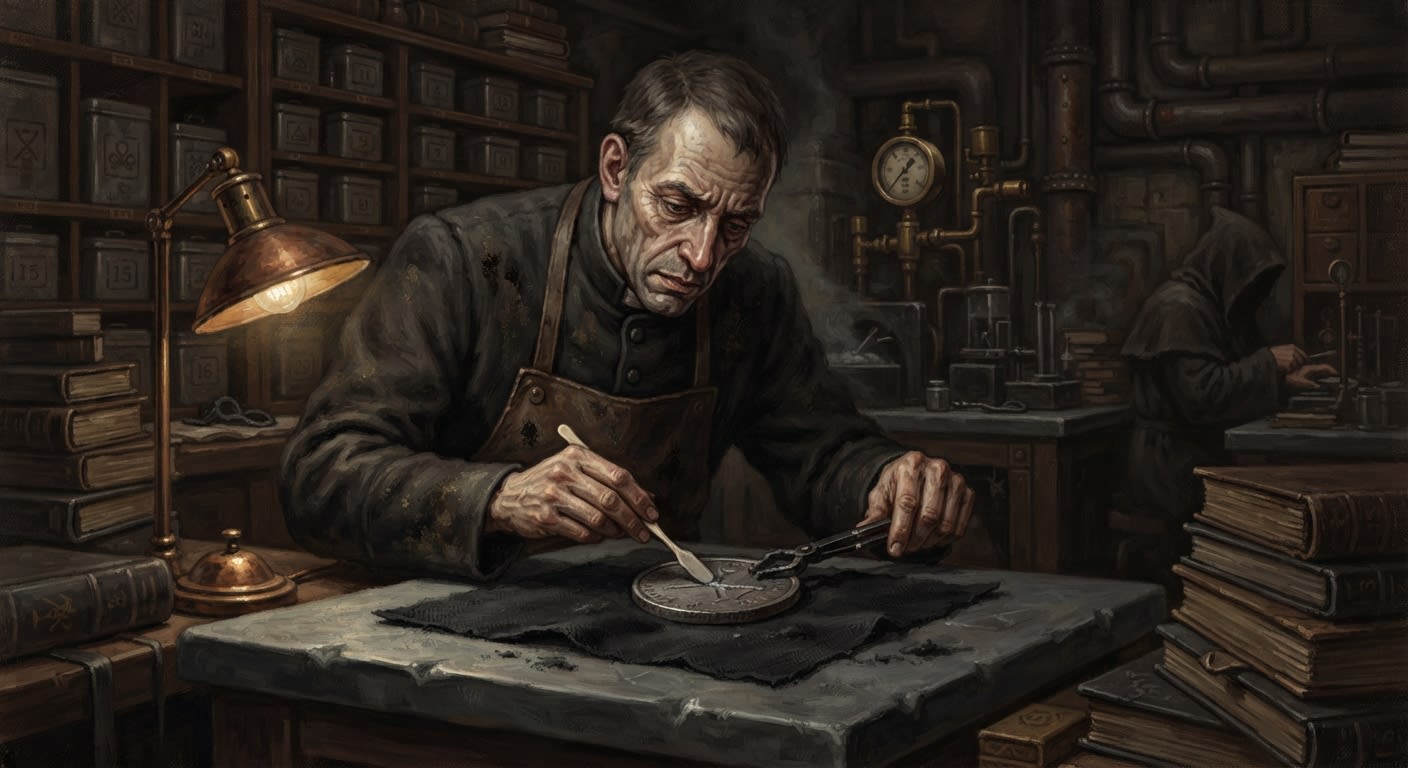
The ash-test is the first thing done to a Crown of Grace after it has been made, and the ugliest. A consecrated die has just struck the Triune Knot into iron. A priest of authorised rank has just recited the Monetary Benediction over the batch. Then a clerk in a stained apron takes the newly holy object with tongs, lays it on black cloth, and draws a line of dirt across its face to see whether it will behave.
That is the whole rite: iron, ash, a line, a look. The Synod has more beautiful sacraments. It has none more candid about what it thinks of the thing being sanctified.
I call it a sacrament of suspicion, and the Bureau of Doctrine has twice asked me to stop. The phrase remains in circulation because it is accurate, and accuracy, unlike most Crowns, requires no assay.
The Codex files this entry under the regularisation of A.S. 92, when the Crown received its first full monetary circular, because the coin and the suspicion belong in the same drawer. The ash-test's own ratification date I have not found. I have searched Tithes, Records, and a box in the Palatine Counting House labelled PROCEDURE (OLD), which contained one boot. I will not invent a date. The Bureau employs other people for that.
#On Procedure
The examiner works at a tray of slate or lacquered iron under an assay cloth dyed black so that ash shows. The Crown is lifted from its batch drawer with tongs, never with fingers, because the palm is warm, the palm sweats, and the palm has opinions about money.
The coin is set obverse up. From a shallow bowl the examiner takes consecrated ash on the flat of a bone spatula and lays a single line across the face, rim to rim, through the Knot. The line must be thin. A thick line hides behaviour, and a thin line tells tales.
Then everyone waits for the length of one Monetary Benediction recited at ordinary speed.
A clean Crown accepts the ash. The line lies where it was put, grey on dull iron, flat and bored. That is the whole of passing. There is no glow and no chime. The coin has consented to be dirtied by the Church and made no remark.
A contaminated Crown answers in one of three ways, which the examiners rank by the paperwork each one produces. It may bead the ash, gathering the line into little grey knots like a prayer-cord tied by someone who has never prayed. It may curl the ash toward the rim, as though the line would rather leave the coin's face than lie across the Knot. Or it may eat the ash. The line thins, breaks and is gone, and the iron beneath looks exactly as it did before, which is the part examiners mention only after the second drink.
Beading sends the batch to quarantine. Curling sends the batch to quarantine and the examiner to a second examiner. Eating is grounds for immediate seizure and what the Crown of Grace entry correctly calls a very short interview. The interview is conducted with whoever delivered the coin. The coin is not interviewed. We tried.
After each coin the used ash is swept into a lidded tin and kept, because used ash is evidence. Every assay room has a shelf of these tins, dated, sealed and unloved, and every assay room has one tin that no clerk will move. At the mint the line is drawn on every coin. The pay offices, as the Crown of Grace entry records with some bitterness, have at times drawn it once per sack.
#On What Ash Proves
The ash-test proves that a coin's surface obeys, and that is worth knowing. It catches crude forgery, contaminated batches, coins struck from metal that remembers being something unpleasant, and the lazier sort of hostile working. It takes seconds and costs a pinch of ash. No mint could function without it.
It proves nothing else.
Ash cannot hear. A counterfeit that sings too sweetly when struck against a bone pin will lie under its line as flat as a sermon. Harmonic sweetness is the song-test's business. Ash cannot read, either. A coin that writes in a blank ledger, shifts in its box or whispers may accept the line perfectly well. Ledger neutrality belongs to the silence-test, whose procedure varies by schedule and suspicion. That test became mandatory only after the Screaming Coin of A.S. 177 and the counterfeit relic penetrations that had followed by A.S. 180. Nor can ash follow a purse home. It does not know whether a coin returns after payment, or whether the widow who holds it has lately found charity difficult.
Above all, ash cannot detect Contract Theurgy. Contract Theurgy does not live on the surface of anything. It lives in the relation between coin and holder, holder and debt, debt and signature. You cannot lay a line of ash across a relation. Several junior examiners have asked whether you can. One tried it on his marriage.
A Tithes training primer issued to mint examiners stated that "the ash-test burns false metal."
Withdrawn. Ash burns nothing. It lies on metal and reports how the metal receives it. The primer's phrase survives in popular speech and in at least one Codex entry, where it stands as shorthand. Taught as procedure, it produced examiners who waited for smoke and meanwhile passed coins that had declined, quietly, to cooperate.
#On False Crowns and Sibiu
Velmora's counterfeits are the reason the ash-test matters, and the reason it embarrasses. Her copies carry the correct weight, edge and diameter, convincing rust, and sometimes cleaner die work than the lawful batch they imitate. Many fail the ash. Some pass it when the examiner is tired, as most are after the fourth hour, or ambitious, which is worse. An ambitious examiner wants his batch clean, and the ash is very small and the quota very large.
The copies that pass fail later, and they fail by generosity. A purse grows heavier when its owner means to spend and lighter when he means to give. An account book corrects itself in the holder's favour. A coin paid out at market turns up again beneath the mattress. The coin never seizes the hand. It arranges a circumstance in which keeping seems reasonable, the holder keeps it, and the keeping is his own act. The ash may later reveal what the coin was. It absolves nobody of what they chose while holding it.
The Ten Thousand Keys understand ash better than our instructors do. They never flood a market with false iron, because floods provoke assay. They salt it instead: three coins to a relief fund, seven to a grain convoy, one too many in a dowry chest. Salted coins meet the ash one at a time, in rooms where the examiner has already passed four hundred honest Crowns that morning and has begun to see the line hold before he has drawn it.
At Bastion-Sibiu, coin-testing is frontline work, and the numbers show it. The Sibiu inspection files report that one Crown in eight hundred entering inspection there whispers. That figure belongs to Sibiu. Other entries and a number of sermons have carried it off as a Synod-wide rate. The Bureau of Tithes has never measured a Synod-wide rate and would prefer that you not ask why.
The A.S. 200 revision of the Sibiu-sector handling order added a line that the ash-washers call the widow's clause.
So a coin that passed at the mint is tested again before it is given away. The reasoning is sound and bleak. False Crowns fail by generosity, so the moment of giving is when a false coin is most likely to show itself, and the poor woman receiving alms is the person least able to afford a coin that does.
#On the Clerks Who Breathe It
The ash-washers take their name from washing their hands in ash at the start of a shift and in water at the end. They consider the order significant. At the mint and the pay office they answer to the Bureau of Tithes. Disputed samples go to the Bureau of Alchemical Standards, which returns them some weeks later with the finding "residue consistent with ash." The finding is true, and nobody sent the tins in order to learn it.
The work gets into the chest. Examiners cough grey by their third year. The Bureau issues gauze masks, and the masks ruin the test, because a masked man cannot bend close enough to watch the line. Most examiners take the masks off. The Bureau of Mercy has files.
Fatigue is the great enemy, and false positives are its bastard child. A draught from the door makes a line curl. A damp coin beads. A clerk with a grudge against a supplier sees knots where there are none. Honest iron that has been seized stays seized, and the merchant who brought it must prove his innocence to men who have just watched his coin misbehave.
Then there are the citizens, who lie. Asked whether a coin has behaved strangely at home, a holder says no. He says it because he is ashamed, or fond of the coin, or because he knows the Bureau will take the coin and leave the debt. The ash reports on the coin. It has nothing to say about the man, and the man knows that.
#The Ratification
Ash is cheap. A mint burns through a cartload a year and never counts it. Obedience is expensive, and the ash-test measures only its outermost coat: whether iron will lie still under a line of Church dirt for the length of a benediction. That is worth knowing, and it falls a long way short of enough.
The examiners' last instruction appears in no primer I have found, though every senior ash-washer repeats it to every junior. A Crown that takes the line too well, flat and even and perfect, grey to the rim with not a grain astray, goes on to the song-test with a note attached. Lawful iron is lazy. It takes ash the way a tired soldier takes an order, completely and without grace. A coin that obeys beautifully has been practising.