
#On the Name the Bureau Did Not Use
No map the Synod ever sealed shows the Ash Steps.
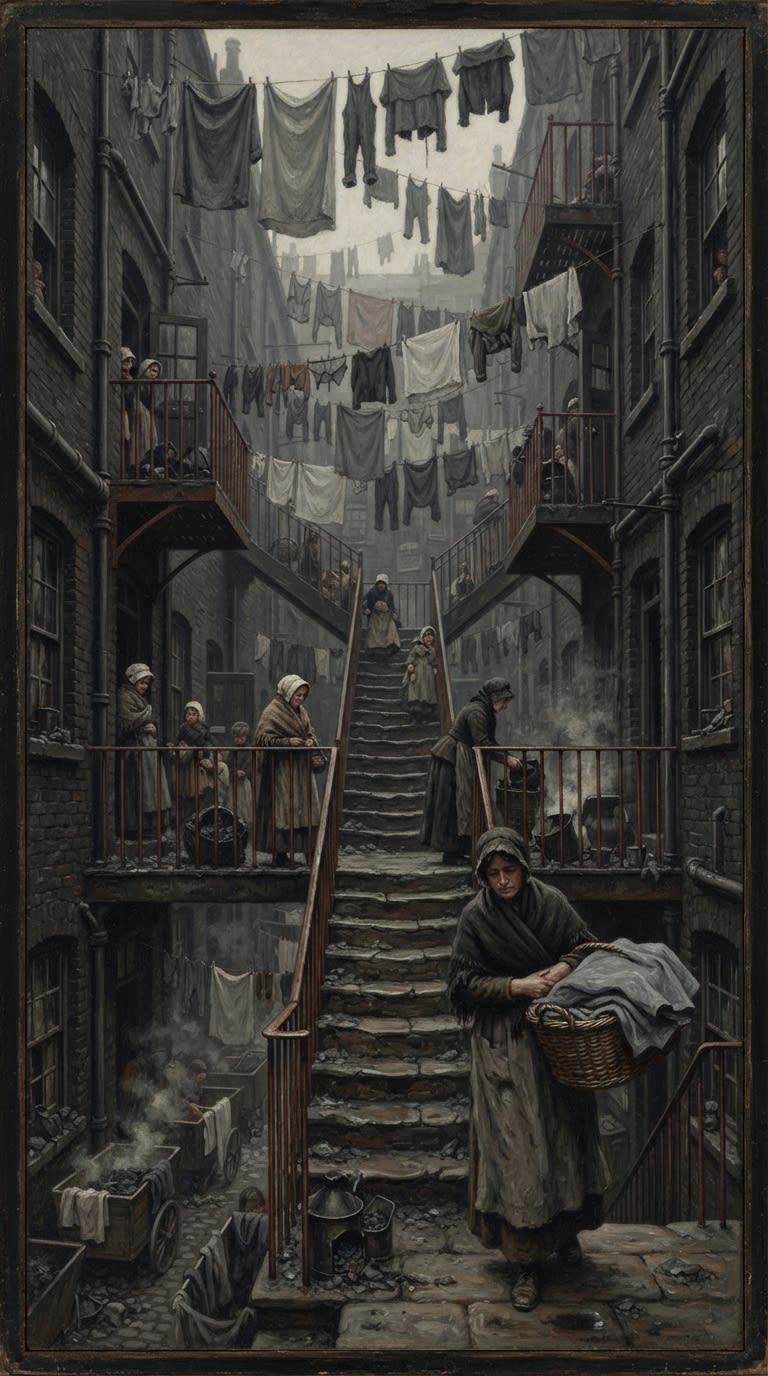
The parish under the nickname has an official name. That name has been corrected three times, each time by a clerk sure the clerk before him was a fool, and the mothers who mattered remember none of the versions. They called the place the Ash Steps: a stair of soot-blackened stone houses climbing out of a wash-yard, where laundry dried grey even in summer and the gutters ran the colour of weak tea. A name that simply describes a place is dangerous to a bureaucracy, because anyone can use it without filing a form.
BUREAU OF RECORDS — PARISH DESIGNATION HISTORY (EXTRACT, DAMAGED) Designation as first entered: ███████████ First correction: ███████████. Cause: ████████. Second correction: ██████ ████████. Cause: ████████████. Third correction: ███████████. Cause: ███████████████████. Resident usage "Ash Steps": noted. Not recognised. Not to be entered.
I have read that extract in four copies. The third cause is blacked out in every one of them. Either the reason was embarrassing or someone in the Bureau of Records has a sense of humour, and I have met the staff.
A later Doctrine gazetteer lists "the Ash Steps District" among the lawful wards of its diocese.
Withdrawn. No such district was ever designated. "Ash Steps" was a name used by laundresses and midwives for part of a parish, and the Codex will not give it a lawful standing its own residents never asked for. A retroactive designation would be the first honour the state ever paid the place. It would also be a trap.
#On the Houses That Made Sound Die
Stone keeps heat badly and sound even worse. The houses of the Ash Steps stood shoulder to shoulder up the slope, with thick walls, small windows and back stairs shared between neighbours. Their chimneys drew so poorly that soot settled on every sill, rope and cradle-cloth within a week of washing, and the air stayed thick with it. Under a bell-tower a newborn's cry carries to the vestry. On the Ash Steps it went three houses and died in the ash.
Laundry hung everywhere. Lines crossed the stairs at head height, sheet behind sheet, so a woman climbing with a basket could be seen neither from the bottom of the steps nor from the top. The wash-yard at the foot kept its carts moving at every hour, and a laundry cart is the one vehicle in any parish that nobody searches. Nobody lifts the second sheet.
Below the lines were cellars, coal-hatches and shared landings, and every room had two ways out. Bureau inspectors walked the front streets, since those are the only streets a Bureau map shows. The Steps had very few front streets. Almost the whole district was backs.
#On the Registry Room
The Nursery Levy Decrees of A.S. 152 required a preliminary birth notice within twelve hours and full natal registration within seventy-two. Across most of the continent, that put a clerk inside the week of a birth. On the Ash Steps it put him on the same stair. The parish registry room was an easy climb from every birth-room in the district, and a man carrying a stamp case climbs a stair faster than a mother stops bleeding.
In that room the arithmetic of the Bureau of Conscription reached the bedchamber. The room itself was a desk, a stamp case, a natal roll and a smell of mouse dirt and ink. The registrar slept there with his boots under the desk. In A.S. 154 Mother Sava burned that roll, having already hidden eleven names elsewhere. The fire belongs in her dossier. This article is about the ground it burned on.
The district made the fire possible. Its air had already taught the parish how to lose an infant's cry, so eleven births never needed to be heard. Its laundry had taught the parish how to move bundles in plain sight. Its women had already built a map on which a child could be carried somewhere else before the seventy-two hours ran out. Sava brought the lamp. The Steps had been stacking kindling since the Decrees were read from the pulpit.
The eleven entries left behind were closed stillborn, cause undetermined. When the parish office found its roll in cinders, it wrote the phrase in wherever the fire had left gaps, because it would rather record a dead infant than an unaccounted one. So the Ash Eleven entered the Great Ledger of Souls as corpses that nobody buried.
#On the Women's Map
The women's map of the Ash Steps was never drawn. It lived in the heads of washerwomen, wet-nurses and widows, and it was measured in obligations rather than yards.
Its basic unit was the milk debt: who had fed whose child through a bad week, who still owed a cup, and who would repay it at three in the morning without asking why. After that came the trusted widows, meaning which of them would unbar a back stair after second bell and which would go to the priest before dawn. Then came the wet-nurse houses, and which of those had milk to spare and a husband who drank too hard to count infants. Most important of all was the timing of the registry team. The whole district set its clocks by when the parish clerk left his room, which stair he took, and how long he stayed at a birth before starting to count the linen.
The signals were deliberately modest. Soap on a fence-post meant wait. Diesel and lavender meant clear. A strip of grey rag on a line meant the registry team had already passed. A clerk who noticed any of these would have seen washing, lamp fuel and a woman who liked lavender. The signals were built for exactly that.
Official surveyors could see none of this because they were looking for property lines, while the women were mapping favours. A surveyor's chain can tell you who owns a cellar. A milk debt tells you who will open it.
#On What Came After
The Ash Steps did not invent the Pale Kin Runners. The profession was forming across the wards within two years of the Decrees, and mothers were hiding children long before any Bureau existed to hide them from. What the Steps gave the Pale Kin was a grammar and a quarrel.
The grammar was learned on those stairs within a day of the fire: stillbirth, ash-dummy, wet-nurse, laundry cart, silence. Every false stillbirth filed since then descends from that sequence. The Ash Registrars trace their line directly to the burnt roll. They learned there that the paper can fail before the child moves, and that a document which fails at the right moment protects a child better than a locked cellar. Their ash-ink and their fondness for a cause left undetermined both start in that room. The doctrine of placement over possession started on the stairs outside it. Sava did not keep the children. She passed them along the women's map to households that owed her, or owed someone who owed her.
The quarrel is about who received them. The Blood-Kin Purists read the Steps as a parish of aunts, grandmothers and cousins with milk, and say the eleven stayed within kin. The Ward-Builders read it as a stair of strangers bound together by shared washing, shared debts and shared crime, and say that is exactly the kind of ward a hidden child can survive in. The Registrars say both sides are arguing about carting and that the rescue was finished once the roll burned. The Codex does not settle the question. Nobody knows where the eleven went, and any faction that claims to know is selling something.
The Bureaus learned from the Steps as well. Standing Order 34-PK, which yoked Records and Purity into a single hunt, was drafted by men with the Ash Steps in mind. Every instrument written after A.S. 154 tightens a gap that the Steps had already slipped through.
#On the Present Crack in the Wall
As of A.S. 201 the Codex cannot certify the condition of the Ash Steps. Records holds no survey under that name, since it recognises no such name, and the parish of record is still listed as a designation under correction. Whether the stair still stands, has been rebuilt, or has been swallowed by some later ward is a question this office has no license to answer and no desire to guess at.
What survives is the practice. Mothers in the old ash wards leave a single baby shoe in a wall-crack during winter and take it out again before dawn. Midwives tap their shears twice against a basin when a registry team is waiting in the stairwell. The wall-crack points at another wall. In A.S. 163 Sava was found dead in a wall-cavity at Innsbruck, with her shears, a cracked lantern and eleven pairs of outgrown children's shoes. The mothers do not need that explained to them, and the Bureau would prefer they had never worked it out.
Purity confiscates ash-step charms whenever it finds them: a strip of grey cloth, a soot mark on a lintel, a tiny sole pressed into wax. Seizing them has not reduced their number. Shoes are the only contraband that children produce faster than the state can take it away.
Pale Kin broadsheets describe the Ash Steps as "the Shrine of the Eleven, where the stones remember."
Proscribed and corrected. Nothing on the Steps was ever consecrated. The laundry was dedicated to nobody. The stones remember nothing, and that is the only reason the women trusted them.
Records dislikes the Ash Steps for reasons it cannot put on a form. Every other parish on the continent is known through its roll. This parish is known through the burning of its roll, so its most important record is ash, and the rest of the file is correction slips. Purity dislikes it more simply. It is a place Purity cannot raid, because the thing it would need to raid is a set of habits.