
#On the Narrowing
Ash Bend is the second hundred metres of the Via Stahlhand. It runs from the end of the Wall Cut to the first smooth stones of the Nave Approach, and it is the only stretch of the four hundred and eleven that turns. The breach in the Kärntner Gate of Vienna ran straight when Clemens Stahlhand came through it. The road does not, and the road is right.
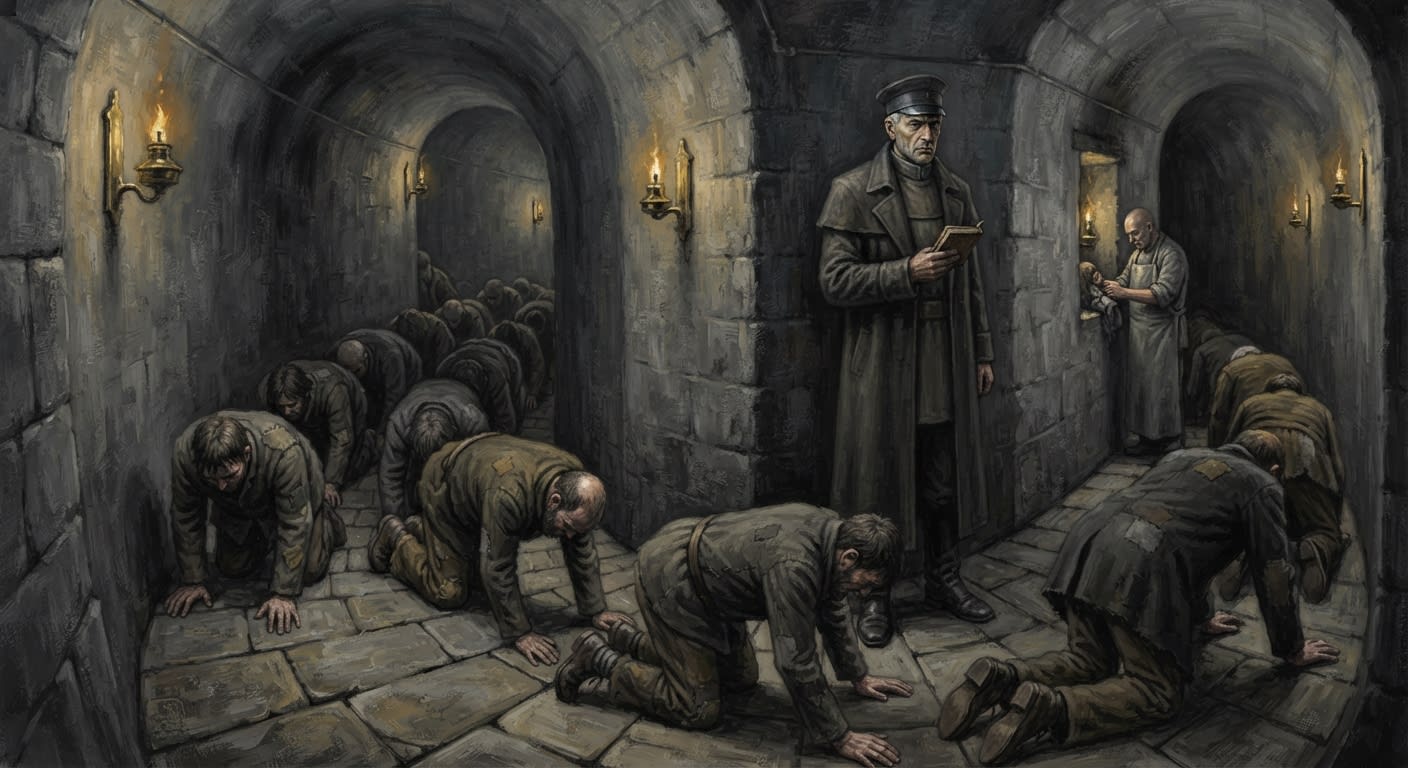
At the Bend the sorted rubble walls close in. Back in the Wall Cut a file can crawl three abreast with room for elbows. At the Bend it drops to two, and at the elbow of the turn to one penitent and one upright guide. The walls there are dressed in grey stone. They are not quite blackened and not quite clean, and they have taken the colour of a hearth swept the morning after. That grey gave the segment its name. Nobody agrees on what made it grey.
The guides say the Bend was laid over the pyre-ground where the garrison burned its dead once the cellars would hold no more. The Bureau of Engineering says the grey is lime-mortar dust from the post-Siege consolidation works and will say so to anyone within earshot. The Bureau of Records has filed both accounts under the same reference number, which is its way of saying it would like everyone to stop writing to it.
The pilgrim reaches the Bend having already spent a hundred metres of kneecap. The Wall Cut's stones are irregular but flat. The Bend's are set on a slight cant toward the inner curve, so the file drifts toward the wall that holds the guides' lane. Engineering calls the cant settlement. Doctrine calls it instruction. The pilgrims call it the place where the knees go, and they do not bother with capitals.
#On the Names
At Ash Bend the guides recite the names of the garrison dead of the Siege of Vienna. They do this at a speed set by crowd density, and this is the whole of the Bend's genius and all of its shame.
The roll comes from a Records copy of the garrison musters and burial lists, amended over the years as families come forward with petitions, proofs and ink. Nobody has published how many names it holds. The number shifts when a claim is admitted or struck, and the Bureau prefers a roll that never quite closes. A closed roll could be finished. An open one needs guides.
In the first decades after A.S. 95 the recitation belonged to garrison chaplains and to surviving veterans who knelt beside the files and said the names they had known. Some of them wept. Some forgot names. Once or twice a veteran stopped reciting altogether and had to be led away. When the Via passed under the Bureau of Pilgrimage after the Harmonized Routes Edict of A.S. 123, the Bureau replaced memory with a licensed script and put the reciters on their feet. The veterans were thanked, and the guides do not forget names.
The Remainder Formula is the part to watch. When a file jams at the elbow, because a widow has stopped or a veteran's knee has given out or a foreign delegation has discovered its limits, the guide stops reading names and speaks the Formula. That one phrase stands in for every name he has not reached, and the line moves on. The Bureau considers this doctrinally complete: the Creator does keep the names, and the guide says so. The families listening from the file hear something else. They hear that their grandfather was due in eleven names, and a stranger's ankle has folded him into a single phrase along with everyone else.
People also mishear the names. The Bend's curved walls return sound badly. A name spoken at the elbow comes back from the outer wall half a syllable later and a vowel wrong. Pilgrims have been known to take the echo home. At least one parish in the Munich Provisorium keeps a memorial candle for a garrison sergeant who never existed. He was put together out of two surnames and the curve of a wall. The Bureau of Records knows about the candle and has declined to put it out, on the grounds that the sergeant has by now received more devotion than most real men and it would be cruel to audit him.
#On the Bureau's Mercy
The Bend is where the Bureau keeps its mercy, and where it charges for it.
Ward-surgeons stand at the elbow in grey aprons that match the stone. They have salts, water, splints for kneecaps, and a printed card listing the injuries that entitle a pilgrim to a Completion Deferral, which lets them resume the Via at the Nave Approach on another day without losing their place in the roll. The card is short. The fee table attached to it is not.
Knee-cloths wear through at the Bend more than anywhere else on the route, because of the cant. A licensed attendant sells replacements from a niche in the outer wall. The niche is older than the licence. The attendant is not, and he gives the impression that he is the reason the niche exists. Replacement cloths come in three weights. The heaviest is embroidered with Clemens's steel hand, and the Bureau of Tithes apparently took no part in pricing it.
Families who can pay may buy a Named Remembrance. This is a wax seal, pressed against the pilgrim's token and registered at the counting rooms of the Central Corridor headquarters. It guarantees that one chosen name is spoken at Full Cadence whatever the density of the file, and it holds even under the Remainder Formula. The guide is obliged to break off, speak the purchased name in full with rank and parish, and then go back to the Formula. Everyone in the file hears the difference. That is the product.
Guides at the Bend are rotated more often than guides elsewhere on the Via. The Bureau gives the reason as vocal strain. The guides give it more quietly as the names. Reading the same roll forty times a day at three speeds leaves a man hearing garrison surnames in the rattle of cart wheels and the dripping of a tap. The guide who has walked the Via seven hundred times upright served the Bend for his first two hundred. He told me he could still recite the roll at Initial Cadence faster than I could read it. I invited him to try. He got through four hundred and twelve surnames before a supervisor stopped him for doing it without a file present, which the Standard counts as unlicensed recitation.
#On What Bends
Doctrine has never said publicly why the Via turns at the Bend. The breach was straight. The route could have been straight too. Engineering prepared a straight survey in the early consolidation years and it was declined. The refusal carries no reason, only a seal.
I will give the reason myself, since the office that sealed the refusal and I have been using the same pen for decades.
A straight road lets a pilgrim imagine the charge. On his knees in the Wall Cut, with the Impact Plate somewhere ahead, he can picture himself as Clemens walking into the breach with the reliquary of Saint Aldebrand raised over his head and the note already gathering in the bone. Every pilgrim who has pictured that has come away worse for it. They start to think that when the next breach opens they will be the one to walk into it. Men like that end up in unsanctioned sorties, in schisms, or in letters to Strasbourg.
The Bend takes that away from him. At the elbow he cannot see the altar, and he cannot see anyone ahead of him except the heels of the penitent in front. What he can hear is a stranger reading out the dead faster than he can take them in. For a hundred metres the pilgrim is one of a queue, and the Siege comes to him as the garrison knew it, which was waiting, cold, hunger and names. The glory of the blow is waiting further on at the Hammer Line, where it belongs, and by the time he reaches it he has been made small enough to deserve it.
On the first of November the stone of the Via hums, and the guides at the Bend recite over the sound without changing their cadence. I watched it once. The file faltered and the guide did not. He kept to Half Cadence straight through the hum as if the stones had nothing to add. Afterward I asked him whether the hum was louder at the elbow. He said the Standard contained no provision for it. Asked the same question about the night file, he gave the same answer.
Unlicensed pilgrim leaflets sold outside the Kärntner Gate identify Ash Bend as "the place where the Bishop-Warden struck down the sorcerer," and some advise pilgrims to kiss the grey stones of the elbow for that reason.
Corrected. Clemens Stahlhand struck Althazar of Pest before Saint Rupert's altar, and that place is now marked by the Impact Plate at the end of the Hammer Line. The true strike-stone rests in the Basilica of the Ledgered Saints in Strasbourg. Ash Bend is an approach segment, and all that is buried under its stones is the dead, or else mortar dust, depending on which Bureau is answering. The leaflets have been confiscated. The pilgrims go on kissing the stones, and the Bureau has stopped discouraging it, because a kissed stone slows the file and a slower file means Full Cadence.