
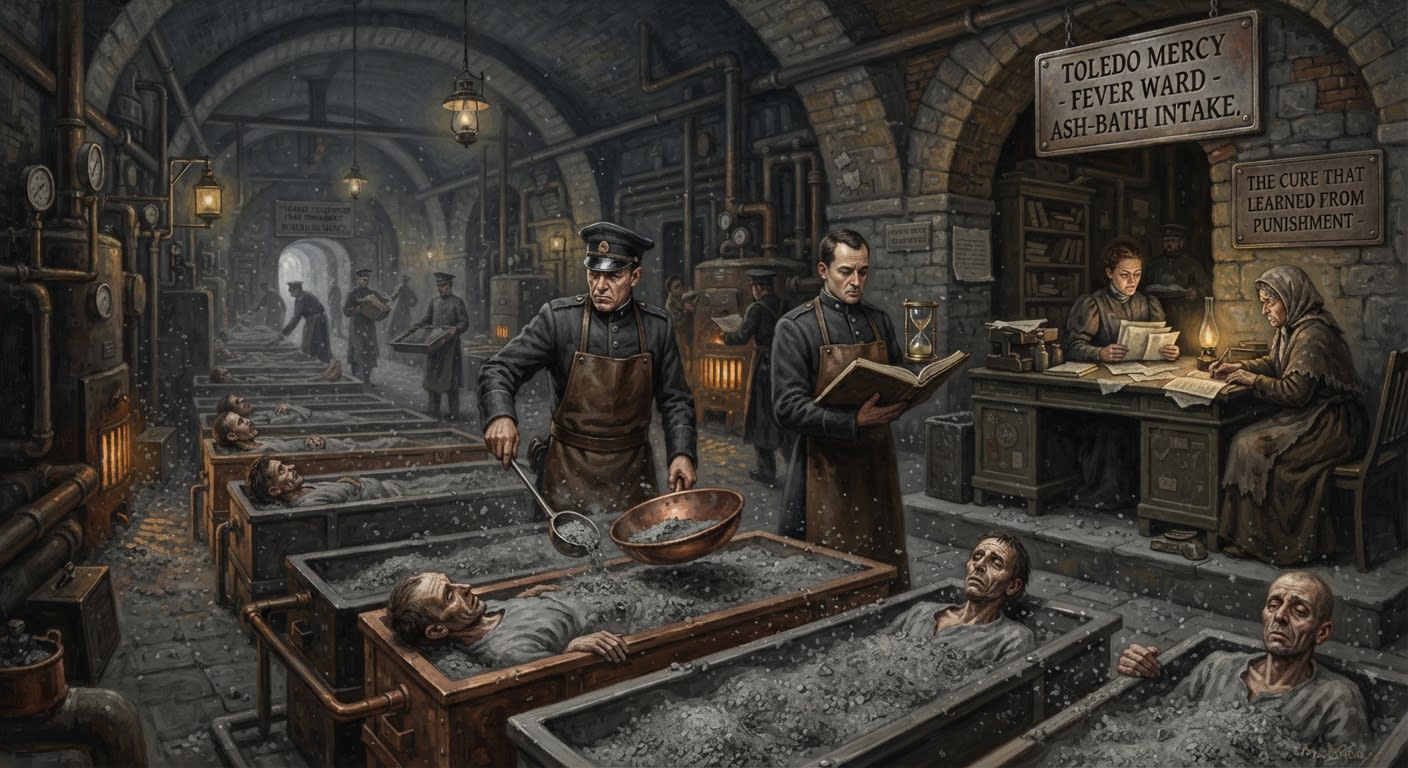
#On the Cure That Learned From Punishment
The Ash-Baths of Toledo are what happens when a hospital studies a court and admires the wrong lesson. Across the precinct, in the rebuilt cathedral forecourt, the Cinder Trials kneel the condemned in a shallow pit and pour warmed ash over them by hymned measure. At Ninth Bell a Doctrine ash-reader cracks the crust and reads the fracture as a verdict. Everyone present understands the arrangement. The ash accuses, and the accused knows it.
The Baths belong to the Bureau of Mercy. Mercy took the pit, the heat and the grey vocabulary and set them to healing. Fevered patients are lowered into troughs of hot ash so that corruption may be sweated from the flesh. Few survive longer than an hour. Survivors are walked through the streets as living reliquaries, cracked and smoking, until they fall down or stop drawing coin. Those who fall are graduated cures. Their families receive a linen bill.
I have attended the Trials and I have attended the Baths. The Trials are worse to watch and easier to forgive. A court that buries a forger to the ribs has at least told him its opinion of him. Mercy tells a feverish child's mother that the ash is care, and then it takes her signature.
No founding register for the Baths has reached the Ledger. Toledo was reading ash as law within a decade of its reconstruction, and Mercy received its charter in A.S. 92. No register says whether the first trough was warmed under Mercy's seal or under some older ward habit that Mercy stamped afterwards. The Bureau prefers that the Baths have always existed. In Toledo, a missing birth certificate counts as a credential.
#On the Ash, the Fever and the Ledger
Intake at the fever-ward desk follows Mercy's usual order: papers first, then confession, then pulse. The confession carries the most weight. Mercy cannot draw out a corruption it has not named, and a fevered patient will name almost anything if the Ward-Sister suggests it slowly enough. Pride. Appetite. A curse muttered at a tax assessor two winters ago. The Ward-Sister writes it down, and the fever acquires a theology.
The family consents next, which pilgrims never see. A mother, a husband or a grown son sits before the string-tied ledger and hears what the ash will do, which is cure, and what it will cost, which is itemised: sieving, warming, linen, attendance, procession bell, certificate. Mercy does not require payment at the desk. It requires payment within three days of the outcome, whichever outcome arrives.
Then the patient goes below. The troughs sit in sweating vaults under the wards. The ash is sieved, warmed in copper pans and ladled to the collarbone notch while an attendant turns a sandglass and slates colour, sweat, speech and stillness. The full procedure is filed in the abstract under Ash-Baths, and I will not copy it twice. Records bills by the page.
The abstract leaves out the ash itself. Families are encouraged to believe it carries devotion. The Ward-Sisters never say it comes from the forecourt. They say it is of the same custody and let the forecourt's reputation finish the sentence. Officially the Trial ash is sifted from the reliquaries of Saint Isidore, the saint whose casket made Wrath recoil at Kalnik Ridge. Engineering calls it pumice with a pinch of relic dust. Petitioners whisper that tower-ash from the burning of the Relic of Saint Iago went into the first pit. Mercy has claimed none of this for its troughs, and it has never denied any of it to a weeping mother. No register I have been shown fixes what the troughs contain.
A Mercy fever-ward pamphlet, printed for pilgrims arriving at the Tagus quays, described the Baths as "the healing office of the Cinder Trials, sharing the forecourt's sanctified ash."
Corrected under Doctrine seal. The Ash-Baths hold no forecourt warrant and share no ash-reader. No authorised order draws their ash from the Trial bowls. The pamphlet has been withdrawn. The reprint drops the sentence and keeps the woodcut of the forecourt pit on its cover.
The attendants think about fuel. A trough that must be warmed twice burns more coal than a trough emptied at the hour. One Ward-Sister on the east stair, too tired to lower her voice, told another that the patients who cool slowly are the expensive ones. I did not correct her arithmetic. It was sound.
#On Living Reliquaries
Survivors come up the east stair grey from the collarbone down, and the crust splits at elbows and knees as they climb. Heat still leaves them in the morning air. Attendants walk at their sides with ledgers open, recording each stumble. The route runs uphill toward the cathedral precinct, past chapels whose doors stand open for the occasion. On Trial days, forecourt ash drifts across the awnings of the Bell-Market, so the procession walks through two kinds of grey, one judicial and one medical. Only the medical kind is billed to the family.
Pilgrims kneel. Some touch the linen, and the touch is priced. The Bureau of Tithes enters the coins as devotional receipts. A family that can afford it leases an extended peal from the Bell-Market so that its survivor walks under sound. A family that cannot afford it walks in silence, and the crowd reads that silence correctly.
The Bureau of Relics declines to authenticate living persons. The pilgrims ignore the declination. To the faithful of a martyr-city, anything that has passed through heat and still stands has been proven.
Many do not stand for long. The skin opens along the crust-lines somewhere between the second chapel and the fourth, and the procession stops so the attendant can write. The crowd, having paid to watch a cure, decides it has watched one complete. Mercy agrees. The Bureau of Records files these deaths under Mercy outcomes rather than mortality, because Mercy drew up the columns. The family receives a certificate with a grey border and one line of scripture from an approved list of nine. The certificate appears on the bill.
#On the Famine and the Governor's Irritation
A.S. 185 brought failed harvests, mule-fever on the Tagus road and caravans stalled in the uplands. The Tithes schedule held. Toledo's queues grew longer, and the fever desks began admitting a new sort of patient: delirious, hot to the touch and thin enough that their ribs could be counted through a shirt. Their fevers were real. So was their hunger, and hunger is not on Mercy's tag list, so the desks recorded fever and sent them down.
I wrote to the Toledo wards that a man who has not eaten in six days is suffering from something other than corruption of the flesh. Mercy replied that corruption often presents as appetite. The reply is in my files. I keep it beside my correspondence with heretics, where its tone fits best.
Governor-Praelate Alaricus made the same observation with less correspondence. He opened the Granaries of Saint Benedict at second bell without waiting for Strasbourg's approval. The loaves went to children first and fever wards second. Within a fortnight, admissions to the Baths fell. Mercy recorded a seasonal variation. The bakers call it the season of bread.
Alaricus did not close the Baths. He had no warrant to close them and every reason not to try, since pilgrims pay to watch the processions and half of Toledo's respectable citizens have built their piety around attending them. He moved ration disputes out of the ash forecourt and into a side hall with benches and water. He left the troughs to Mercy. The Bureau of Tithes objected to the water.
#On the Present Baths
As of A.S. 201 the Ash-Baths are active, warmed at dawn and processing on schedule. Every office has found its reason to keep them. Mercy calls them cure. Doctrine tolerates them as ash pedagogy, useful for teaching a martyr-city that heat purifies. Tithes likes the bills, which are paid, and the touch-coins, which are paid faster. The city likes the spectacle. Toledo was built on the memory of the siege of A.S. 15: Father Clemente in the burning tower, the fourteen women with oil, walls that learned to scream. A population raised on that memory will always turn out to watch someone smoke in the street.
The families know. The ones who live upriver learn it last. They come down the Tagus with children burning in their arms, pay the quay toll, and in Trial weeks pay the cinder-drift charge on top of it. Then they climb to the fever desk because the pamphlet has a woodcut and they cannot read the circular. The Toledo families learned long ago, and they bring their fevered to the desk anyway. Grief in this city has no other licensed place to go, and a signed consent at least buys a certificate that says cure.