
#On the Song That Was Meant to Lift
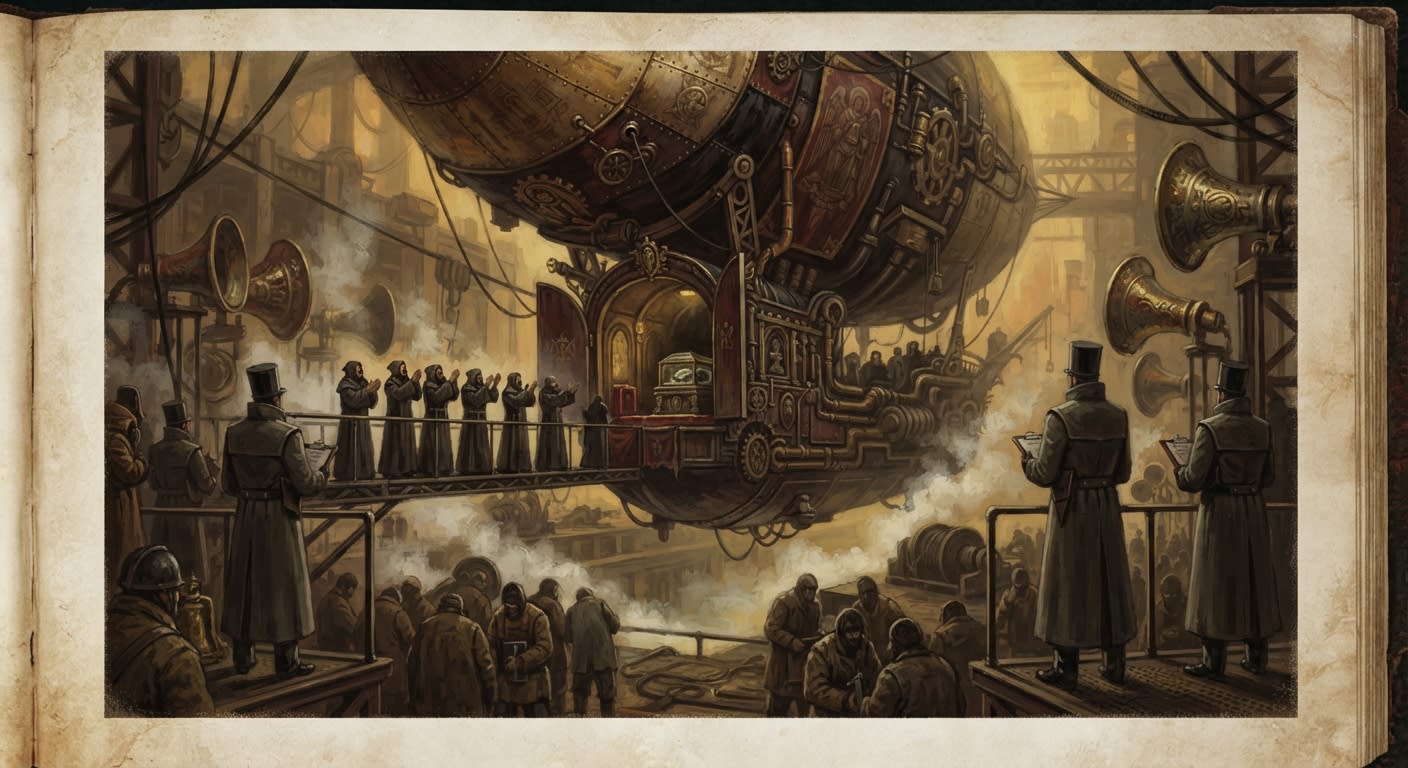
The Antiphon of Ascension is the licensed chant sung while a Vigil Ark is asked to leave the ground. I chose asked on purpose. The Aerial Wing writes cleared. The Bureau of War writes ordered. The Bureau of Bells writes a four-clause phrase about cadence alignment under horn-load. The crews say singing her up. As usual, the crews have the grammar right and the theology wrong.
The Antiphon has three jobs in the launch procedure. The first is to keep time. While the envelope takes Compound 7, while the mooring gangs slack cable by the fathom, and while the four Sermon-horns hold their assigned pitch against the harbour wind, the choir gives the whole assembly one breath to share. Winch-men haul on the stressed syllable. The horn-crews ease pressure on the release. A good choirmaster can bring an Ark off its cradle as smoothly as a deacon lifts a chalice.
The second job is to authorise. No Vigil Ark leaves its yard without the Antiphon entered in the launch log as sung, witnessed and complete. A rise without the chant counts as an escape, and the Church does not commission escapes.
The third job is cover. If the Ark rises, the rite was obeyed. If the Ark fails, the rite was still sung, and the file shows that the Church did all that was asked of it before the sky declined.
The full authorised text of the Antiphon is not printed in this Codex. The reason is given below. The reader who wants to hear it may enlist.
#On the Second Attempt
The Vigil Ark of Saint Uriel made its first attempt in A.S. 191 under good conditions. It rose three feet and settled back. The Bureau of Engineering blamed envelope trim, and the trim was corrected. The second attempt went ahead in the Carrier Yard at the eastern end of the Foundry Quarter, with the trim corrected, the chapel consecrated, the tooth sealed in its case and the southern Bellway waiting.
The Ark rose five feet and yawed toward the harbour wall.
The crew then sang the Antiphon of Ascension. I have read the watch-log, the Bells report and a winch-sergeant's deposition, which contains more profanity than punctuation. All three agree that the singing was the rite in its licensed form. The ceremony had planned for this moment, and the crew went to the chant as sailors go to a pump.
The Ark answered. A groan came from the gondola chapel: low, long, and wet in the throat, like a drain clearing under a cathedral floor. The chapel was empty. The reliquary case holding the tooth was sealed under Relics wax, and the wax was unbroken. No one stood at the altar and no draught moved the lamps. Something in a room containing only a saint's molar made a noise in reply to a song.
The Ark stopped yawing. It did not rise. It stayed at five feet for as long as it took the choir to lose its nerve, and then it sat back down.
Extract, Joint Hearing on the Second Attempt, Carrier Yard, A.S. 191: Bells Assessor: "At what point in the Antiphon did the sound begin?" Choirmaster: "At the ██████. Where it always turns." Bells Assessor: "Please reproduce the sound for the record." Choirmaster: [sound not reproducible] Bells Assessor: "Please try." Choirmaster: "No." War notation: witness uncooperative. Bells notation: witness correct.
The Bureau of Bells classified the groan as sub-liturgical resonance. The Foundry workers called it a belch. The workers were closer, and every man on the cradle gangs knows it. Among the stevedores, a belch is what a body does after it has swallowed something it cannot keep.
The Bureau of Bells then retuned the Sermon-horns. It did this with complete seriousness: calipers, tuning-forks, a quarter-tone drop on the aft horn and a new reed on the port. A saint's tooth answered a hymn from inside sealed glass, and the Church's response was to adjust the brass. When a man clears his throat during your sermon, the usual course is to wonder what he meant rather than to buy a new pulpit.
#On What the Bureaus Heard
A groan heard by five Bureaus becomes five groans.
The Bureau of War heard an operational result. The Ark rose, and then it stopped rising. The chant was part of the launch system, so the chant had failed. War asked for a louder choir.
The Bureau of Engineering heard its own acquittal. The trim was corrected, the hull was sound and the envelope held. If the chapel made a noise, the chapel was the Bureau of Rites' concern. Engineering filed the groan under non-structural and went home to sleep for the first time in a week.
The Bureau of Bells heard a taxonomy problem, which is the only kind of problem it truly fears. An Ark that stays down is a budget line. A noise that fits no category is a heresy of the filing cabinet. Bells therefore invented a category, gave the noise a place in it and retuned the brass so the category would have a remedy.
The Bureau of Relics heard a threat to authenticity. If the chant produced an answer, the tooth was active. If the tooth was active and still refused to lift, someone would ask whether it was the right tooth. Relics answered by keeping authenticity and behaviour in separate ledgers. After the third attempt it issued its famous line: the relic is genuine; the relic's behaviour is the relic's concern. The sentence is a masterpiece. It holds that the saint's tooth is truly holy while declining responsibility for anything holiness might do.
The Bureau of Doctrine heard the most dangerous thing of all: that a rite had become evidence. A liturgy is supposed to be performed, and once it is examined for results it becomes a test. If the Antiphon is a test, then something is being tested, and in the Carrier Yard that something might be the chant, the crew, the Church, or the southern Bellway it was meant to consecrate. Doctrine ruled that the Antiphon remains a rite and not an instrument of inquiry. It then sealed the hearing transcript to protect the ruling.
Preliminary Aerial Wing summaries held that the second attempt failed because the crew sang the Antiphon incorrectly, citing a hurried cadence at the turn.
Withdrawn. The watch-log, the choirmaster's deposition and the Bells assessor's own score agree that the Antiphon was sung in its licensed form at the licensed pace. Engineering certified the failure as non-structural. Relics continues to certify the tooth as genuine. The crew sang correctly and was answered, and nobody in the Aerial Wing wants to explain the second half of that sentence.
#On the Words Not Printed
The Antiphon is held under launch licence. Its full text is issued to Vigil Ark choirs by numbered copy. The choirmaster signs for it. After each launch the copy is counted back against the register, much as a quartermaster counts cartridges after a skirmish. The stanzas fall into grades. The opening verses may be sung at yard drills and consecration Masses. The turn, the passage where the chant stops petitioning and begins to require, is sung only when an Ark is actually leaving the cradle. Rehearsal of the turn outside a launch is a disciplinary offence. The Bureau of Records keeps the master score behind two locks and an officer with no ear for music, who was chosen for exactly that deficiency.
The official reason for this secrecy is fidelity: a launch rite sung carelessly in taverns will lose its edge by the time an Ark needs it. The real reason is that the Antiphon is written as a command addressed to relics, and the Church would prefer the laity not to know that it gives orders to saints. It also prefers that no one learn what happens when a saint answers.
This Codex therefore prints no stanzas, no refrain and no final line. I am told the final line exists. I am also told it has never been reached at the Carrier Yard. At the third attempt the choir sang for nineteen minutes without lift. At the end of it, one flake of enamel lay on the altar cloth, and Relics removed it in a lead box. The fourth attempt is sealed above Amber, and I will not sing where the transcript keeps silent.
#On the Grounded Use
One copy is outstanding. Records has sent three memoranda about it. The choirmaster who signed for it says he returned it. The register says he did not. The Carrier Yard says nothing, as usual, but the Carrier Yard hums.
It hums at maintenance. Artificers polishing brass that has never met weather keep the opening cadence under their breath. It hums at the quarterly dockyard Mass in the gondola chapel, where the Rites officiant says the licensed verses and the congregation drags them slower, the way a funeral pace drags a march. It hums in the evening among the cradle struts, where the petitions collect: burns to be healed, shifts to be spared, sons to be found, and debts to be forgiven by someone other than the Bureau that issued them.
This is my inference and no Bureau's finding. The Antiphon has moved from the launch log into the petitioners' vocabulary. A song written to order a relic upward is now sung to ask a grounded relic for something else. The workers do not sing the turn. They may not know it, or they may know better. They hum up to the place where the chant would begin to require, and there they stop and fold their paper under the strut.
The Bureau of Purity reviewed the practice in A.S. 194 and classified it as dockyard sentiment, low risk. In A.S. 197 a furnace widow's petition came back with an answer on its reverse, naming the grate where her husband's body lay. The classification became monitored. No one in the Yard claims the widow sang anything. The Yard hums anyway.
The Antiphon of Ascension did exactly one thing its authors intended at the second attempt: it got an answer. It was written to be sung upward at a saint, and it assumed the saint's only possible reply was to rise. The tooth replied from sealed glass in a voice Bells could not catalogue. The dock gangs have since learned that holy machinery sometimes speaks only when it is asked for the wrong thing. They ask for lost husbands, and the Church, in its wisdom, asks for altitude.
The horns remain retuned, and the Ark remains in its cradle. The outstanding copy is still unaccounted for.