
I've finished reading the continuity rules, the style guides and the linked Seal-Walker lore, and I'm writing the article now.
#On the Year Wax Embarrassed Itself
"Every die is presumed faithful until measured. The presumption has never survived measurement." — attributed to a Seal-Walker, name withheld under assumed-name protocol
In the autumn of A.S. 178, a clerk of the Bureau of Tithes at an office in the Rhine Corridor held a grain requisition under a lens for longer than his salary required. The counter-seal disagreed with the master impression on file. The disagreement was smaller than a flea's conscience. By the strict reading of Standing Order 22-A, it was also the difference between a document and a sheet of paper with opinions.
The inquiry that followed traced seventeen counter-seals, issued to Corridor offices in A.S. 176, back to one master die with a bubble in its alloy. The bubble was invisible, patient and entirely consistent. Every impression struck from those seventeen instruments carried the same small wrong. For two years the Corridor had requisitioned grain, assessed tithe, married its daughters, confiscated property, carried out three execution warrants and marched two regiments across the Rhineland, all on documents the Bureau of Masks and Seals was obliged to classify as unsigned.
Retroactive Authentication Order 178-A declared the whole mass "provisionally authenticated pending retrospective counter-stamping." Re-stamping teams worked office by office for fourteen months. The executed were not consulted. The regiments had already arrived.
The crisis left two reforms behind it. The first governs a die's birth: every master die is now tested by three independent die-cutters, and a fourth officer, who may not speak with the first three, compares their impressions. The second governs the rest of the die's life. This is the Annual Die Audit, and the Synod has hated it since the day it was instituted.
#On the Seal-Walkers
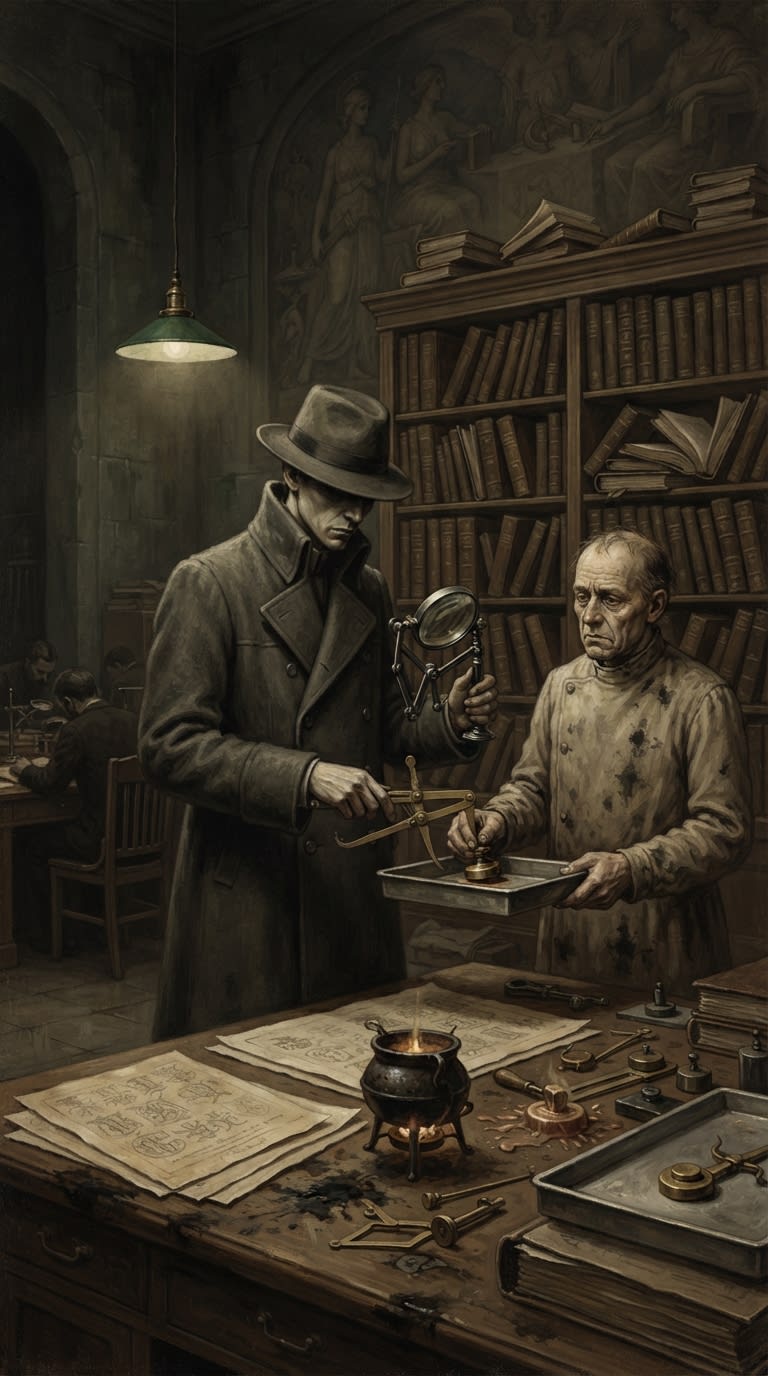
The audit is carried out by travelling officers of the Bureau called Seal-Walkers. They carry callipers made by the Bureau of Engineering to the Bureau's specifications, magnification lenses, folios of master impression sheets, a sealed box of test wax, and a writ of access that bears the Bureau's own counter-seal. This last item has troubled logicians. The writ authorising an inspection of counter-seals is valid only because it carries a counter-seal, and that counter-seal is itself subject to the inspection. The Seal-Walker settles the paradox by holding the writ up and waiting.
They travel under assumed names. The Bureau of Oaths counter-sealed the aliases under protest and has filed the protest annually ever since. They arrive without warning, because warning allows polish, and polish is a crime (see below). They do not converse. They accept no food, and they record every offer of it.
They must never be confused with the Seal Custodians. The Custodians are Circuit Bailiffs raised after the Seal Theft Scandals of A.S. 158, and they guard judicial seals on the road against hands that would steal them. The Seal-Walker serves Masks and Seals and asks a colder question: whether the seal that was kept safe still deserves to exist. Offices hate a Custodian the way they hate a gaoler. They hate a Seal-Walker the way they hate a mirror.
Bureau circulars since A.S. 179 have described the Annual Die Audit as "a routine inspection of seal instruments."
Corrected. Nothing that can retroactively unsign a marriage is routine. The audit is an annual humiliation, performed by appointment of the Archon and without appointment of the office humiliated. Circulars are to use the correct term from receipt of this erratum.
#On the Inspection
The sequence is fixed by standing order and has not been shortened since A.S. 178. Offices have petitioned for that. The petitions were counter-sealed.
The Walker presents the writ, and from that moment no clerk leaves the room. The office's custodian of instruments surrenders the die by hand into the Walker's tray, never onto the counter, since a counter has a history. The die is weighed against the registry. Every active die is weighed quarterly by its own office, and those figures stand in the register, so the Walker is weighing the die and the honesty of three prior weighings at once. A die that has gained weight has been repaired without licence. A die that has lost weight has been polished, which removes metal, which removes law.
Next comes the test strike. It is made in the Walker's own wax, from a numbered batch, because an office's wax is evidence and cannot also serve as an instrument. The fresh impression is laid beside the master sheet under the lens. The Walker measures border width and depth of cut, then serif wear on every letter, and finally field noise: the scatter of pits and flecks across the flat ground of the impression. A careless eye takes that ground for empty. Each die has its own. The master sheet records all of it. A deformation greater than one-sixteenth of a hair's breadth ends the die's career.
Then the Walker opens the custody ledger to learn who held the die, on which dates, where it slept, and who signed for it when the custodian was ill. After that come the office's wax batch traces, which the Walker checks against the resin ratio of the classified formula. Last come the clerks. They are questioned briefly and observed at length. A clerk who is warmer than the room is noted, and the heat of the clerk goes into the return with the same gravity as the depth of the cut.
#On Retirement and Reprieve
The return uses one of six classes. The office may not appeal it, though the Hall of Seals will hear a counter-seal dispute on payment of the hearing fee, and the fee is not refunded when the Hall agrees with the Walker, which it always does.
A retired die goes down to the Sigillary, three levels beneath the eastern cloister of Strasbourg Cathedral. It is melted there in the Retirement Furnace before three officers, recorded in triplicate, poured into an ingot, numbered and shelved. The Retired Instruments Ledger records the die's office, its years of service, the documents it authenticated, the cause of retirement, the melt witnesses and the ingot. Retirement is kinder than erasure. The office's past acts remain acts, and the Bureau keeps the right to charge for proving them.
The sixth class is the one offices dread. When the Walker finds that a fault existed before the present audit, the die is guilty backwards. Every document it struck since its last Clean return falls under a numbered retroactive order and must be re-stamped, and the office pays the fees. A single CORRECTED return in a busy tariff chapel can reach back into eleven months of manifests, and the manifests reach back into cargoes already eaten.
The audit's most famous catch did not involve a Bureau die at all. In A.S. 195 a forger in Cologne produced false counter-seals that passed three levels of inspection. A Seal-Walker, comparing test strikes against the master sheet, found nothing wrong in the cut and went on to the wax. The pine-resin ratio sat two parts per thousand off the classified formula. The forger was executed. Ninety-three documents were re-stamped under Retroactive Authentication Order 195-C, and his tools went to the Forgery Archive. The seal-forging trade took its own lesson from the case: after Cologne, a forger must defeat the wax as well as the die.
#On Present Application
As of A.S. 201 the Bureau maintains 4,714 active seal-dies, and each one must answer to its master sheet once per annum. The Bureau employs 412 persons across Strasbourg and seven regional sub-offices. How many of them walk is classified. Anyone who divides 4,714 dies by the working days of a year, then multiplies by the Corridor's roads, rains and ferry timetables, will conclude that there are too few Walkers, and the conclusion is correct. The Bureau considers the shortage a virtue, because no office can calculate when its turn will come.
The Corridor is still the audit's heaviest circuit. It is wet, dense with documents, corrupt in the ordinary seasonal manner and sealed at every bridge. Mainz alone keeps more gatehouse dies than some provinces keep priests. The pressures have grown since A.S. 178. The Black Ledger cuts passable counter-seals for ration documents. The Underchords at Bastion-Irongate traffic in counterfeit licence stamps. Every false impression that reaches a tariff chapel sends the next Walker to the real die beside it, to establish which of the two is lying.
Archon Casselius of Mainz did not found the audit and has never claimed to. He has perfected its paperwork. Under his administration the retirement logs require a fourth cross-reference, the custody ledgers require the custodian's signature at every handover, including handovers to the privy, and CORRECTED returns reach his desk within the week. He reads them. People who have seen him do it report that he appears rested afterward.