
#On the Heat Beneath the Face
Every lawful face in the Theocracy passes through fire before it passes through a purse. The fire is kept in the Anneal Courts. They lie south of Die Row, inside the ringed enclave of the Crownwright Diehouses in Cologne's south quarter. These furnace yards take in metal twice. The first time it arrives as a raw blank, and the furnace softens it until it will take a die without splitting. The second time it arrives struck, and the furnace tempers it until the face it now carries can survive a lifetime of thumbs, counting-trays and offering plates. Between the two heats the metal is merely expensive. After the second it is somebody.
The Courts went up with the rest of Sable Court in the buildout of A.S. 94 to A.S. 100. In those years the old guild district was walled, mirrored and handed to the Mint-Chapter and the Crownwright Guild under their joint Compact. No separate charter for the furnace yards survives, and none was ever wanted. Nobody founds a boiler room. One builds a palace, and the boiler room comes with the bill.
#On the Yards and Their Weather
Bullion comes up from the Black Canal locks to the south. It is cut, warmed and pickled in the Courts. From there it is carried north to Die Row's presses and brought back to be tempered. Then it goes out to the Assay Cloisters to the east to be judged, while the Strike Floors thunder in the west. Most coin in the quarter crosses the Courts twice. The Wardenate has noticed this. So has everyone else.
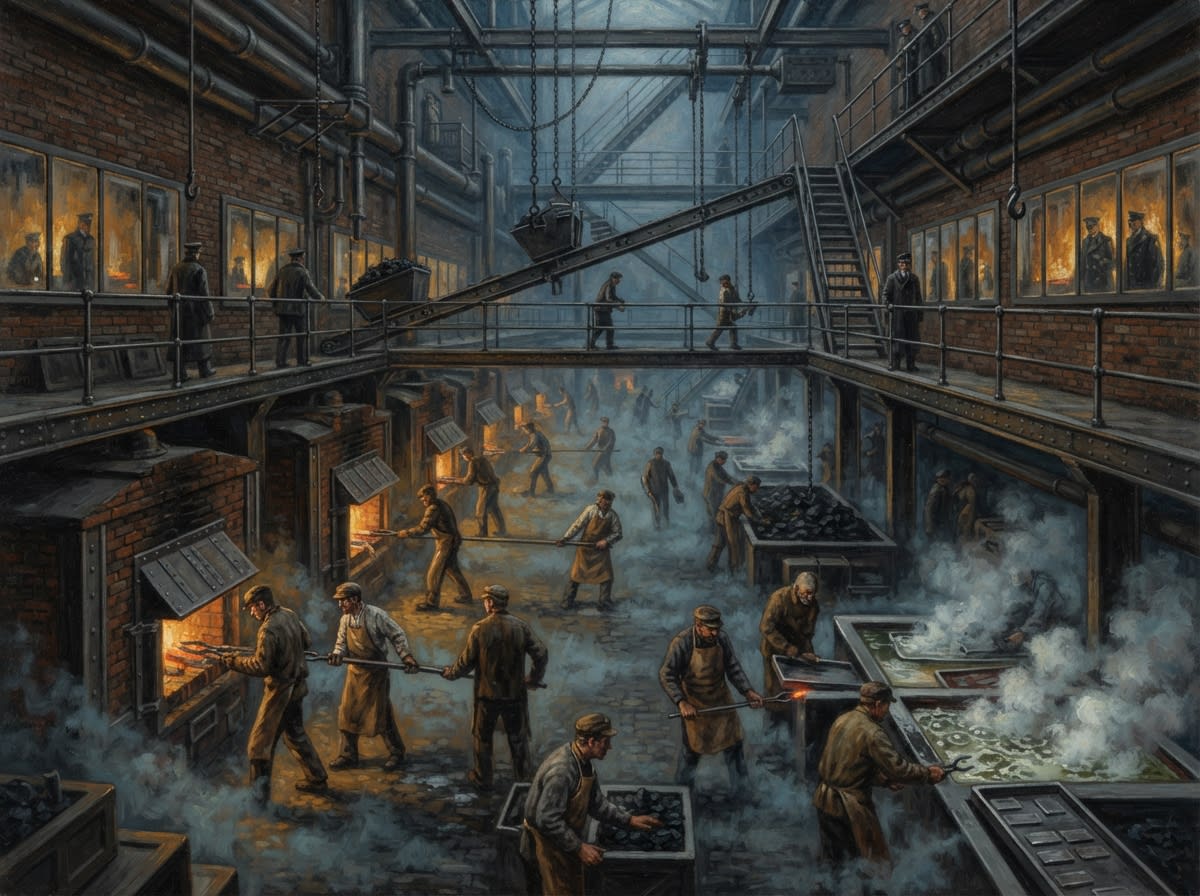
The yards are black brick paved with black brick, under iron gantries that carry coal skips and blank-trays from stack to stack. The stacks themselves rise in a row, soot-throated and never cold. In winter they make the quarter's private weather: a fine ash-snow that settles on sashes, eyelids and bread, and tastes of iron. Low fog comes off the quench-vents at every shift change and lies waist-deep across the yards, so labourers seem to wade rather than walk. The smell is coal and vinegar. The vinegar is the wash that pickles scale off hot blanks. The coal needs no apology. It is the only honest thing in Sable Court.
Mirrored inspection windows line the yard walls at head height. A furnace tender who looks up sees himself sweating and never sees the clerk behind the glass. Above the windows run the Warden Walks, and the boot-rhythm of the counting circuits falls through the gantries like a second, slower hymn. Below the yards run the furnace tunnels: flues, ash-pits, coal ways and older brick throats that were never properly mapped. The lawful district ends down there and the other one begins.
#On Heat Labour and Its Theology
The Courts keep the lowest orders of the quarter's working ranks. Furnace tenders manage the fires. Tray-bearers carry blanks in iron trays too hot to hold and too valuable to drop. Acid runners go between the vinegar vats and the Cloister gates. Warrant crews shovel coal under debt-labour warrants. Beneath all of them are the furnace penitents, sentenced to purity-penance shifts in the heat until their fines are paid. Most penitents work until their speech dries out. A few are paid off first. The ledgers record both outcomes in the same ink.
Crownwright doctrine holds that a face must survive heat before it may be trusted to survive circulation. A blank that cracks in the first fire was never fit to carry a soul. A struck coin that warps in the second has told the Chapter something unflattering about its face. The furnace is therefore a court in the old sense. It judges, and it does so before the Cloisters are permitted an opinion.
When the Bureau of Doctrine condemned mechanised die-cutting in A.S. 134 as "spiritually imprecise," it addressed dies alone. Court foremen have cited the ruling ever since against every mechanical stoker, draught-engine and conveyor offered to the yards. Hand-fed fire, they argue, carries the reverence of the hand. It also carries the wage of the hand, the debt of the hand and the Guild's monopoly over whose hands are allowed near the metal. The ruling protected piety, labour and Crownwright authority at once, a thrift Doctrine rarely manages on purpose.
Earlier Chapter notices described furnace penitents as "voluntary penitential labour offered in gratitude for correction."
Corrected. Penitents are assigned by debt-labour warrant. Gratitude is measured at release, where it has so far proved difficult to find.
#On Ruined Blanks and the Lower Yard
Heat ruins metal as readily as it perfects it. A blank may scale, bubble, warp, soften past use or crack along the grain of some old impurity the canal clerks failed to weigh. By law each ruined blank is logged, weighed, sealed and sent back to melt under witness. The ledger calls the difference between trays in and trays out furnace loss. Furnace loss is the most fertile line in Sable Court's accounts.
The workers learned early which ruined blanks were counted and which were only estimated. Much the same education reached the acid runners who saw rejected batches and the assay clerks who learned which defects mattered. From those lessons came the Clipped Choir. By A.S. 187 the Choir held the furnace-tunnel mouths beneath the Courts, alongside its canal shadows, its market corners and its broker stalls in Clipper's Market. Stolen trays cool in the tunnels there, full of blanks that the ledger records as ash.
The Courts are not the Choir, and the distinction should be kept. The yards feed the Choir the way a granary feeds rats: by existing, by being counted carelessly and by employing people who are hungry. The equipment in the tunnels is modest. There are shaving knives, acid pens and edge cradles. There are soap moulds for pressing false rims, finger-veils lifted from Die Row's apprentice bins and face-swap ledgers kept in a cant of weights and hymn-counts. The clipped coin made there buys bread for the men who tend the fires above. When a tender's wage fails, the Choir's does not. The Chapter calls this corruption of the labour force. The labour force calls it supper.
#On Hazards and Inspection
The Courts kill slowly. Furnace accidents are the quick exception: a tray tips, a flue backdraughts, a penitent faints across the quench-rail. The ordinary death is lung rot from metal dust and coal fume. Vinegar burns eat the hands of acid runners. Heat exhaustion takes the old tenders in summer, and afterwards the Chapter records them as having retired. Penitents lose their voices first. Some write their names on the yard walls in soot so they can still answer at roll.
At every shift's end comes the clean-hand inspection. Palms are turned up to the mirrored glass, nails scraped over a felt tray, and mouths opened, because a blank sliver fits comfortably under the tongue. Speaking a name during a heat is forbidden, as it is during a strike cycle, and in the Courts the rule enforces itself. Wardens above watch the whole business through slit-windows in the bridge floors. They know that anyone who can hide heat can hide metal.
The yards' oldest fear is blank-die panic. It arises when a die is rumoured to have passed through the fires unstruck, without a face, where no ledger saw it. The panic has closed the Courts several times. The rumour has never been confirmed. Closures cost more each time.
#On the Present Heat
The Face Theft that began in A.S. 199 fell hard on the furnace yards. When citizens found their coin-faces altered, the Mint-Chapter recalled seventeen denominations. A recalled coin has to be softened before it can be re-struck, so the Courts now run two work orders at once: they temper new faces and unmake old ones. Die Row works triple shifts and the Courts triple their heats to match. The Strike Floors thunder all night. The hymn-timing slipped twice, and two batches were struck with faces that neither the shift choir nor the Cloisters could name. Both batches were tempered in the Courts with complete propriety. Heat keeps no Archive clearance.
The Unface Society claims authorship of the whole campaign from the furnace tunnels beneath the Anneal Courts. It declares that it aims to abolish the Face Registry, destroy the Archive plates and flood the Theocracy with faceless coin. The Bureau of Purity doubts that six engravers and a disgraced archive scribe could carry out so wide a contamination, and says so in writing. The claim stands as claimed. It is recorded here without the Bureau's endorsement or its dismissal, which is the posture the Bureau itself has chosen.
The master die haunts the yards more than any other district. It is denied by the Chapter and rumoured everywhere else: a cylinder said to bear no face and every face. The Codex does not settle whether it is steel or superstition. The Courts' difficulty is plainer. Every blank that enters the first heat is faceless metal, lawfully and by necessity. The Amber orders of A.S. 201 require faceless blanks found outside the process to be surrendered within one bell. Inside the Courts, faceless blanks are simply the day's work. A heretic who wants faceless coin does not have to invent it. He only has to interrupt a tray.
WARDENATE SEIZURE EXTRACT — ANNEAL COURTS, TUNNEL MOUTH ███, A.S. 201 Recovered: one iron tray, Chapter pattern, stamp filed off. Contents: ██ blanks, unstruck, first-heat soft. Surrendered: no. Bearer: furnace penitent, speech dry, name unreadable in soot. Bearer's own coin on inspection: face present, not matching bearer. Disposition: ██████████. Tray returned to furnace loss.
So the Courts are watched twice. The Bureau of Records and the Chapter watch them as an industrial site, reconciling trays, loss and warrants against the Great Ledger's concordance. Purity watches them as a place where heresy incubates. Unstruck-metal cults have always preferred warm rooms, and nothing in Cologne is warmer.
The Die Row engravers cut the face and the Cloisters certify it, while the Archive files it and the Chapter claims the credit. The Courts do the humbler work first. They take metal that has no name and make it pliant enough to accept one. Then they take the named metal back and harden it until it cannot refuse. The fire does this to blanks at every heat, and the Chapter has asked it of Cologne since A.S. 94.