
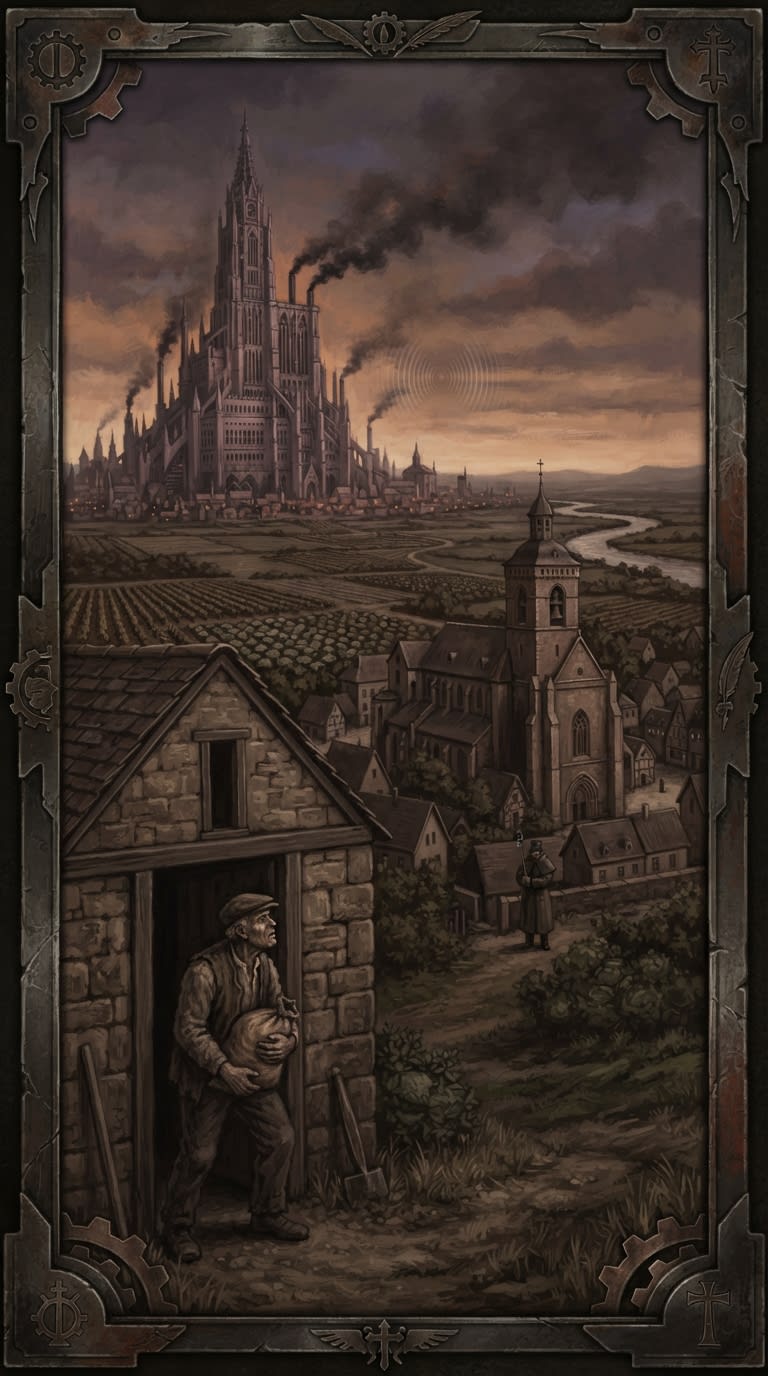
#On the Region That Hears the Capital
Alsace is the country within earshot of Strasbourg, and it has never been allowed to forget the fact. Cartographers disagree about its edges. I leave them to their compasses and their quarrels. Measured by sound, the answer is simple. Alsace begins where the city walls end, and it ends where a man hoeing cabbages can no longer tell whether the bell he hears belongs to his own parish or to the Tower.
The land between the Rhine and the Vosges is flat, well drained and orderly. There are barley strips, cabbage beds and orchards, and vine rows climb the foothills. Every village has a church, a well, a tithe barn and a bellrope, in roughly that order of importance, though the order changes on assessment day. The Rhine runs along the eastern side, wide and brown and heavily taxed. The Vosges stand to the west and supply stone, timber and weather, and the Synod has found a use for all three.
There is no bastion here. The Sagittal Line runs far to the east, from Königsberg down to Constantinople. Its wire, its trench-towns and its steady consumption of sons belong to other provinces' mail. Alsace is heartland. The frontier is governed by cannon. Alsace is governed by being close to power, and closeness is the more intimate instrument.
A frontier peasant fears the Deceiver's hosts. An Alsatian peasant fears the capital's opinion, which is closer and better organised. The Great Deceiver has never sent an assessor to Obernai. The Holy Bureaus send one every autumn.
#On Stone, Grain, and Tithe
Strasbourg eats the countryside and calls the meal devotion.
Look first at the stone. The Tower of the Quill rises from Alsatian sandstone cut at the quarries of Rouffach. It is pink-grey in the morning and corpse-pale by evening, and it is flattering in neither light, which suits the purpose. Matthias Kammler laid the lower courses in A.S. 92–94. Every clerk who climbs the Tower with a petition and comes down with a headache is walking on Rouffach hillside. The Tower's upper courses were replaced after the fire of A.S. 141. That was the Tower's misfortune alone, and nobody in the countryside burned for it, so the quarry villages still count the whole building as theirs.
The quarrymen are proud of this. They say the Tower of the Quill is Alsace standing on tiptoe to see over the city wall. I have heard the joke three times, and each time the teller checked the road first. Pride in a Synod monument is permitted. Pride that implies ownership is a doctrinal question, and doctrinal questions travel faster than oxcarts.
Grain moves by the same rule as stone. Cabbage, barley, wine, eggs, cheese from the Vosges valleys and pigs of every theological temperament roll toward Strasbourg's markets along roads that tollbooks have measured to the hand's breadth. The tithe goes first to the parish barn, then to the district assessor, then to the city. Each stage keeps a column and a grievance. The Fiscal Census has observed that a soldier may die on the Line and leave his arrears in Alsace. The arrears outlive him in excellent health.
The vineyard families are the most careful people in the province. A vintner cannot hide a harvest the way a grain farmer can hide a sack. His crop stands in rows on an open hillside, labelled by God and counted by men. So he hides nothing. He only makes sure the assessor visits on a day when the good barrels are "still settling." They have been settling since before the Concordat of Strasbourg.
#On the Whisper Across the Fields
Every child in the province knows the legend. A farmer in Alsace stands in his barn at dusk, about to cheat his tithe by one sack, one cask or one unrecorded calf. He hears a small bell from Strasbourg. He stops. He puts the sack back. The next morning he confesses to the parish priest, who thanks him, records his name and recommends him for no further attention. The farmer goes home feeling clean. The ledger goes home feeling complete.
The bell is Bell 7-C, which the bellmen call the Whisper and everyone else calls the Heresy Bell. It hangs in the lesser belfry of the Tower. It rings on a schedule set by the Bureau of Bells and approved by the Bureau of Doctrine. It detects nothing. The rope in the bellman's hands knows the hour and has no views on it.
Whether its thin voice can reach a barn in the fields is a question for acousticians, and the acousticians have wisely declined to answer. On a still evening with the wind off the river, a Strasbourg bell might travel a good distance over flat ground. On most evenings it could not. None of this matters. The Alsatian farmer does not need to hear the Whisper. He only needs to believe he might have. Belief carries farther than bronze, and the Synod pays nothing for its upkeep.
A primer used in the vine parishes of the lower Vosges teaches that the Whisper "hears the furrow as it hears the street, and no field is too far for its listening."
Corrected for internal teachers' use. Bell 7-C hears nothing, in the street or in the furrow. It marks the hour. The farmer supplies the listening, and he does it without charge. Parish copies of the primer are not to be recalled. Recall would require an explanation, and nobody has budgeted for one.
The mothers are the ones who teach it, which is why it lasts. A child in a Rhine village hears a far-off chime and asks what it was. The mother puts a finger to her lips. The child learns the gesture before the word, and the word before the reason. Twenty years later that child is an honest tithe-payer with a fine hand and a flinch that shows in the shoulders, and the Bureau of Doctrine counts one more soul brought to Order without anyone having to be paid for it.
Compare the Latchford Permit-Yards, where the same legend is told about a merchant weighing a false oath. The Latchford merchant is far from Strasbourg and has to imagine the bell. The Alsatian farmer is close enough to hear some bell, any bell, and blame it on the Tower. Distance makes the legend a fable. Being near makes it household law.
#On Parish Bells and Licensed Sound
No village bell in Alsace rings on its own authority. The Bureau of Bells, first constituted as an office in A.S. 52, regulates every sacred peal in the Synod's domain. Its present standard is the Bell Codex ratified in A.S. 115, and Master-Carillonist Aldo Venn directs it from the Bell Tower of Strasbourg Cathedral as of A.S. 201. Every parish tower in the province holds a licence. The licence names the bell, the hours it may ring, the occasions it must ring and the peals it is forbidden to sound. Clappers are recorded. Ropes are inspected. A cracked bell must be reported before anyone takes the liberty of hearing the crack.
The last clause has done more to empty village treasuries than hail. A small parish bell with a thin, high voice becomes a liability the moment someone in the village says it sounds like the Whisper. After that, every chime from that tower sets off a round of confessions and a flurry of letters to Strasbourg, followed in time by a visit from the Bureau of Purity. Purity does not travel for pleasure. A parish that has been visited once pays for the recasting and does not complain about the bill.
Alsatian bellmen are the most nervous officials in the heartland. They ring exactly on the hour. They check the hour twice. A few keep their own logbooks, in secret, to prove what they did not ring. When the great Leviathan speaks from the Tower, the whole plain hears it, and every village bellman lets go of his rope in case anyone thinks he was answering. Fames is heard with dread at harvest time, for reasons the granaries understand.
A village that falls out of the capital's rhythm is soon noticed, the way a choir notices one voice singing flat. Alsace does not fall out of rhythm. Its people plough by the Cathedral hour, harvest by the parish peal, marry on licensed days and bury by the schedule.
#On the Present Condition
In A.S. 201 Alsace is loyal, productive, watched and useful. It sends stone to the city's towers, grain to its tables, wine to its chanceries and clerks to its Bureaus. Many of those clerks write in the careful hand of people raised to believe that a pen stroke carries on the wind. It has no garrison worth describing and does not need one. Its roads are safe and its tithe barns are full. France has quarrels in plenty. Alsace keeps its head down.
Doctrine counts it among the Synod's quietest successes. Purity counts it among its best-behaved districts and suspects it for that reason. Purity suspects everything. That is Purity's charter, and its hobby.
The Synod does not fear the farmer who hears the little bell and puts the sack back. It has already won him. The dangerous Alsatian is the one who hears the far-off Whisper in the evening, keeps his hand on the sack and goes on counting. He is rare. He is being looked for.