
I've read the continuity reference, the style guides, and the Alpine source articles. Writing the prose now.
#On the Marches That Pretend to Be Mountains
"Every valley's exception is ancient. Every valley's quota is current." — Procuratorial tithe circular, undated
The Alpine Marches are a jurisdiction that uses a mountain range as its disguise. Cartographers draw the Alps. The Concordat Hall at Strasbourg draws the Marches, and the two drawings agree only where a pass, a salt office or a coal depot forces them to. The Hall names the Marches among the great regions it entrusts to a Procurator, beside Francia, Iberia and Germania. The Procurator's seal carries the combined authority of law and doctrine up the valleys. It carries badly. Seals are heavy, and mules are particular.
No charter founding the Marches has reached my desk. The phrase turns up in the Procuratorial rolls the way snow turns up on a ridge: already there, already disputed at the edges, never once announced. The border changes with the season. In summer the Marches reach as far as a clerk can walk with a tithe-book before dusk. In winter they shrink to whatever the hospice houses can reach with ropes. The Tyrol and the Inn valley lie inside them, so Innsbruck lies inside them too, and it has spent a century pretending otherwise. Salzburg sits on their northern shelf and weighs salt and saints on the same scales. The Swiss cantons keep the western passes under an arrangement that some files call Alpine Accommodation and others call the Mountain Obedience Schedules. The cantons consider both titles an insult to their liberties, and they are right.
The contents of the Marches are easy to list and impossible to finish listing: passes, salt roads, pilgrim roads, mule paths, ore galleries, coal depots, toll chapels, hospice houses, avalanche chapels, bell towers whose tables disagree with the Bureau of Bells, and valley councils who agree with everyone in writing. No Sin-General stands at their gates. Their whole reputation rests on that fact, and so does their whole danger.
#On Salt, Coal, Relics, and Other Forms of Obedience
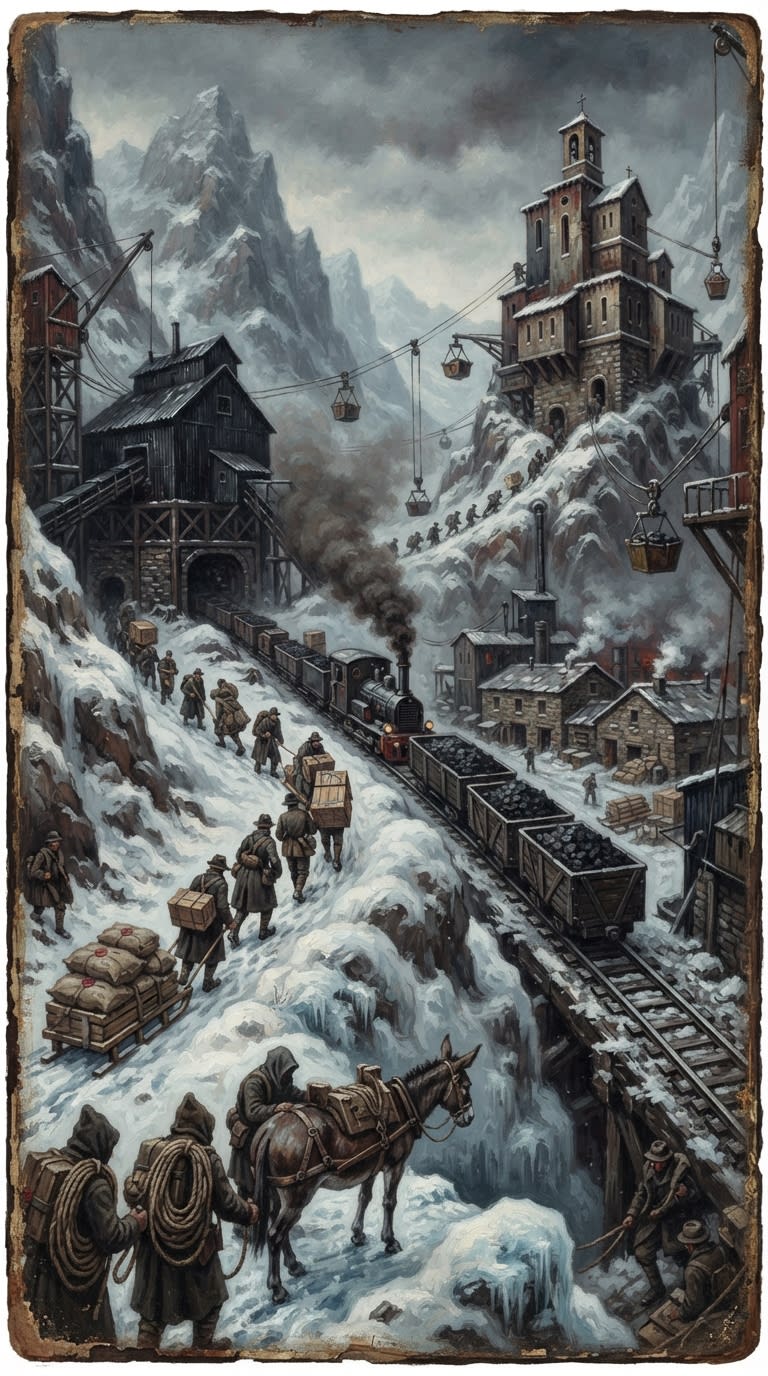
Strasbourg preaches that the Creator's economy moves by grace. In the Marches it moves by mule. On the good roads it moves by rail, and on the bad ones by men with ropes, cursing in dialects the Bureau of Records has twice tried to abolish.
Salt goes north and east under Tithes seals. Ore comes down from galleries that were worked before Reason and will still be worked after the Synod has forgotten why. Coal leaves the depots in black trains bound for the Central Corridor, and beyond it for the southern feeder lines that end in mud at Bastion-Shipka. Relics cross the passes under Relics declaration. Every Alpine pass notice opens by demanding that holy freight be declared before ascent, and every pass-master knows three ways to make the declaration arrive after the freight.
The habit is older than the Synod. When Reason held the valleys, Salzburg's religious houses hid relic packets in salt bins and bell hollows and labelled a cave full of saints as winter paving lime. The Cellar-Saints of the Tyrol climbed higher than any cellar, above the treeline into caves where Innsbruck's grandmothers still drive goats they do not own. The Synod inherited this talent and taxed it. It has never cured it. A people who kept the Church alive by lying to inspectors do not stop lying because the inspectors changed their hats.
The wounded go upward, always upward. The Bureau of Medicine keeps its quietest houses above the Swiss passes, where snow closes a road more cheaply than a guard does, and talks less. War sends up the men it cannot release and would rather not shoot. The Marches take them in, record nothing unusual, and send the mule back down for coal.
#On the Poisoned Harvest and the Arithmetic of Shipka
At one point in the annals, Kargath's breath reached the harvests of the Alpine Marches. The annals record the event and keep back the year. I will not supply what they kept back.
It came as contamination, not as an army. No Blightbearer column came down through the passes. Doctrine calls the event breath, and breath is the right word for a thing that arrives in a grain sack. Granaries opened onto sour heaps. Stores swelled and stank past anything damp could explain. Quartermasters who counted bushels to the peck found the bushels all present and the bread made from them wrong: food that feeds hunger, the Maw's oldest joke and his only one. The valley councils fear missing a quota more than they fear any Sin, so they kept sending the Procurator returns that described adequate yields. The returns were believed for as long as returns usually are.
Hunger does not stay where it starts. The Marches could not feed their own depots, the depots could not feed the lines, and the load slid south and east until it reached the one muddy spur that could carry it. For days the Reed Road at Shipka carried trains nose to tail with grain scraped from wherever grain still existed, while clerks in Strasbourg praised "resilient logistics" from warm rooms. A poisoned field below a glacier became a delay in the Phocis marsh. The delay became a thinner ration on the walls of Bastion-Constantinople.
At Shipka, delay answers to a second master. The marsh corridor lies in Syrion's seepage, where a train can arrive on time by its own chronometer and three days late by the bastion's. Every hour the Marches lose on a snowbound pass is an hour handed to the Dreamer's fog at the far end of the line. The Bureau of the Hourglass does not care where a delay was made. It stamps the sigil in the margin either way.
Earlier War and Tithes correspondence described the Alpine Marches as "rear country" and as "minor mountain supply districts, secondary to Line requirements." Western provincial notes, Burgundy's among them, waved vaguely at "the Alpine region" without naming any jurisdiction.
The Alpine Marches are a Procuratorial region, and when they fail, the southern Sagittal Line starves by way of Shipka. The Bureau has always regarded them so. The Bureau regrets that the earlier documents were drafted by clerks who had never watched a coal train stop.
#On Local Obedience, Which Is Never Quite Submission
The Marches obey. I have read their minutes and can certify it. A council clerk says yes in a tone that records six reservations. A pass-master stamps a War writ, then holds the convoy for weather that arrives, with remarkable piety, exactly when local dignity requires it. A hospice prior hands the upper ward to Medicine and keeps the lower chapel for the valley's own rites, as though the Creator respected floorboards. The bell-ringers keep tables older than the Bell Codex. In winter the Bureau inspectors who fined those same ringers in autumn come back, humbly, to consult them.
Strasbourg calls this concord. War calls it adequate. I call it what it is: a region that learned first under Reason and then under us that the surest way to keep a thing is to hand over the receipt.
I admire it, and I do not trust it. Salzburg let a warm shinbone kill two bishops in A.S. 141. After the Fourteenth Doctrinal Congress of A.S. 147, its processions had to be managed like artillery. After A.S. 160 it learned to make money from reduction notices. Innsbruck kept Mother Sava's bones in a wall until auditors broke through in A.S. 163. Fifteen years later the Innsbruck Audit found three sons whose family had hidden them for fourteen years, and the city declared itself astonished. The Swiss received the Broadcast patients of A.S. 199 under Medicine wax and wrote no unusual business in their minutes that same week. Every valley insists its exception is ancient. Every valley is correct, and that correctness is what makes the Marches so tiresome to govern.
The Bureaus answer concealment with inspection, and inspection breeds more concealment. Records sends auditors, and the auditors climb until their calves ache and their sympathies begin to itch. Purity follows the auditors. Tithes follows Purity with a scale. Medicine goes wherever it likes and leaves no tracks in the snow. Four offices now hold overlapping writs on the same toll chapel, and the chapel's sexton serves all four with a separate ledger for each. He is the most faithful servant of the Synod in the Tyrol. He is also the likeliest to be hanged.
#On the Present Condition
As of A.S. 201, the Alpine Marches are loyal, profitable, snowbound, over-audited and indispensable. No enemy army waits at the passes, and none is expected. The hazards are the kind that never make it into sermons.
Quartermasters at the eastbound depots test the grain before loading, by order, and they still find sacks that are too heavy and smell of nothing, which is worse than sour. Kargathite contamination moves by sack, not by siege. The eastern mountain corridors toward the Carpathian passes carry Velmoran coin and debt-paper along with pilgrims and powder. Tithes keeps a watch in the Alpine salt offices, on the sound principle that any office whose job is weighing things will one day be offered something to weigh differently. Relics still cross the passes a little late. The wounded still go up quietly. The coal still comes down.
Every winter the Procurator's returns describe a region in order. They are accurate. Order in the Marches means the passes are open, the villages are fed, and outside power is moving upward and inward in local hands. Whatever it leaves behind, the snow swallows.
I asked the registry clerk what belonged in the enemy line. He looked at the coal ledger for some time, then at the harvest returns, then out of the window toward the passes, and entered nothing.