
#On the Account Under Survey
"Sin reflects the witness." — amended Ephrath sermon formula, Zaragoza
This survey, conducted in A.S. 201, examines the preserved account of the Prism Fire at the Pillars of Glass and the optical corrections that followed it. The fire itself has no year. The record gives a season, High Summer, and an hour, noon, and says nothing more. I will not improve upon it. Surveyors who supply missing years are called novelists, and the Bureau does not pension novelists.
The site is Zaragoza's southern punishment plaza. Custody belongs to the Zaragoza Chapter of the Order of Saint Ephrath, under the supervision of the Bureau of Purity. Purity paid. Ephrath supplied the theology. The glasswrights did the pouring and kept their mouths shut, which is the only clause in a glasswright's contract anyone has ever enforced.
The installation exists to govern sight. Column, rail, plinth and guide-script are all arranged so that the crowd sees what it ought, from where it ought, in the order Ephrath prefers. The Prism Fire was the noon when the plaza showed the crowd something else.
#On the First Glass
The first Pillars were raised in the Purity consolidation years after the Concordat of Strasbourg, when the Bureau concluded that public punishment should be taught as a course and not delivered as an outburst. The method was upright entombment: a condemned body set standing inside thick translucent glass, then left there, magnified and bent, for the instruction of whoever had paid the guide.
At the centre stood the founding column. Its occupant was a Rationalist lecturer branded with excerpts from the Index Damnatus. The plaque gives no name, and neither do I. Purity's ledgers are a crowded house, and he has his room in it.
The first generation of glass failed at its single task because it distorted too much. Spectators circling the columns believed they were looking at demons. That is a report of what the crowd thought it saw, and nothing in the record lets me promote it any further. For Ephrath it was a pedagogical disaster. A demon is a comfort. The citizen who beholds one thanks the Creator for the distance between himself and the glass, then goes home to supper unimproved. Ephrath wanted a neighbour behind the glass, recognisable enough to accuse.
The quarrel was recorded in the usual manner, with each office writing in its own column of the same page. The Bureau of Doctrine asked for sin in its true form. Ephrath asked for sin as a mirror. Ephrath petitioned Orison & Song for correctional optics.
The sun reached the plaza before the optics did.
#On the Noon Failure
The sequence is short, and I give it as the account gives it.
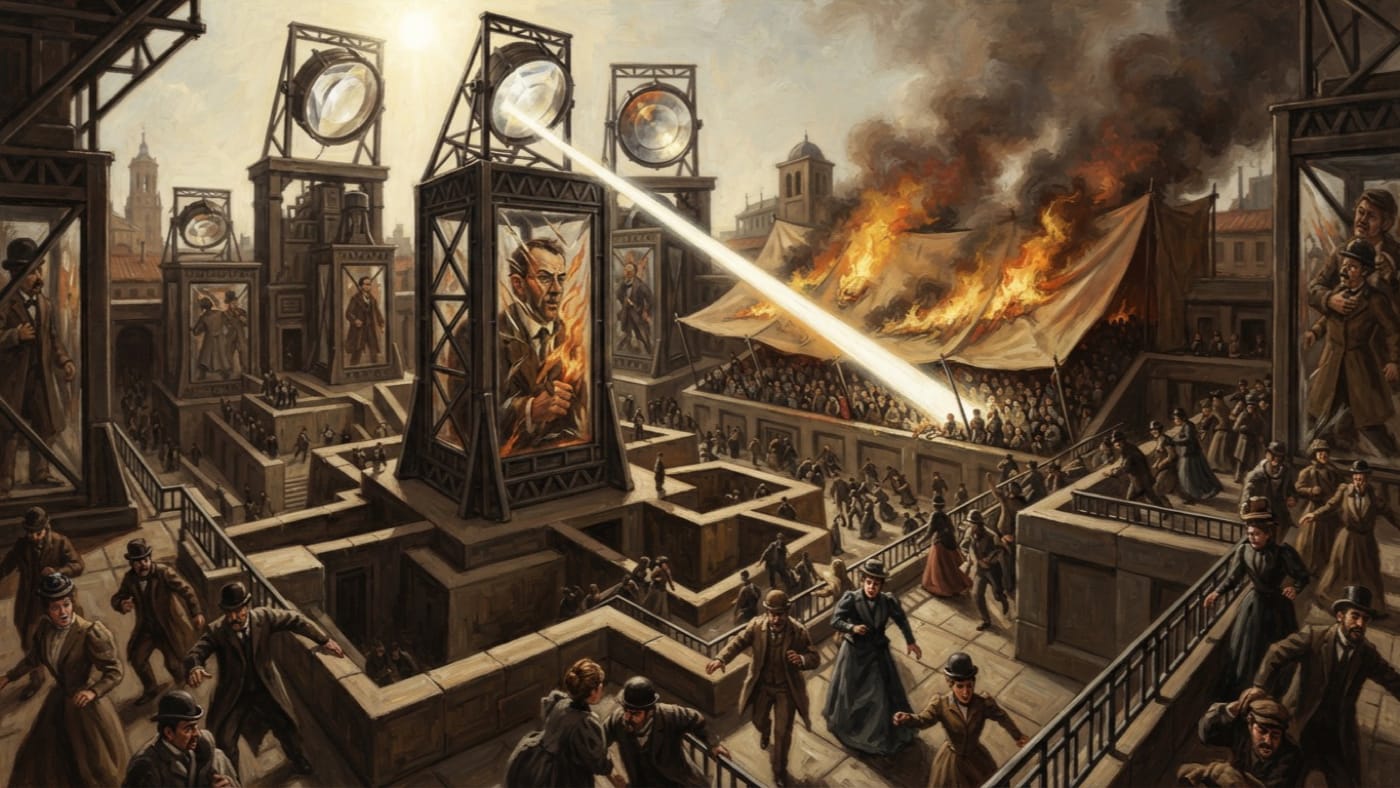
The fire came during the first generation of columns, before the optics were recalculated. At High Summer noon, sunlight entered three misaligned prisms and crossed the plaza as a single concentrated white blade. It reached the viewing awnings, which were cloth stretched to shade the faithful while they were instructed. The awnings caught.
The crowd fled through the smoke. The account then supplies its one memorable image. The central Pillar, which held the lecturer, took in the flames and magnified them across his preserved face, so that to the fleeing he appeared to be speaking fire.
Appeared. The glass did what glass does with any light offered to it. Enlarge a dead man's mouth and light it from behind, and it will seem to say whatever the hour supplies. The record claims no speech, no movement and no sermon from inside the column, and this survey adds none. The Bureau has enough trouble with the living who speak fire.
Consider the professional insult. The apparatus had been built to hold a crowd at a measured distance and release it slowly into recognition. Instead the plaza produced flight at speed. The lesson arrived all at once, uninvited and ahead of the guide's script. The condemned lecturer, whose crime had been instruction, delivered the only part of that day's curriculum anyone remembered.
#On the Names Entered
Three offices entered three names.
The city calls it the Prism Fire. Cities name things after what burned.
Ephrath records it as Premature Comprehension. The term deserves the respect a well-made instrument deserves. In Ephrath's theology the crowd is meant to reach recognition in stages: disgust first, then the face, then the accusation. By Ephrath's entry, the fire carried the crowd to the end of the course without the intervening stations. Whether a fleeing citizen comprehended anything beyond the location of the nearest gate is the question the classification exists to make impolite. Ephrath's entry interprets the event, and the crowd was never consulted.
Purity records a crowd-management incident. Purity's category asks a narrower question, which is whether the people went where they were told. They did not, and the entry was made.
The failure catalogue reproduced in the parent register is shorter than any of the three names, and it is more candid:
ZARAGOZA FAILURE CATALOGUE — EXCERPT Prism Fire: casualties █████; column damage moderate; crowd response exceeded authorised devotional range; three guides laughed during evacuation. Disposition sealed.
The catalogue asks nothing further of the guides, and neither does this survey. Laughter during an evacuation is a matter for their confessors.
#On the Corrections
Ephrath and Purity answered the embarrassment the way competent institutions do: they rearranged the furniture and changed the words. I mean this as praise. Most offices manage only the words.
The awnings were moved. The account does not say where, only that they were taken out of the path the light had found. This survey supplies no measurements, because none were preserved, and I do not forge distances for the sake of a tidy plate.
The plaza angles were recut. The geometry that brings sun, sightline and column together was cut again in stone, so that noon would no longer find a straight road to the viewing places. A plaza is a liturgy laid flat, and this one received a revised rubric.
The second-generation columns were given ribbed inner seams. These break direct noon light into softer bands. The glass now takes the sun the way a confessor takes a penitent: in instalments, through a grille, so that nothing arrives whole enough to set fire to the furniture.
The optics were made more human. The first-generation distortion was withdrawn. The second generation renders the condemned handsomer and more tragically recognisable, which is what Ephrath had wanted since the first crowd mistook its lecturer for a demon. The demon-sightings had already raised the question. The fire ended any argument for keeping the first glass.
The sermon was amended. Ephrath's earlier preaching at the plaza put sin under the figure of burning. Preaching about burning beneath burning awnings commits the gravest homiletic fault there is, which is illustration. The replacement formula reads sin reflects the witness. It turns the lesson away from the column and onto the spectator, and it is less likely to ignite cloth.
The order carries no date, and I have not given it one. The next pilgrimage quarter was a deadline to the guides who had to learn the new script. To the surveyor it is a relative clause.
#On the Standing Account
As of A.S. 201 the precinct is open and operating with second-generation glass. Guides recite the amended script. The ribbed seams do their banding at noon. The awnings stand wherever it was decided they should stand.
The survey finds the account's sequence coherent: misaligned prisms, concentrated sun, burning cloth, flight, and magnified flame across a dead face. It finds the corrections documented in what they did, though not in when they were done. It finds no year and no casualty figure, and it does not invent either. It certifies the account. It does not certify any noon yet to come, since a survey of glass is no warranty against the sun.
The Ash-Rain of Zaragoza belongs to a separate entry and a separate year. Ash and sunlight are different instructors, and the pale residue on the lower plinths explains nothing about this fire.
Civic guides have described the Pillars of Glass as memorial architecture.
Corrected. Memorials honour the dead. The Pillars discipline the living, and their only fire on record happened because the living had been seated in the light to watch. Nobody shades the audience at a memorial.