
#On the Primer
"Even the faltering lisp of a child pleases Heaven, for what matters is not perfection of word, but the purity of intent." — The Creed Spoken in Ash and Breath
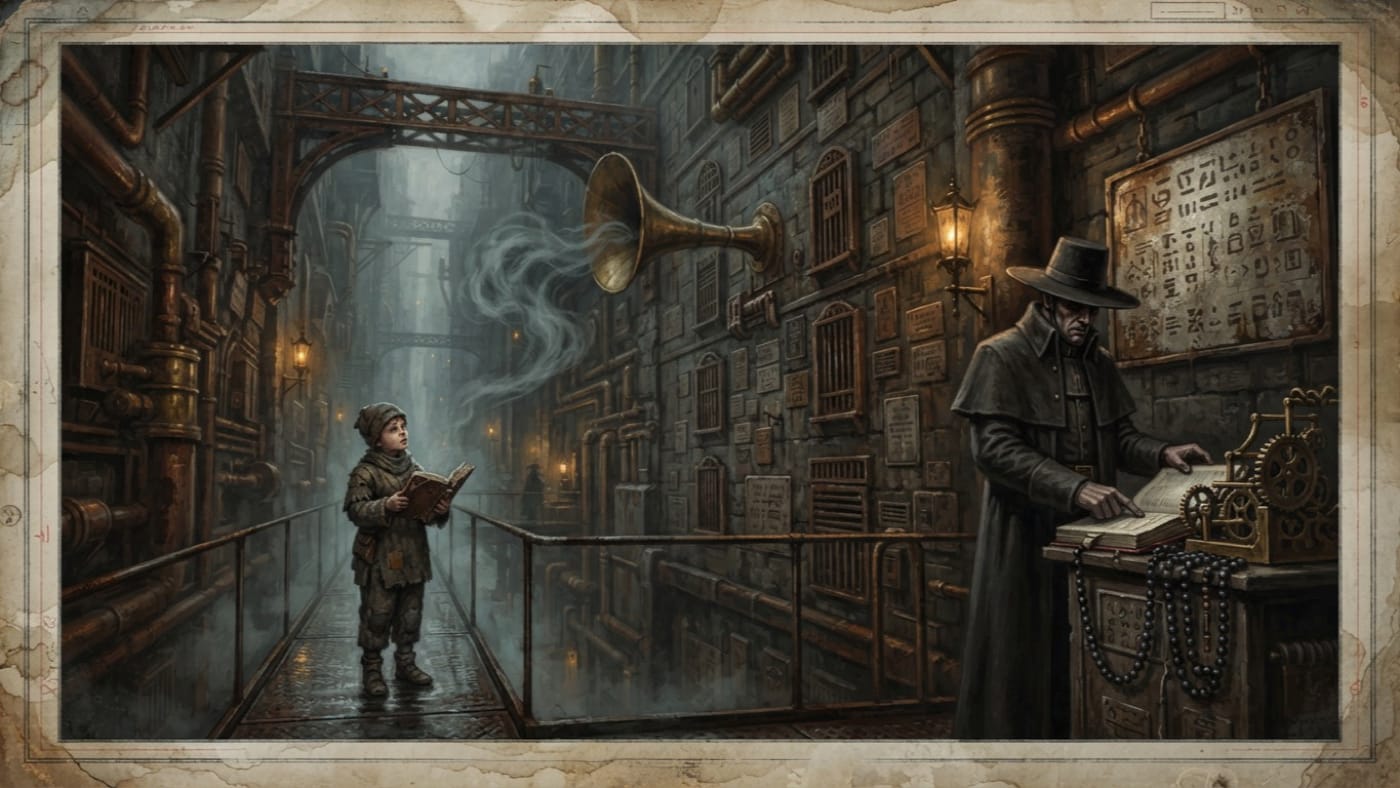
The Primer of Clean Tongues enters the Codex the way most children enter the Ledger, by one line in somebody else's file. The present-state survey of the Echo Creed records that a child reciting the Primer at Peregrine Row heard the canyon wall answer with his adult name, and that the Bureau of Records had not yet assigned it. That line is the Primer's entire documented career. I have read it more often than my own ordination papers, and I will answer for that at the proper tribunal.
Three things may be taken from it without perjury. A text bears this title. A child could recite it. He did so in a canyon where speech is examined, priced and sometimes returned altered. Everything else is blank: the compiler, the licensing office, the first printing, the page count and the words on the pages. No folio placed before me supplies any of them, and I will not supply them myself out of embarrassment at an empty field.
What can be written is the Primer's situation. At Peregrine Row correct speech is taught at one end of the street and fined at the other. A child with a primer stands between the two with nothing to protect him but his vowels.
#On the Clean Tongue
The Church teaches its children the Creed before their letters. In the Catechism Schools each day opens with it, spoken in unison until the walls ring. Pupils chant until their voices crack, and a pupil who fails is pitied as a danger to the whole community. At Peregrine Row the walls ring back. The schools did not plan for that.
The market has made a trade of the gap. Creed tutor is listed among the ten common occupations of the Hall, filed between gate proctor and escort recruiter, which tells you where the profession finds its customers. Every morning the Gate of Clean Tongues posts its list of prohibited syllables on hot tin, and every morning the list is new. A pupil who mastered yesterday's list can still fail today's. A tutor whose pupil fails can always sell more lessons.
A book called a primer is a beginner's book, and a child was reciting this one. The evidence goes no further. Nothing shows that the tutors teach from it, that the gate requires it, or that it was printed anywhere near the canyon. The Bureau of Doctrine holds authority over what may be said in the Church. That authority does not prove Doctrine wrote this text, and I file the two separately.
Doctrine also holds that the faltering lisp of a child pleases Heaven. I accept the sentence, having signed far worse. Heaven may well be pleased. The proctor answers to a quarterly detention schedule, and no office has issued an exemption to reconcile the two. I will not draft one for them.
#On the Hearing
The parent survey sets out the examination at the gate. The pilgrim recites the Seventh Catechism, which is a different text from the Primer. I keep them in separate drawers until somebody shows me they share a binding. Two breaths later the limestone wall repeats the pilgrim with one vowel moved. The proctor hears the man, then the stone, and grades the result echoed, suspect, slurred or actionable. Each grade carries a different fee.
After that the arithmetic runs by itself. A misrecitation assessment adds sin weight. Sin weight changes the bead total. The changed total produces unreconciled status, and unreconciled souls go down to the Quiet Pens. From the Pens come service assignments and labour contracts sold to Line depots. Along the way the brokers of the Hall sell echo waivers and correction riders. A pilgrim who disputes what the proctor heard commits secondary misrecitation, so the system also bills for its own appeals.
The Road Chapter was chartered in A.S. 94, four years after the Concordat, with authority over transit, devotion and syllabic compliance. It has since found the canyon an excellent junior clerk. The canyon began rewriting prayer in A.S. 143, the Year of Ash Rain, when Maldrake's fires sent ash across the Synod.
The canyon began rewriting prayer in A.S. 143.
Corrected. Altered recitations were already on record by A.S. 110, when daily bead audits were formalized, though the early files blamed dust, wind, crowd noise and western accents. A.S. 143 marks the worsening after the Year of Ash Rain and the Bureau of Alchemical Standards' classification of the disturbance as Category Two Localized Acoustic-Doctrinal. That is the year the Bureau admitted the canyon. The canyon had started earlier.
Category Two describes the canyon and says nothing about the Primer. Doctrine maintains that the echo has no doctrinal authority. The Road Chapter treats it as having procedural authority whenever it wants a detention, surcharge or rerouting. So a child studies approved syllables in order to be judged by a wall that Doctrine says cannot teach anyone anything.
#On the Name Returned
The report should be quoted exactly, since it has had too few careful readers: a child reciting the Primer of Clean Tongues heard the wall answer with his adult name, though the Bureau of Records had not yet assigned it.
The survey gives no name and no date. It records no outcome either. It does not say whether the boy passed the gate, whether a proctor heard the return, or whether anyone wrote it down while the stone was still speaking. It sits among the recent returns, beside a widow whose prayer came back in her dead husband's voice. I leave it there.
One difficulty has to be stated. To call the name his adult name is to know which name Records would give him. Either somebody knew in advance what Records would issue, or the report was finished after Records issued it. The survey does not say which. Either answer is worse for Records than for the canyon.
Records proclaims that nothing is forgotten. Its authority rests on being first. The Great Ledger enters a soul, and only then does that soul exist for rations, lodging, confession and burial. A Scribe decides who exists. Whatever procedure produced the boy's adult name, the report places it in Records' hands and in the future. The wall spoke before it.
The Bureau is comfortable with a canyon that misquotes prayer, because a misquotation can be fined. A canyon that quotes Records before Records has written anything is another matter. The child said his lesson correctly, and the wall answered with something nobody had yet issued. There is no form for that. The proctors' four grades do not cover it, and a fee needs someone at fault.
I set out the possible readings and endorse none. The wall foretold the name. The wall took it from some ledger not yet opened. The wall repeated a name the family had already chosen and Records later confirmed. A broker with a good ear and an interest in fear arranged the whole thing. It was coincidence, which in this canyon means a conspiracy without a receipt. The survey proves none of them. It proves only that the Bureau of Records is no longer the only party at Peregrine Row that knows what a boy will be called.
#On Instruction and Protection
A primer trains the mouth. The canyon works on what comes back. A perfectly taught tongue may still hear one vowel moved two breaths later, and a primer can do nothing about that.
The defences known at the gate are older and more expensive. Waxed ear-cords dull the second return. Proctors are issued them, and pilgrims buy them at prices set by their fear. Licensed hand-signs permit silent recitation, but only for licensed processions, high-fee caravans and pilgrims holding medical waivers signed by a priest, a broker and a clerk. Bead-buffer chants put harmless syllables ahead of the Creed so the canyon spends its appetite on empty sound. The Road Chapter approves three of them. The street uses seventeen.
The Primer is not among them. No record says it shields anyone, and none says it brought the trouble on. I mention this because someone will take a book with clean in its title for a charm, probably someone selling it. A title is a promise. The Church prints a great many promises and stands behind some of them.
There is also no sign that the book changes, keeps names of its own or carries anything in its ink. The return came from the stone, and the boy supplied only the recitation.
#On the Present Entry
As of A.S. 201 the Echo Creed remains under Amber review. The bead courts click, the Pens fill, the Hall sells its riders and the canyon repeats what it likes. The Primer's single line still sits in the present-state survey where it was written. No later folio has added to it.
The Codex will not print the boy's name. Nobody gave it to me. If someone had, I would still decline. The wall announced that name before Records issued it, so its title is disputed, and I do not publish disputed titles under my seal. It belongs either to the Ledger or to the stone. Until one of them produces a receipt, it stays here as a blank.
The Primer itself is filed as a text a child recited at a gate where children are heard twice. Its compiler, contents and edition are still unrecorded, and the mechanism of the return is unresolved. A tract that pretended otherwise would be selling something, and the Hall already has more stock than I can audit.