
#On the Command
"The walls hold. The ledger bleeds." — Codex entry on Bastion-Sibiu, A.S. 201
The garrison of Bastion-Sibiu has four commands, and the Plateau Guard has the remit that sounds simplest. The Alpine Watch keeps the passes. The Convoy Escort Corps keeps the roads. The Bureau Detachment keeps the ledgers, the censures and the inquisitor's chair. The Plateau Guard keeps whatever remains, which is the bastion's perimeter and its interior. That means the walls, and it means the whole crowded city inside them, where people pray, trade and go hungry.
The Guard's billets run along the east and west arcs of the Barracks Ring. The Watch is quartered on the northern arc and the Escort Corps sleeps in dormitories on the southern. So the Guard sleeps at the hinges. Every survey available to me puts it there. None of them says when the command took its present name, who first led it under that name, or how many men answer to it now. I describe the command as it stands in the assessment of A.S. 201. I will not supply a founding legend that the archive never troubled to keep.
The military problem fits in one line. The Plateau Guard defends a fortress that has never been breached, against an enemy who has never needed to breach it.
#On the Rings
"A city designed by soldiers is a barracks. A city designed by clerks is a filing cabinet. A city designed by both is Sibiu." — Overheard in the Rathaus Quarter, attributed to everyone and no one
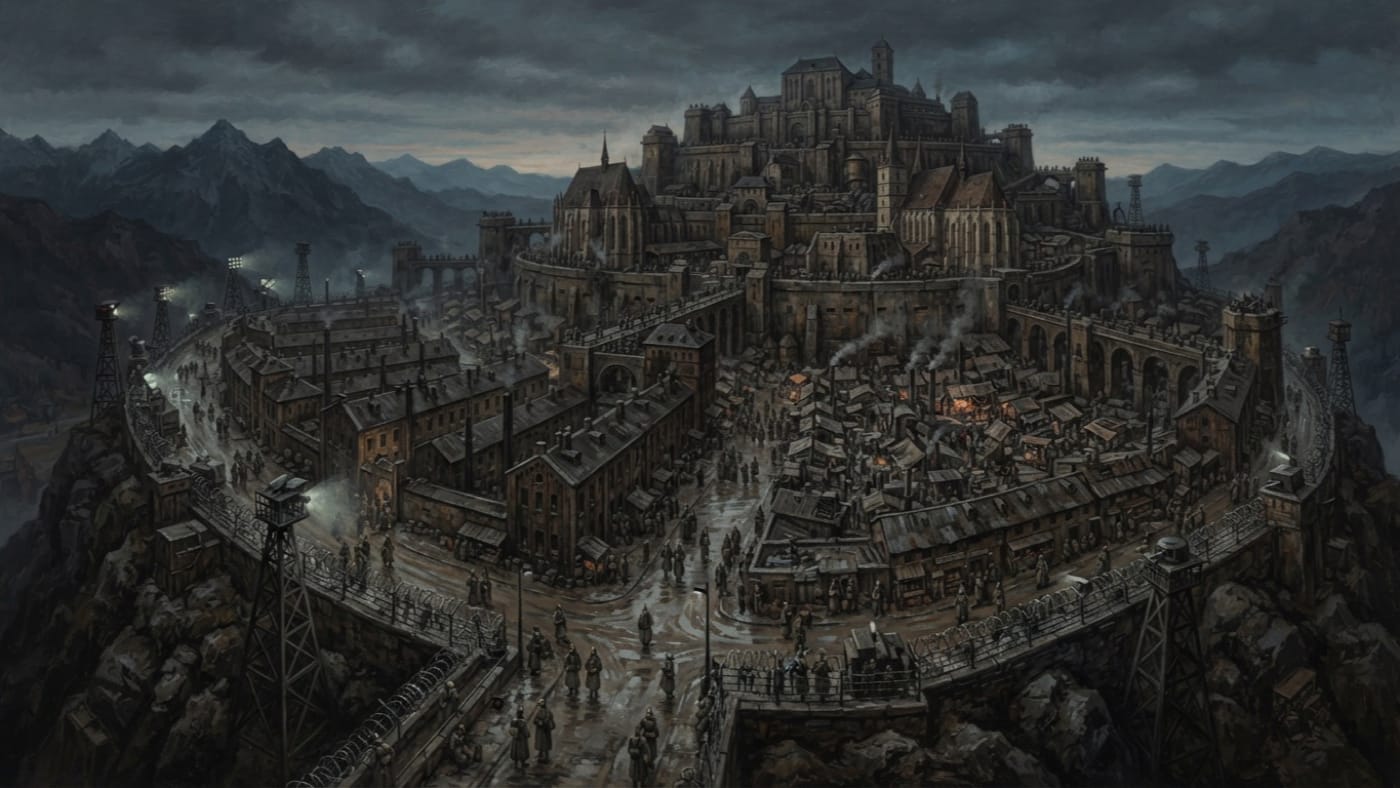
Sibiu stands on its plateau behind the Transylvanian Alps. It is the middle vertebra of the Sagittal Line, between Przemyśl to the north and Irongate to the south. The Saxons of Hermannstadt laid the first rings. The Church expanded them under Concordat mandate from A.S. 92, and by A.S. 110 the outer works had reached the treeline. A remit of "perimeter and interior" therefore covers a great deal of stone.
The Wire Ring is outermost. It combines electrified wire, catechism-towers that broadcast hymnal suppression, and gun emplacements laid out in a pattern the Bureau of Engineering calls the Thorned Crown. The soldiers call it something the Bureau of Doctrine will not allow in print. Inside the wire lies the Barracks Ring, where the Guard sleeps. Next comes the Market Ring, with its ration windows, repair shops, canteens and sutler-stalls, and the Weighhouse where the Escort Corps logs every shipment. Then the Church Ring: seven Saxon fortified churches, now barracks, armoury and chapel all at once. Their walls are three metres thick and their firing slits have been widened for rifles. At the summit is the Citadel Ring. It holds the senior command, the Bureau offices and the Assay Chamber. It also holds the vaults of the Bureau of Tithes, which sit directly beneath the cathedral altar, an arrangement the Bureau insists is coincidence.
In Sibiu, interior defence means defending people as well as masonry. The Church Ring's congregations are armed, and their sermons are brief. What survives of the Saxon community is pressed into a few streets near the old Rathaus, where it still keeps its own parish rolls. At Saint Martin's of the High Wall, services are still held in the Saxon dialect, despite fourteen Doctrine directives requiring Synodal Latin. The Market Ring queues for its rations and quarrels over its scrip. All of it sits inside the Guard's remit.
None of my sources assigns a Guard company to any of these places, and I will not invent a patrol schedule to flatter the map. One survey records eight thousand soldiers quartered in the Church Ring and says nothing of whose command they serve. I copy the figure. I decline to guess.
#On Supply and Pay
"Gold is the only siege engine that does not require assembly." — Bureau of Tithes, Internal Memorandum (Leaked, A.S. 197)
Three approaches feed Sibiu. The central road crosses the plateau from Budapest. The northern road comes down from Przemyśl through the Carpathians. The southern road climbs from the Danube crossings near Irongate. Velmora's agents work all three, and they pay for loyalty with wealth taken from the territory she holds. Guarding these roads occupies the Convoy Escort Corps, the largest of the four commands. At any given hour, more of Sibiu's soldiers are walking supply roads than standing on its walls. Whatever the roads deliver, the Guard must then live alongside.
Three specialists must certify every cargo at the gate: a Tithes auditor, a Doctrine censor and a Purity examiner. The process takes four to eleven hours. A rifle at the gate can stop a wagon, but it cannot certify one. Nothing in the Guard's remit lets it authenticate scrip, rule on a debt or open an inquisitorial proceeding. Those powers belong to the Bureau Detachment and to the Assay Chamber. The Chamber examines ten thousand items a week and clears ninety-six per cent of them. The published figures say nothing further about the rest, and I will not say it for them.
The threats that get through do not look like threats. They include bribed teamsters, quartermasters, checkpoint guards and officials, along with cursed coin, spoiled provisions, and contract-scrolls folded into requisition forms. Above all, there is counterfeit scrip. Crown scrip was introduced at Sibiu in A.S. 130 to keep Velmora's currency out. In A.S. 181 a Tithes auditor named Goss found that fourteen per cent of the scrip circulating in the bastion carried serial numbers the master ledger had never issued. The current assessment puts the figure at twenty-two per cent. Across the whole bastion, only forty-three per cent of transactions involve verification. That is the bastion's figure, and the Guard has no separate one.
So the soldier on the east wall is paid in the currency his wall is meant to keep out. He spends it in the Market Ring on bread that is genuine and warm. Something like one note in five names a serial the Church never printed. The other choice is a four-hour queue at the verification window.
Prior editions of this Codex stated that Bastion-Sibiu intercepts "an average of three corrupted convoys per season."
That figure came from A.S. 190 records and is obsolete. The Bureau of Tithes' assessment for A.S. 200 gives eleven per season. These are interceptions by the garrison as a whole and should not be credited to the Plateau Guard. No source states how many convoys were examined to produce either number, so neither number is a rate. The Bureau attributes the rise to improved detection. The garrison attributes it to Velmora.
#On Sufficiency and Obligation
"Desire nothing beyond thy ration. The Crown provides. The Crown suffices." — The Doctrine of Sufficiency, as posted in the barracks, canteens and chapels of Sibiu
The Doctrine hangs in every barracks in Sibiu, which includes the Guard's billets on both arcs. The soldiers recite it. The Bureau of Purity checks every quarter whether they believe it. The Bureau of Tithes checks every day, by other means.
The Doctrine asks a man to want less. Velmora's lenders ask him only what he wants. The Bureau of Doctrine holds that a man who desires nothing cannot be bought. The interception returns list who was bought: teamsters, quartermasters, checkpoint guards, and officials whose pay has fallen behind the cost of keeping a family in a war zone. I find no saint of surplus on that list. Hunger did not save them, and the Doctrine never promised that it would.
The Ten Thousand Keys work the highland villages between the passes and the bastion. Harvests fail often up there, and the cult lends to farmers whose harvests have failed. The loans are generous, the terms are clear and the repayments are manageable. The relief is real, and that is what makes it dangerous. The collateral is a brass key cut to fit no lock the borrower owns, handed over with a signature. Synod charity requires a six-week application through three Bureaus and a theological examination. The Bureau of Purity has burned six hundred of these contracts, and the Bureau of Tithes has confiscated fourteen hundred keys. The cult keeps growing.
The Doctrine's position, which I ratify, is that no pact signed within the Church's lands removes the signer's choice. Every key is handed over by a hand that could have stayed closed. Duress does not cancel that choice, and neither do debt or a failed harvest. That is the comfort Doctrine offers the garrison, and it is also the charge Doctrine lays against it. A Guardsman on the west arc with a brother in the highlands may choose rightly every day of his posting. He chooses each time, and nobody keeps count of the days.
#On Present Duty
"We are solvent, Hieromnemon. The question is: in whose currency?" — Garrison Commander's dispatch, A.S. 201
The perimeter holds. By every measure the Bureau of War uses, the Plateau Guard's walls are among the most successful masonry on the Line. The interior is another matter. In A.S. 200 the Bureau of Tithes reclassified Sibiu's economic condition from "contained" to "chronic," and "chronic" means the trouble is now inside the walls and circulating. The Guard's single remit now covers two wars. It wins the first on the ramparts every night. The second goes on in the canteens, and nobody in Sibiu knows how it stands.
Walls inside the Citadel Ring weep gold, as first documented in A.S. 178. A sentry's report on the subject was classified in A.S. 199. The Assay Chamber finds the gold pure and untainted. The Bureau of Doctrine's third explanation, which is the one now in force, instructs all personnel to stop discussing it. The garrison collects the gold anyway. Some soldiers say the veins beneath the bastion already belong to someone else. That is their reading of the reports, and nothing has proved it. Nothing has disproved it either. The Guard walks past those walls on interior duty, and the gold is as clean as the bread.