
#On What Was Commissioned
The Pilgrim's Ladder Commission is the archive's name for the acceptance of the Pilgrim's Ladder into sanctioned use in A.S. 110, the year 1820 in the common reckoning. Readers who picture a standing body with a long table, a chairman and a dinner allowance will be disappointed. I have looked for that table and did not find it. The files describe a commissioning, the passage of a machine from experiment to instrument. Clerks capitalised the word often enough that it hardened into a proper noun.
Three things must be kept apart. The Ladder is the prototype, a tracked diesel land-ship with a stair of guns down its spine. The Commission is the moment the Synod agreed to own it. The Processional Arsenal is the doctrine that grew out of that ownership and now claims to have been there from the start. No file I am permitted to open records the day, the month or the place of the acceptance. The year is secure. The rest is ceremony, and ceremony can wait.
#On the Disciplines Inherited
Nothing at the Commission was invented there. Two older catastrophes had already disciplined the Ladder before it arrived, and the Synod accepted it partly because those catastrophes had been turned into procedure.
The first was the First Floating Cathedral Burn in the early A.S. 70s. A Danube shrine-barge detonated over powder that no one had written down. The dead were counted afterwards. The powder never had been. From then on every shrine-platform kept a shot-ledger, and the ledger became what the crews still call a purity device: an object whose chief virtue is that it makes forgetting a crime.
The second was the settlement of the Cadence Reforms of A.S. 95. Repeated recoil desynchronisations had shaken shrine-platforms apart in mid-volley, and the remedy was a matter of jurisdiction. For the length of a firing sequence, choir conductors held operational authority over gunners. The guns would wait on the song. Sister Margit's account of the Pressburg mutiny belongs to this background. In her telling she sang the mutineers into surrender by outlasting them, and I record it as her account and nothing firmer.
The Commission took over both settlements whole. It did not have to argue that gunners should log their shot or that a conductor should hold the beat. Those questions had been answered in blood and ink by men who were no longer available for consultation. The question still open in A.S. 110 was whether such a disciplined machine could be trusted near a crowd.
#On the Machine and Its Claimants
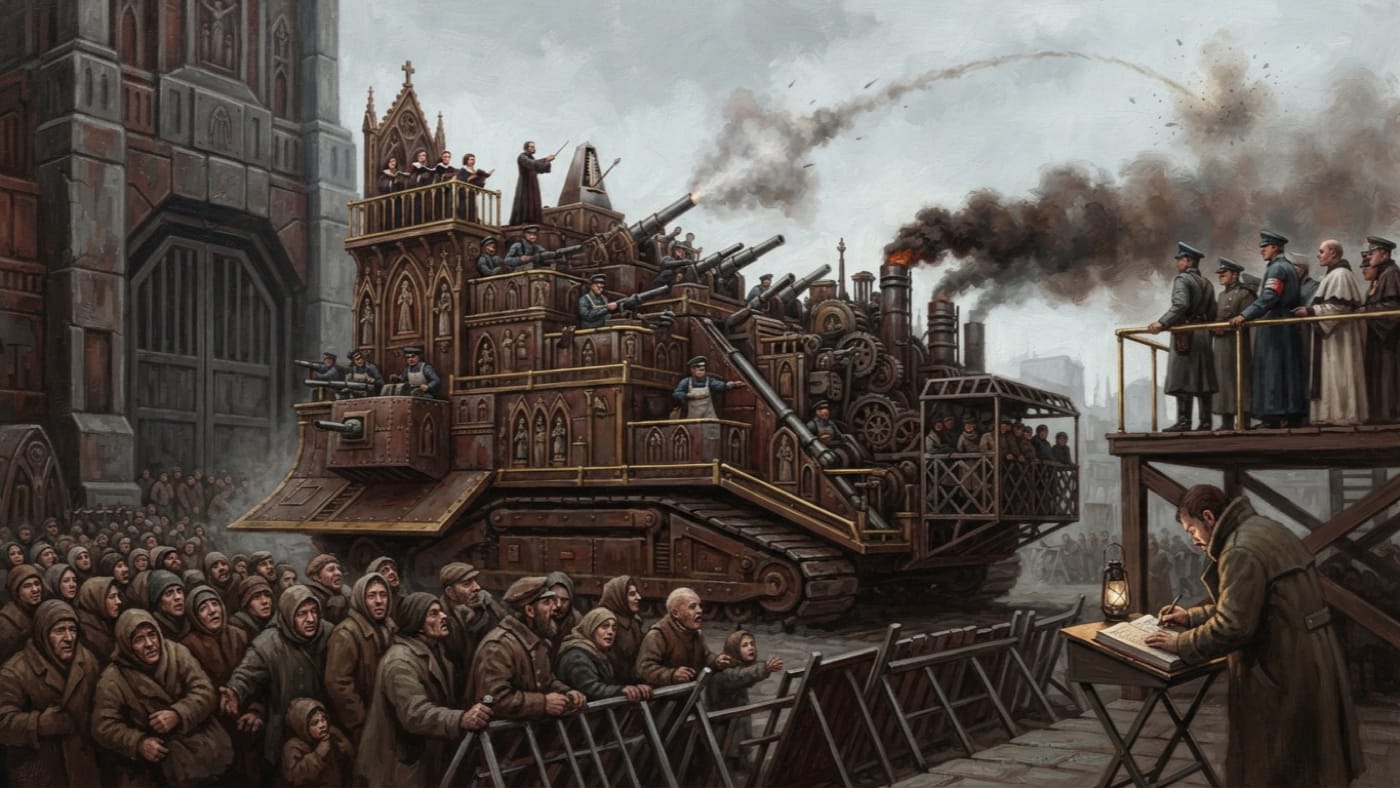
The prototype needs only a sketch here, since its anatomy has its own file. From prow to stern the Ladder rises in firing terraces. Each terrace is a battery-chapel of mortars, hymn-screens, brass rails and relic wards, and the whole is carried on treads and fed on diesel. Choirs stand at the rails. Pilgrims ride in the lower holds and walk behind. It is a church that has agreed to be shot at and a battery that has agreed to be prayed over, and every party to that agreement wanted something different from it.
The Bureau of War wanted mobile escort, assault support, a way to intimidate restless towns, and protection made visible to people who cannot read a proclamation. The Bureau of Orison and Song supplied licensed cadence and wanted the hymn to stay master of the barrel. The Bureau of Engineering supplied motion and recoil coordination. The Bureau of Doctrine supplied meaning. The Bureau of Tithes supplied fuel, shells, wax and chalk, and then supplied the invoice.
I state these as functions because functions are all the files contain. No surviving roll names members, no tally records a vote, and no charter carries five signatures in five inks. What the files do show is a contest over one deck: who moves it, who times it, who picks its targets, who explains it, and who pays for it. The Ladder could not be accepted until each claimant believed it had won.
Early Commission abstracts described the Ladder as a "pilgrim escort and defensive reassurance vehicle."
Corrected. Approved internal classification: coercive mobile shrine-platform. Public term remains reassurance.
#On the Demonstration Before the Supply Shrine
At this point the account narrows to a single scene. I give it as the institutional account gives it, because I was not there, and I doubt that anyone who later wrote about it at length was there either.
The exercise took place outside a supply shrine where the grain queues had turned ugly. The file does not name the shrine, the town, the season or any witness. It records that the crowd was frightened and that the fright had begun to spread down the line, as it does in any queue of hungry people who suspect the grain will run out before they reach the door.
The Ladder advanced in first cadence. The choir came in. The mortars fired beyond the crowd line. Every clerk since asked to defend that afternoon has leaned on the word beyond: the shells passed over the queue and burst at a distance. The report says the barrage "stitched shut" the panic. The crowd stopped moving.
The phrase belongs to a reporting officer who wanted to sound like a surgeon, and it describes an outcome only. People who had been about to run did not run. The file does not say why they stood still. It might have been awe, or deafness, or the shock of a church firing artillery over their heads, or the plain animal reckoning that a running body makes an easier target. Orison has offered explanations, and Doctrine has approved some of them. None has been demonstrated to my satisfaction, and none was needed. The Commission was never asked to explain the effect. It was asked whether the effect could be repeated.
The Ladder's own file adds one sentence that I am obliged to carry forward: approval came before the dead were counted. The total is missing. I do not know whether the dead fell to shell fragments, to the crush before the barrage or after it, or to causes the clerks judged unrelated. I know that the order of events was written down, that approval came first, and that no later hand has thought it necessary to supply the number.
The administrative reasoning was short. A frightened crowd had been held still by a machine in cadence, the machine had stayed under control, and the shot-ledger had received every round. On those grounds the Ladder was accepted.
#On What Acceptance Made Routine
Before A.S. 110 there were deck labourers, choirs and ammunition handlers. After it there was a profession. The Shrine-Deck Crew took shape around the accepted machine, because that machine now needed the same men every day, under the same rules, answering to the same seals.
The crew's offices split the act of firing among several hands, which is how the Synod prefers its violence. The Cadence Caller keeps time: the metronome bell, the choir's entry, the measure on which a gun may speak. The Battery Steward signals the battery. The Ordnance Deacon holds the seal that authorises any discharge at all. Timing and authority are separate goods. A Caller who refuses to stretch a measure can prevent a shot. A Caller cannot choose a target, and crews who tried to blur that line found out what the Inquisitor of Measures is for. Below them, Deck-Rats, Powder Acolytes, Ward-Chalkers and Choir Runners keep the powder dry, the chalk unbroken, the cues moving and the engines fed.
The sequence became liturgy. Renew the chalk-and-relic wards. Tune choir and recoil to the bell. Load by measure. Fire on the sanctioned beat. Log at once. Purge the residue and confess any irregularity. Gun-side and choir-side keep separate counts, so every disagreement produces a document and every document produces a suspect.
That is what the Commission actually achieved. A barrage that frightens a crowd is a weapon. A barrage that frightens a crowd and leaves two ledgers behind it is a policy.
Bodies paid for it. The crew manuals list burns, crushed fingers, falls from the deck, fumes in the engine pit, lost hearing, and choir throats that haemorrhage under sustained volley. At the end of the day choristers are dosed with bitter tincture and sent back to the rail. The public language speaks of protection. On deck the talk is of wet throats and broken chalk.
#On the Commission's Descendants
Every Processional Arsenal in service fires under doctrine descended from this acceptance. The Bell Codex, ratified in A.S. 115, standardised a bell the Ladder already obeyed. It was not drafted at the Commission, and the Commission should not get the credit. A Ladder-pattern platform was lost in the Collapse at Prague Gate in A.S. 147, which showed what the doctrine costs when cadence fails. The files still dispute whether that platform was the original prototype, and I will not settle the question here.
Writing in A.S. 201, I find the Commission most remarkable for what it left out of the record. It kept the year. It kept the phrase. It kept the order in which approval and counting happened. It did not keep the dead.