
#On the Approved Words
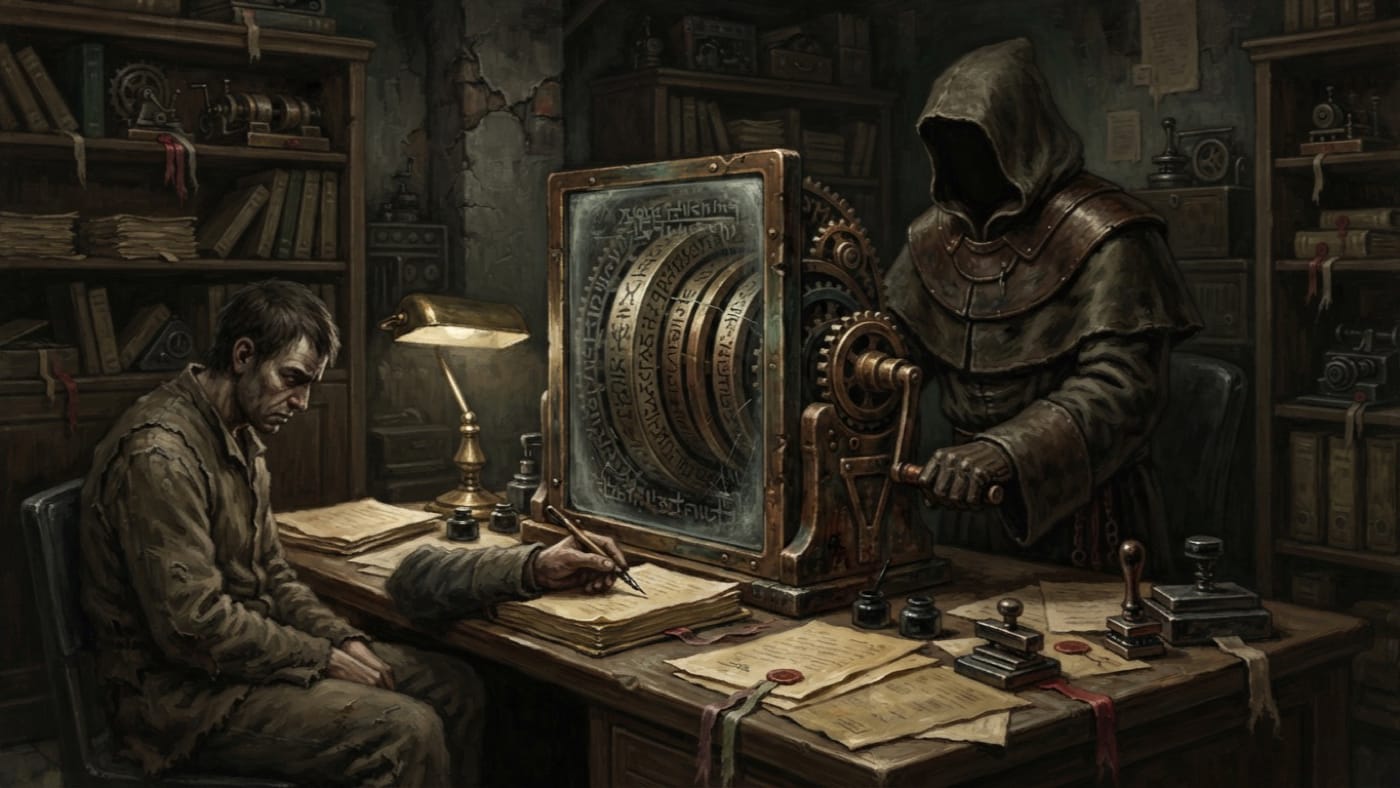
The phrase wheel tells a frightened mouth what it may say next.
It belongs to the issued kit of the Codex Auditor. The inventories file it between the interview script and the seal authority, and its entry is four words long: approved penance language. The Bureaus consider this a complete description, and so, on reflection, do I. The confession rubric records what the penitent ought to have said. The interview script supplies what the Auditor asks. The wheel supplies the words the penitent will say afterward, aloud, as often as instructed, until the record is satisfied.
Readers who expected a diagram will be disappointed. I am permitted to explain the instrument's work. Its construction belongs to the issuing office, which has never asked my opinion. The name has led laymen to imagine spokes and brass and a little mill grinding out absolutions by the handle. Better men than laymen have been misled by a name. The Auditor who carries one does not explain it to the person across the desk. That person never needs to see the wheel. They only need to learn what it gives them to say.
#On the Silence Before the Instrument
The ancestry is plain, even though the birth certificate is missing.
Between A.S. 78 and 83, three regiments in the southern garrisons feeding the lower Sagittal Line stopped taking communion. They drilled, marched and stood at Mass. They let the chalice pass and said nothing. Records filed the districts under Irongate, Shipka and other headings chosen to keep the map pins apart. The regiments' names remain sealed. No preacher was found and no pamphlet surfaced. The full disgrace is set out under Schism of the Unspoken, and I decline to recite it twice for the benefit of readers who skip parent articles.
What matters here is the lesson. In A.S. 84 the Bureau of Purity classified silence as a communicable behaviour under Standing Order 22-D and required hesitation beyond Bureau Standard 7-C to be reported. The Standard's value is not printed here. Readers who want it may apply to Purity, and Purity will make a note of their wanting it.
The Unspoken had shown the Church that an empty mouth can carry contagion. Over the following generation, the Church's answer was to make sure no mouth was ever empty of approved words. The Confession Reform of A.S. 104 standardized confessional phrasing until a deviation could be laid beside the norm and measured like a short loaf. The Quiet Purges of A.S. 112 showed that the apparatus already existed in everything but its name. Purity gave it a name in A.S. 114 and called its officers Auditors.
The archive does not record when the first phrase wheel was issued, who devised it, or how often it has been revised. Records holds no accession for any of it. I have not forged one, and the Ledger may credit me with the restraint.
#On Its Use in Correction
An Auditor's work proceeds in a fixed order, and the wheel comes late in it.
First the baseline: approved phrasing and district norms, which the Reform made comparable. Then drift: word choice, timing, omissions, and a face that does not match its words. Then triangulation across confession abstracts, school recitation logs, factory attendance, ration halls and sermon transcripts. Then the interview, which begins scripted and does not stay that way. Then classification. Only once the case has been sorted does anyone need penance language, and then the Auditor needs it quickly, in the approved form, with nothing improvised.
My understanding of how the wheel is used comes from its place in this sequence. No manual has been shown to me. The Auditor has classified the case and assigned a response: a penance regimen, a public recitation, or a lighter sentence obtained by mercy bargain. The wheel provides the words that response requires. The penitent leaves with them. Under the Auditor's standard practice of soft correction, the local Street-Vicar receives the case, and the vicar's own office already deals in public recitation tests, correction slips and mandatory recitations. The assigned words are therefore heard again later, in a chapel or a stairwell or a factory yard, before witnesses.
That second hearing is the real purpose. Once the words have been prescribed, the penitent's delivery of them can be compared with the prescription. A pause before the third phrase can be recorded. So can a dropped clause or a voice that weakens on the Creator's name. The penitent who came in under suspicion of drift leaves with a new baseline, written for them alone, and from then on they will be measured against it.
The wheel supplies the words. The penitent supplies the pause.
That distinction should not need a stamp, and in practice it requires several. The Bureau of Doctrine defines what may be taught. Purity enforces it. Records preserves the copies and compares them. The wheel does none of these jobs. It cannot tell whether a man believes. It only makes his recitations comparable from one sitting to the next, and the rest of the apparatus does the judging.
Accurate recitation of assigned penance language constitutes clearance of the recorded variance.
Withdrawn. Accurate recitation is evidence of accurate recitation. Clearance rests with the examining Auditor, whose own profession teaches that a clean tongue is trained.
#On the Examiner's Discretion
The weakness of any language aid is that it serves the guilty and the grieving equally.
A widow given penance words for a slow amen will say them slowly as well. The pause the Auditor wrote down was grief, and it was there before the wheel was consulted and before the interview began. The Auditors' own lore counts reading grief as doubt among the profession's standard failures. The lore admits the error and goes on making it.
Fear causes the opposite fault. A penitent who has practised at the kitchen table recites the assigned words perfectly, in the right order, with no breath out of place. The Auditor's maxim calls such cleanness trained, and a trained tongue looks very like a hiding one. The penitent who stumbles is marked for drift, and the one who doesn't is marked for rehearsal. Both are entered in the ledger. Neither is told which mark they received.
Then there are the incentives, which the profession admits only among its own. Quotas reward detected variance. Patrons reward selective blindness. A penance regimen assigned to fill a monthly count uses the same approved words as one assigned to a man genuinely drifting toward heresy. The wording looks the same in both files. The difference sits in the Auditor's black-book, if anywhere.
Auditors who want to be thought sharper than the wheel invoke Blessed Marrow-Eye Lestine. Professional legend says Lestine could smell doubt on paper and condemned an entire choir because its harmony hesitated. No record credits Lestine with the phrase wheel, and the legend would be spoiled if one did. Lestine's admirers revere the ear. They carry the wheel in case the ear is unavailable.
#On Present Application
In A.S. 201 the apparatus is in daily use. Its working rooms are known: confession annexes, registry backrooms, school archives, factory attendance huts and the quiet rooms where interviews are held. They are lit by bright lamps and smell of brine-scrubbed stone, chalk dust and hot wax. A gloved hand turns pages. A pen scratches too slowly. Someone across the desk breathes as evenly as they can manage.
This tract does not claim that a phrase wheel lies on every desk in every such room. Issue records do not cover that, and Records objects to my guessing. It is enough that the wheel is listed in the Auditor's kit and that its words reach the public. On the street, people practise their answers aloud, and some of those answers were issued to them. Children learn penance phrasing for faults they have not yet committed. Mothers rehearse it on the stairs. Foremen hear it on the line and quietly mark who still needs to look at a slip.
The southern regiments taught the Church that it could not rely on the people for words. The Church has since supplied a great many, and it keeps a record of how promptly each one is returned.