
#On the Named Pattern
The Orla-Seven Torque Pattern is the final tightening specification for critical hymn-gaskets. It is issued under the name of the Bureau of Engineering and governs the last minute a Gasket-Hymn Mechanic spends with the key on the bolt. It applies where conditions have turned against the repair. Water may be in the joint. Cold may have stiffened the stock. Vibration may be walking the flange out of true. The pipe may predate the Bureaus and have kept its own opinions about where it ought to sit. The specification lists these as water intrusion, vibration instability, and pre-standard conduit interfaces, which is Engineering's way of saying wet, shaking, and old.
The pattern is short. The training plates give it in one line, and every candidate learns that line before they are trusted with a live seal:
Three light passes, one listening pause, two opposing seats, final quarter-turn on the closing syllable.
Most of the formula is plain craft. The passes and the seats have neat witness marks and a rite sheet behind them, and an auditor can check them both. The fourth clause has caused the trouble. A pause in which the mechanic is told to listen concedes that the seal may have something to say, and that what it says may matter more than what is printed on the card. Two factions have spent the better part of a generation fighting over that pause.
#On the Repair at Metz
The pattern takes its name from Saint Orla of the Seventh Line, vocational patron of the craft. Her official Life is waterlogged at the year. I date the flood at old Bastion-Metz to A.S. 132 (1842 CE), and I will keep doing so until Records finds the nerve to dry its own files.
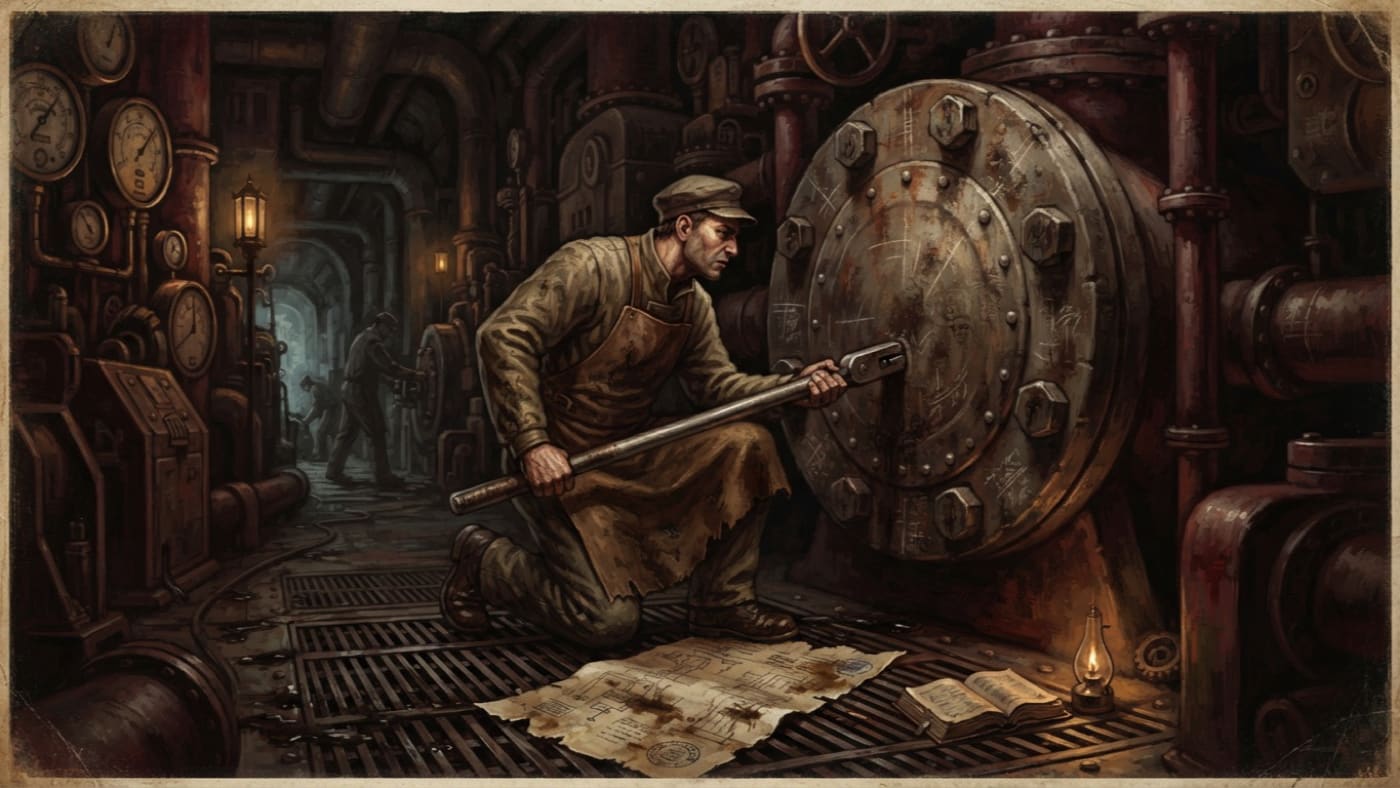
During that flood Orla stayed at Seal Seven. The conduit there fed the western pressure door, and the door held the water off a low ward of sleeping families. The seal had slipped and the old gasket had swollen. She seated the replacement and drew it down across eight bolts in a star pattern, with the water rising past her waist and then past her chest. The seal held, the door stayed shut, and the ward lived. Orla died at the flange.
Those eight bolts belong to Seal Seven. They are not a rule for every seal that bears her name, and an instructor who tells candidates otherwise has confused a relic with a specification.
The Bureau of Doctrine canonised her thirty years later, in A.S. 162 (1872 CE). After that, Engineering attached her name to the tightening pattern. The Ledger does not record the year of that christening, and I decline to invent one for the convenience of a placard. Orla did not name the pattern herself. Nor did the printed specification exist at Metz in its present bureaucratic form. She did the work and Engineering wrote it up afterwards, which is the usual order between saints and specifications.
#On the Passes and the Pause
Orla-Seven is the last stage of the repair, and the stages before it do most of the work. The full rite has nine movements: diagnose, cleanse, align, seat, recite, torque, seal, verify, document. The pattern belongs to the sixth. If the first five were done badly, the most beautiful quarter-turn in the Church will only press a lie down tight.
So the work starts with the flange. Old wax comes off under solvent and chalk-salt until the groove is bare metal. Alignment pins bring the faces true. The gasket goes in dry, untwisted and the right way round, and the wax comes later. The craft has always said "a clean flange forgives," and it is right about that. A clean flange forgives a great deal, but it does not forgive a bad seat.
Then come the recitation and the key. The two are timed together, so that the verse paces the hand and stops it from rushing.
The three light passes bring the bolts down evenly in the craft's star order. No bolt is driven home while its neighbour across the flange is still loose. The gasket is persuaded into its seat rather than forced, and each pass takes up what the last one left slack.
The listening pause comes next. The hand stops and the key rests on the bolt. The chapel goes on making its noise: the low thrum of the works, a lamp ticking, someone's boots on the grating. The mechanic listens under all of that for the flange itself. It may make a gasket squeal. It may hiss, which is the sound of a seal almost failing. Or it may give the dull knock-back that has frightened grown mechanics off their rations. The specification prescribes the pause. It does not say how long the pause lasts, and it prints no table of what to do with what one hears. Both sit in the hand of the person holding the key.
The two opposing seats draw bolts across from one another down to their seat, so that the gasket closes evenly from both sides instead of being pushed out from one.
The final quarter-turn falls on the closing syllable of the spoken line. The key moves as the word ends, and not a breath before. Licensed sheds teach those words. I do not print them here, because the Bureau of Rites has views on copying and I have views on the Bureau of Rites.
Then comes the chalk. A witness line runs across each bolt-head and onto the flange, so that any later movement shows as a broken stroke. After the pattern the remaining movements follow in their order. The repair is sealed with wax stamp, purity tag and signature. It is verified under pressure and vibration, with one more listen for knock-back, and documented on the rite sheet with the names of the witnesses. The torque key closes one movement out of nine and does not finish the repair.
Devotional chapbooks sold in the Metz engine quarter describe the listening pause as "the moment in which Saint Orla heard the waters obey."
Corrected against the Engineering addendum on the saint, which has already had to remove "prayer alone" from her legend once. The pause is a prescribed interval in a tightening specification. During it the mechanic listens to the flange. What the waters did at Metz is a matter for Relics, and Relics has not volunteered.
#On the Disputed Permission to Listen
The Line-Purists read the pause as part of the sequence: a fixed interval, kept in its place, never skipped, and never treated as a door through which the mechanic may walk off the card. To them a pause is observed in the liturgical sense, the way a vigil is observed. Leaving it out is a breach, and so is filling it with improvisation.
The Field Pragmatists read the same clause and see a question. A question admits several answers, and an answer is supposed to change what follows. If the flange knocks back during the pause, they say the next turn of the key should depend on that knock. Why else stop the hand at all?
Both factions are right, which makes for the worst sort of quarrel.
The Purists have a reason, and the reason has a body count. In A.S. 164 (1874 CE), the Split-Ring Disaster at Bastion-Przemyśl began when a shortened cleansing left residual wax in the joints. Seventeen engine pits failed over nine hours and forty-three men died. Since then every instructor in the craft has preached that the skipped line kills, and the Ledger confirms it. Purist discipline catches counterfeit rite sheets, bad stock, skipped cleansing and tired men's laziness. A craft without it would slide into tavern humming and fraud with a stamp on it.
But Split-Ring was a lesson about preparation. Purists have since applied it to everything, including the pause. A delay that is compulsory at the bench can be murderous at a rupture. A pause kept exactly while the flange is screaming may be obedience, and it may also be a wait for the funeral.
Then there is the law. Standing Order 14-Q, revised in A.S. 199 (1909 CE), requires prior written authorisation from a district Hymn-Gasket Master for any change to the verse. Verbal permission does not count, and approval granted afterwards is inadmissible. Suppose a Pragmatist hears the joint answer wrong, changes the line, and makes the seal hold. That mechanic has saved a boundary and written an illegal record in the same minute. The pipe accepts the repair. The auditor need not. An altered sequence may be the right call and still be paid for in full, at the tribunal, by the person who made it.
The Bureau of Doctrine favours the Purists, as it favours anything that can be audited from a dry room. The Bureau of Engineering has to keep the pressure doors shut, so it leans towards judgment at the bench. It leans in its memoranda and stops leaning when its workers stand before the tribunal. The mechanic between the two Bureaus is expected to satisfy the flange and the file at once, and is blamed when one of them refuses.
#On Present Application
As of A.S. 201 (1911 CE), Orla-Seven training plates hang in every licensed gasket shed. Candidates learn the formula before they are allowed near a live line, and they learn the pause on a bench that their instructor is shaking on purpose. The pattern is specified for critical seals in engine chapels from Bastion-Przemyśl to Bastion-Irongate. Downstream trades depend on those joints holding: the Diesel Resonance Plumbers, the furnace crews, and the wards behind the pressure doors. The Ward-Seal Artificers know the pattern too. They also know several things that are not on the plate, and no auditor has yet managed to make them write those down.
The auditor's method has not changed. Wax stamps and witness marks come first, then the rite sheet, and then the torque signature is compared against vibration damage on the flange. A chalk line broken where the sheet claims a clean seat is a confession, and a clean line over a sheet with a missing pause is another. The mechanic signs for both the hand and the record. Both are inspected, and the mechanic answers for both.
The seal at Metz held. Nobody has yet found the Life's missing year, and the rite sheet for Seal Seven was not filed.